
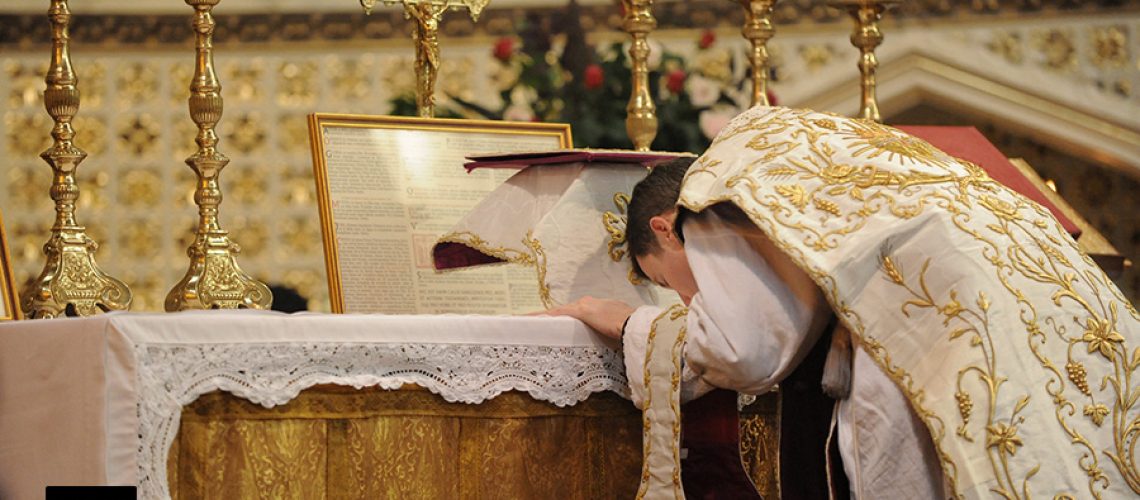
Cleanse my heart and my lips, O almighty God, who didst cleanse the lips of the Prophet Isaias with a burning coal, and vouchsafe, through Thy gracious mercy, so to purify me that I may worthily announce Thy holy Gospel. Through Christ, our Lord. Amen. (From the Ordinary of the Mass, 1962 Roman Missal)
Two books that I was blessed to stumble upon have become very dear to me. The first is Advent of the Heart by Fr. Alfred Delp, SJ. It was a collection of his Advent prayers and homilies written between 1941-1944 while he was imprisoned before his execution by the Nazis.
The second is To Raise the Fallen: A Selection of War Letters, Prayers and Spiritual Writings of Fr. Willie Doyle, SJ. Father Doyle was an Irish Jesuit who served as a chaplain during World War I and died in action in August 1917. If you have not had the opportunity to read these, I would highly recommend them.
Throughout these beautiful writings, one thing is constant: The Mass readings and prayers to which both priests refer through various Sundays and Holy Days are exactly the same as those we use in our Latin Mass, even though the priests wrote between 80 and over 100 years ago. This is no longer the case with the Novus Ordo.
When Fr. Delp referred to the readings of the Second Sunday of Advent, for example, I was able to follow along in my own Missal. Not only were the Epistle and Gospel the same, but all of the other elements—the Introit, the Collect, and the Gradual—were followed verbatim. I was able to appreciate and understand more deeply his writings and beautiful interpretations because we were starting from the same source.
Similarly, when Fr. Doyle wrote about Feast Days and their accompanying prayers with the men in the trenches of France from 1914-1917, those Feast Days correspond exactly with what is in my Missal. There are no date changes or “missing saints.”
Unlike the Novus Ordo, the Mass readings for each Sunday and Holy Day do not change in the Latin Mass. There is no cycle A, B, or C, but the same readings and rituals that have been handed down from the Council of Trent in 1563, which were, in turn, handed down through the centuries from St. Ambrose in 390.
It is a blessing to be able to read the precise words that millions of Catholics, and many saints, read and revered for centuries before me. Indeed, it was these words and prayers that inspired the saints whom I revere now. Their Mass is my Mass, and it’s one more reason why I love the Latin Mass.


[…] – E. C. We Must Not Give Up on Teaching French – Ed West at Wrong Side of History Blog Love Letters to the Latin Mass: The Word Eternal – Cynthia Millen at Catholic Stand ‘Sound of Freedom’ with Jim Caviezel – Brad […]
Cynthia, Keep on keepin’ on – these articles are beyond excellent. I was blest to hear the Holy Sacrifice of the Mass in Latin daily until I left college. It was the liturgical unifier for Jesus’s church worldwide. Of course the demons and their tools in the laity and clergy – all the way to the top – want to destroy the Mass. Even as school age children, we knew most of the Mass in Latin by heart. It was always the same, always. So the devilish plan includes a plethora of versions – different so-called “eucharistic prayers” – a pltehora of languages, and so today how many people can recite from memory the major portions of the Mass? “Novus ordo” is in reality intentional diabolical Novos Disordo. Guy, Texas
Thank you Guy!!
There is the book put together by Les Polius, forward by Father Longenecker on letters by World War I soldiers who thanked St. Therese de Lisieux for interceding for them in battle. Not all of the letters are from French soldiers.. It may not have the Mass readings but a bit related. “Stronger than Steel.”
The TLM is an excellent unifying force for Catholics. Perhaps that’s why it’s being banned. “Somebody” out there has an agenda!!!!
Very uniftying indeed, Society of Saint Pius X, Society of Saint Pius V, Congregation of Mary Immaculate, Most Holy Family Monastery, Sedevacanists.