
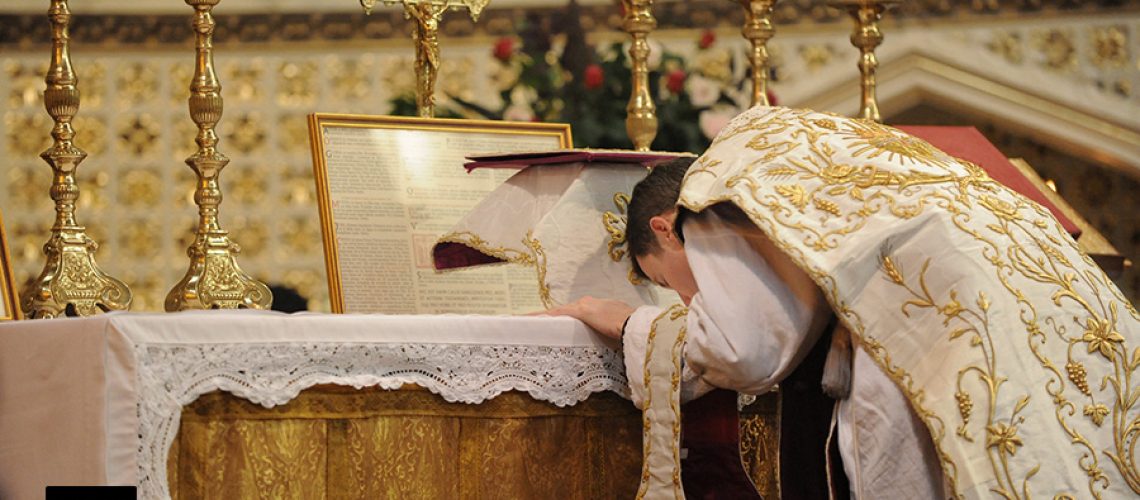
My parish just celebrated the Feast of Christ the King on Sunday, October 29, as first instituted by Pope Pius XI in 1925 on the last Sunday of October to respond to growing atheism and secularism. We have a few more weeks of Pentecost after this before we enter the Advent Season. We follow a liturgical calendar that has been in place for hundreds of years and celebrate our Mass as the medieval Saints did. One of the most beautiful aspects of our Mass is the way in which it ends.
After we respond to “Ite, Missa est” (“Go, you are dismissed.”), we kneel, receive Father’s blessing, and then stand again as he goes to read the first Gospel of John, a practice first introduced into the Mass in the 16th century.
“In the beginning was the Word….” At the end of each Mass, we are reminded how everything began with Jesus. We are taken back to the beginning before we leave to face our future. After that, in a practice begun over 100 years ago, we pray three Hail Marys, Hail Holy Queen, and the prayer to St. Michael the Archangel. How necessary it is now!
Saint Michael the Archangel, defend us in battle, be our protection against the wickedness and snares of the devil. May God rebuke him, we humbly pray, and do thou, O Prince of the heavenly host, by the power of God, cast into hell Satan and all the other evil spirits who prowl about the world seeking the ruin of souls. Amen
We close with an invocation to Jesus, begun in 1904, and repeated three times: Most Sacred Heart of Jesus, have mercy on us.
The Latin Mass carries with it all of the prayers, pleas, and propriety of several centuries. It was the Mass for the Saints we admire, the ancestors we love, offered in the same language throughout the world, and through generations from time immemorial. It is reverent, precious, and solemn.
It has become my love letter to God each Sunday, and now I can’t imagine a Sabbath without it. God bless all who have carried it down and carry it on for us.
Deo Gratias.


Another important thing to remember is that in the past several decades, many Catholics who don’t know any better have been duped into hearing the Novus Ordo said in Latin. They believe they are attending a TLM when in reality it is a substitute.
It is not a substitute but a fake new rite adapted from Anglican and Protestant worship. If one goes to an Anglican Church one will find the same ritual and scripture readings from which certain Catholic doctrinal teachings inconvenient to them have been subtly removed so much so that the protestants are and have adopted the novus ordo mass which the Conciliar church has adopted.
In 1980, I was among the youngest at Fr Gommar DePauw’s Ave Maria Chapel in Old Westbury, NY. Now I’m among the oldest, where there are young families attending, and young priests celebrating the TLM.
[…] From “Catholic Stand” (adapted) […]
A couple of technical corrections to the article. “it’s, Missa est” does not mean “Go, you are dismissed”, it means “Go, the Mass is completed.”
Also, there is no “first Gospel of John”, there is only one Gospel of John.
Oops, auto correct got me. “It’s” above should obviously be “Ite.”
Hi Ross,
You are correct that there is only one Gospel of John, and what I should have written is the first chapter of the Gospel of John. Thank you.
Regarding “Ite, Missa est.” This has been interpreted in many ways, and you are correct that the modern interpretation is “the Mass is done”. Over the centuries, Missa (which is the feminine version of the noun “missus” which means “a letting go, a throwing, a hurling, a sending out”) has been translated to mean “the Mass.” But the literal meaning from the ancient Latin is “It is (est) a sending out (missa).” The “it” is feminine because it refers to the Church (“ecclesia”) which is feminine (also the Bride of Christ). Because Latin allows us to reconfigure words for context, and the early Christians would have been exuberant missionaries (also from “missus”), I like to think that the best meaning is, “Go! It is (the time of) sending out or going forth!” In other words—Now that you’ve been filled with the Holy Spirit and the Bread of Life, get out there and spread the Good News!!
Have a great day,
CM
Walter,
After being part of my Latin Mass parish (which also offers a Novus Ordo Mass in English, btw), I totally agree with your comment about how the Latin Mass unifies the congregation. All missals (and a booklet provided to newcomers), even the old 1952 St Andrew’s Missal that I use, have the English translation side by side with the Latin. In my congregation, there are Catholics whose first language is Spanish, Tagalog, Polish, Arabic, and English, but we all speak the same language at Mass.
I have come to believe that it was a mistake to ever change from the TLM.
Jews learn Hebrew in order to get understand their services to the fullest, and Muslims learn Arabic for the same reason.
But Catholics have been told since the 1960s that it’s problematical for them to pray the Mass in Latin, even aided by missals that show the Latin in one column and English adjacent to it.
Latin forms a large part of the foundation (“constitution”) of English, and English has become a global language.
But it’s supposed to be too much of a strain for today’s Catholics to follow the Latin Mass.
Then again, maybe it IS too great a demand. Catholics who don’t bother to change out of beachwear to go to Mass on Sunday probably wouldn’t want to go to the trouble to figure out what is going on at a TLM.
How very true! The deep reverence once observed with the Latin Mass is now
missing. Also, consequently congregations are dwindling, and I notice the strong
faith appears to be with the elderly who were nurtured by the Latin Mass, their
faith remains strong.