
The irony of living in a world which does not want to recognize or include God in anything is that it is precisely God Himself Who makes all good things possible. Without God, everything seems hopeless and desperate. All you have to do is read or watch the news online, listen to what is going on: the conflicts, the arguments, the so-called discussions where nobody wants to listen to anybody or anything else other than their own voice. Nobody else makes sense except “me, myself and I”.
Now let’s make it more interesting; let us include children in the picture: impressionable and innocent children for whom we as parents are responsible. This certainly makes parenting in today’s world much more challenging. Yet, while it may be tough to navigate these often turbulent social and cultural waters, it is certainly not impossible. With God’s help and grace, although it can be tough, it is worth every bit of effort and prayer. The struggle to be a good parent is real but definitely worth it.
A Common Concern
In August of this year, our family participated in a family camp near Port Burwell in Ontario, Canada. There was a total of 11 families at the camp, plus a cook and his kitchen staff of teenage girls, and a priest who afforded us the privilege of celebrating the Holy Mass every day. For one week, we ate meals together, swam, relaxed, played, chatted, laughed, talked, and listened to each other. We listened to each other’s hopes and fears as parents trying to raise our children in a world where many do not seem to want God in their lives.
As different and unique as each family was, we parents shared the same concern for growing in our faith and passing on that faith – strong and true – to our children. After all, we each knew how crucial our faith is in our lives – in everything we do and who we are as children of God. Still, when we are bombarded left, right and centre by messages, ideologies and ideas which contradict the truth and God Himself, what are we to do? Where do we start? For starters, let us look to those whom we are called to emulate: Joseph and Mary.
The Example of Nazareth
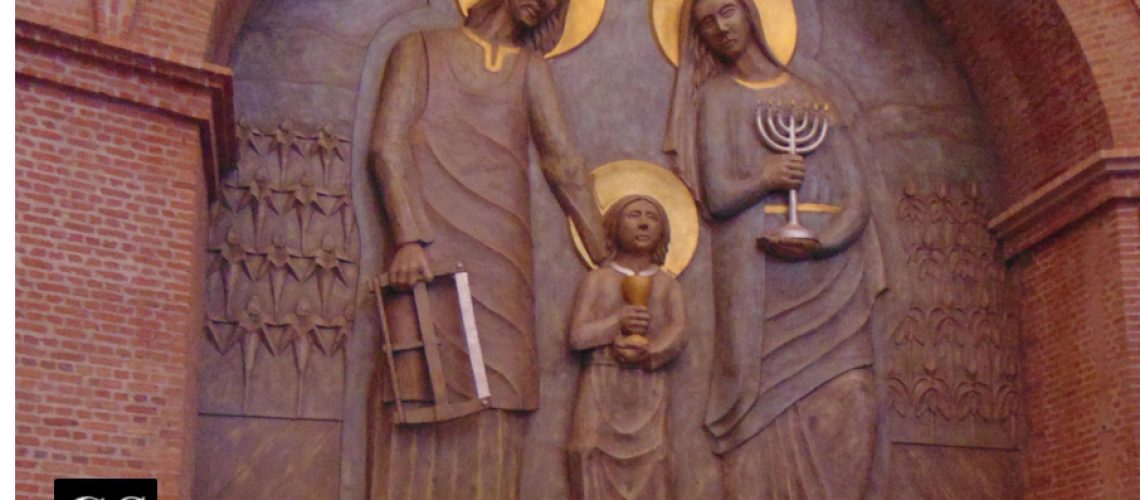
The same dynamic that existed within the Holy Family is intended to exist within our own families even now. Fathers and mothers are to teach their children to live after the manner of the Gospel and so come to know the salvation of Jesus, the love of the Father, and the new life in the Holy Spirit. How are Christian parents to do this? They are to follow the example of Joseph and Mary.
(“The Christian Family and the Evangelization of Children”, Capuchin Franciscan Father Thomas G. Weinandy, Executive Director Secretariat for Doctrine and Pastoral Practices, USCCB, Sep. 19, 2010)
Jesus was not Christian. That probably sounds like a silly thing to have to say, but I think it is important to do so. Jesus was Jewish – born to Jewish parents and raised to be a good and upright man of the Jewish faith. God-made-Man was born to human parents and lived in a family home, formed by the faith of His mother and adoptive father.
I sincerely believe that their family home in Nazareth was a joy-filled one: peaceful yet one would have heard the sound of laughter and familiar conversation as the family gathered together. I believe this for the simple reason that Jesus was Himself a very joy-filled, peaceful, and personable Man, Who was always relating to others around Him. He was in conversations – big and small – asking, answering, listening thoughtfully, praying. There is barely anything of His family life or years of growing up in Scripture, yet His demeanor and actions reflect the kind of Man He had been raised to be so by His parents. The ordinariness of His life belied the richness of a family life steeped in love, affection, and faith.
The Church’s Mini Me
In the Catechism of the Catholic Church, point 2204, we read:
The Christian family constitutes a specific revelation and realization of ecclesial communion, and for this reason it can and should be called a domestic church.” It is a community of faith, hope, and charity; it assumes singular importance in the Church, as is evident in the New Testament. (boldened text mine)
A community of faith, hope, and charity: the family is truly a seedbed of vocations. Within a family, a person is meant to first experience and be significantly and forever changed by the kind of love which does not count the cost. It is where one takes one’s first steps, not just physically but spiritually as well. It is within a family that one begins to get to know one’s Creator and Father God.
The First Teachers
As parents, we are not simply called to teach our children prayers as if they were memorizing the additional facts or the alphabet. We are – by virtue of our fundamental role as primary educators of our children – called to
bear witness to this responsibility first by creating a home where tenderness, forgiveness, respect, fidelity, and disinterested service are the rule. The home is well suited for education in the virtues. This requires an apprenticeship in self-denial, sound judgment, and self-mastery – the preconditions of all true freedom. Parents should teach their children to subordinate the “material and instinctual dimensions to interior and spiritual ones.” Parents have a grave responsibility to give good example to their children. By knowing how to acknowledge their own failings to their children, parents will be better able to guide and correct them. (Catechism of the Catholic Church, point 2223)
While this may seem quite overwhelming – and frankly, it makes me want to be still for a moment or two…or five – this is all to take place within our own families, in our own homes, with those whom we love. Although we already love our families, our personal flaws and imperfections, our weaknesses and doubts can make it difficult to stay the course and persevere as the days go by. In order to make this a reality – overcoming what is humanly “impossible” – we must turn to our Father God for the strength we do not have, the grace we do not deserve, and the faith which can only come from Him.
Practicing What We Preach
In a 2014 article in Huffpost.com, we are told that – based on studies – the number one reason teens keep the faith as young adults is their parents’ practice of their own faith:
The role of parents is even more critical today as trust in institutions decline and many children with more demanding schedules are spending less time in congregations, Smith noted.
Yet, he said, there are some powerful “cultural scripts” that discourage parents from taking an active role in the spiritual lives of their teens.
Among those scripts:
- After age 12, the role of parents recedes, and the influence of peers, the media, music and social media take over.
- Cultural messages that encourage parents to turn their children over to “experts.”
Eight years later, the message of this article is still as valid as it was then. Parents were crucial then in the lives of their children; they continue to be so to this day – and they will always be so for as long as families exist. The last few lines of the article should be considered a call to action for parents of faith:
For their part, parents need to realize a hands-off approach to religion has consequences. “Parents, for better or worse, are actually the most influential pastors … of their children,” Smith said. “Parents set a kind of glass ceiling of religious commitment, above which their children rarely rise.”
How essential it is to truly educate ourselves in our faith and put it into practice, not just on Sundays and holy days of obligation, but every single day. Every single moment is God’s gift to us – we owe Him every single one. There are no holidays from living out our faith. Our children must see us pray and have a relationship with our God. It is not enough to tell them to pray – we must pray with them and be a witness to how our own faith helps us to be better people.
Souls Entrusted
For we who are parents, there is much more at stake than just our children’s physical well-being, financial security or professional goals. Each child is a soul which God has entrusted to his or her parents. Our ultimate goal is to lead our children into the love of our Father God Who is also their own Father in heaven.
Parents teach their children mainly through their own conduct. What a son or daughter looks for in a father or mother is not only a certain amount of knowledge or some more or less effective advice, but primarily something more important: a proof of the value and meaning of life, shown through the life of a specific person, and confirmed in the different situations and circumstances that occur over a period of time.
If I were to give advice to parents, I would tell them, above all, let your children see that you are trying to live in accordance with your faith. Don’t let yourselves be deceived: they see everything, from their earliest years, and they judge everything. Let them see that God is not only on your lips, but also in your deeds; that you are trying to be loyal and sincere, and that you love each other and you really love them too.
This is how you will best contribute to making your children become true Christians, men and women of integrity, capable of facing all life’s situations with an open spirit, of serving their fellow men and helping to solve the problems of mankind, of carrying the testimony of Christ to the society of which they will be a part.
(Saint Josemaria Escriva, “Marriage: A Christian Vocation”, Number 28, Christ is Passing By)


[…] This site uses Akismet to reduce spam. Learn how your comment data is processed. source […]