

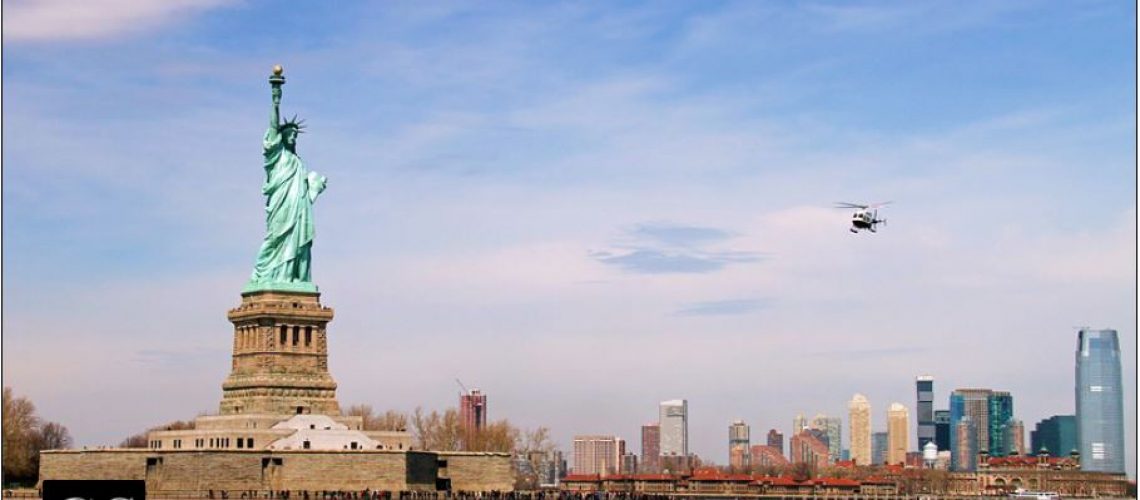
What does liberty really mean? This month, we Americans celebrated the 245th anniversary of our formal separation from Great Britain. As we approach the quarter-millennium mark, many people are discerning the end of that freedom in the rise of a massive, distant yet all-intrusive government. It doesn’t matter whether that government is nominally run by a single right-wing authoritarian dictator or an elite committee of left-wing ideologues. It will be run in actuality by an army of faceless, impersonal bureaucrats committed chiefly to their own preservation and advancement, mainly for the benefit of the top economic class.
This suffocating Leviathan will not be an aberration but rather the inevitable product of classical liberalism’s distorted idea of liberty.
A Catholic Showdown Seven Years Ago
That liberalism was bound from the beginning to produce illiberalism is the argument of political scientist Patrick J. Deneen’s Why Liberalism Failed (New Haven: Yale University Books, 2019). I first encountered Deneen’s thought in an article in The American Conservative, “A Catholic Showdown Worth Watching.” I’ve had a couple of occasions to reprint his prediction that “Liberal Catholicism … is fated to become liberalism simpliciter within a generation.” But the article stuck with me for a deeper reason: Deneen echoed and amplified suspicions I’d been entertaining about the effort to reconcile Catholic orthodoxy with political conservatism.
In “Catholic Showdown,” Deneen ranged two schools of nominally conservative thought. One, represented by the late Frs. John Courtney Murray and Richard John Neuhaus, held that “[classical liberal] democracy is, or at its best can be, a tolerant home for Catholics, one that acknowledges contributions of the Catholic tradition and is leavened by its moral commitments.” The other, represented by philosopher Alasdair MacIntyre and theologian David L. Schindler, contends that “liberalism cannot be understood to be merely neutral and ultimately tolerant …. Rather, liberalism is premised on a contrary view of human nature (and even a competing theology) to Catholicism.”
Deneen said the latter group “might be characterized as a more radical Catholicism.” Why? Radical Catholicism prioritizes the integrity of the faith over tribal loyalties. By today’s rules, paraphrasing former Rep. Dan Lipinski, such a prioritization makes the radicals political apostates and condemns them to the fringes.
Deneen wrote “Catholic Showdown” not long before Donald Trump announced his candidacy for President. Two years later, the populist wave Trump sparked eviscerated conservatism and removed it from its already tenuous control of right-wing politics. By that time, however, it had become clear that conservative Catholicism, for all its greater knowledge of and respect for Catholic doctrine and devotions, was merely a right-wing iteration of “cafeteria Catholicism.” Whatever elements of Catholic social teaching its “primacy of life” principle had not deemed “non-negotiable” had already been sacrificed on the altar of classical liberalism for the sake of secular power.
Liberty as Self-Government
How does liberalism produce illiberalism? How did liberalism distort the concept of liberty? Preliberal anthropology—the philosophical school that asks, “What does it mean to be a human?”—accepted man as a social, political, and relational animal. This understanding didn’t just belong to Christians but also to the pre-Christian civilizations that preceded it. I don’t argue that it had produced an ideal society by our terms. As I’ve written elsewhere, liberalism was a reaction to the perceived excesses and injustices of that time—the original “cancel culture.” Yet liberalism’s foundational errors were similar to the Reformation it accompanied.
First, man doesn’t exist by himself or for himself, but instead is born and lives within communities, with the family his first, most concrete experience of community life. Second, the person comes into this web of relationships at first dependent, then eventually interdependent, obligated to have some needs supplied by others and to provide others their needs in their turn. But this web of relationships isn’t merely utilitarian. Instead, humans enjoy the company of other humans in various ways, forming bonds of sentiment and loyalty that drive generous, magnanimous, even self-sacrificial behaviors that defy reduction to “enlightened self-interest.”
Given man’s communal orientation, the answer to the question “How, then, shall I live?” must always consider the community in which the person lives. Morality thus can’t be subjective but rather an exterior, objective rule adjusted to the survival conditions of the place and time. In this context, liberty is truly self-government: The person requires no outside compulsion to behave in a manner benefitting their community. They do, however, require “a thick set of moral norms, above all, self-limitation and virtue” (Deneen). A person who cannot govern themselves properly must be governed by others.
Liberty as Freedom From Restrictions
Liberalism begins with almost the opposite assumption: Humans in their natural state are autonomous, amoral, and self-interested even unto selfishness. Only the demands of survival force us to live in communities and thus adopt governments to keep us from killing each other. Societies, nevertheless, are artificial, as are the networks of relationships and obligations they entail. Liberty is the absence of artificial constraints on our behavior. Government exists not to advance a notional common good but rather to create and expand zones of freedom in which we can do as we please—that is, so long as we don’t harm others.
I say “almost the opposite assumption” because the preliberal anthropology admitted of local and individual variance. Law existed precisely because not everyone could be counted on to observe the community norms with strict fidelity. Virtue ethics were aspirational, while laws were pragmatic. Liberalism, however, proceeded from a perfect-solution fallacy: Given the impossibility of creating a community full of perfect people, it was senseless even to have the aspirations. Better to have minimum expectations requiring a minimum of government. Liberalism could then pretend to be universal because it expected little of anybody.
Liberalism’s most significant advance was the proposition of individual rights. However, defining liberty as a condition without restrictions proposed no personal responsibility beyond the need to avoid harming others. Instead, it argued that the obligations which came as part of all relationships, even those the old anthropology said were natural, were contractual. They were taken up by free choice and could be laid down again just as freely. The individual owed nothing to the common good beyond what “enlightened self-interest” dictated would ultimately benefit themselves.
Creating Rights and Restrictions
However, the central paradox of liberalism, which would ensure its simultaneous victory and defeat, lay in creating individual rights. By the very nature of laws, guaranteeing an individual’s unfettered right to X would require at least one if not several laws restricting everyone else’s ability to fetter it. Moreover, the injunction to not harm others would also require legally actionable definitions of harm that would impose further restrictions. Without the state’s police power, in the absence of self-government, the desire to have rights and suffer no harm would be little more than a wish.
In other words, the state of liberty that liberalism defined was one it could never produce, except in areas diminished by the very laws which bounded them. It promised individual freedom of choice even as it started taking options off the table. It instilled a hatred of limitations even as it legislated new restrictions and boundaries with a speed that accelerated as technological, social, and economic complexity multiplied. Above all, it declared a war of conquest on Nature even as it promised to bring humanity back to what it supposed was its most natural state of happiness.
Nature is the ultimate limitation on human freedom. From the diseases and pathologies that foreshorten our lifespans to the physical laws that circumscribe our range of action, even to the biology that limits us even as it defines us, Nature presents barriers that the logic of self-interest and self-indulgence constantly strive to defeat. Such logic drives us to consume non-renewable resources with increasing rapidity despite economists’ cautions about the “tragedy of the commons.” Such logic drives us to kill our children and surgically mutilate our bodies in the name of autonomy and self-expression.
The Cost of Liberalism
Democracy cannot be sustained without a shared commitment to certain moral truths about the human person and human community. … Every generation of Americans needs to know that freedom consists not in doing what we like, but in having the right to do what we ought. (Pope St. John Paul II)
There is no archaeological or anthropological evidence that the autonomous, antisocial, amoral “natural human state” posited by liberal theorists such as Thomas Hobbes and Jean-Jacques Rousseau ever existed. Evolutionary biologists are discarding Richard Dawkins’ “selfish gene” story for an explanation in which cooperation plays a role in evolution as great as, if not greater than, competition. Likewise, cooperation may be as much “prewired” into our psyches as is competition, according to evolutionary psychologists’ “moral foundations” theory. The prewiring explains the common themes of C. S. Lewis’ Tao, or natural law, that underlie the apparent differences in cultural ethoi.
Liberalism’s idea of liberty is more than just an error. It is a demonic lie, a fantasy fostered by a miseducated elite determined to rid the world of medieval “popish” superstition. That this lie enabled outstanding achievements and great discoveries does not erase the enormous socio-economic and ecological costs and debts it incurred, which we have left for our children to pay—that is, such children as we have permitted to live. Yet the “sunk cost” bias will have us reinvesting in these errors until the Western world collapses around us and our environment becomes inhospitable to human life.
Conclusion
History is story before anything else—the narrative we use to make sense of events and give them meaning. I write this story not because I hate my country but because I love it. Because I love my country, I don’t want to see us destroy it any more than I want it to be subjugated by some other government. For that reason, we must recognize the truth of liberty and the falsehood of the liberal “Whig history” with which we were raised. It’s imperative we re-learn virtue and self-limitation. But is it too late?
In a sense, Deneen and the radical Catholics had lost the showdown before it occurred. Conservative Catholicism had already sold its soul to the right wing, as Liberal Catholicism had previously sold out to the left. But in another sense, America and the West need radical Catholicism more than ever. Only as radical Catholics can we rediscover the ancient anthropology which integrates and makes sense of our social teaching. Only as radical Catholics can we rediscover the faith in Christ which frees us from sin and enables self-government. Freedom from sin is the only freedom worth having.




4 thoughts on “Liberty, Liberalism, and the End of Freedom”
A thoughtful attempt to define liberalism but seems to confuse modern libertarian and liberal (progressive) ideas. The original concepts by John Locke are not even mentioned. The author is correct on one point: what used to be an honorable term, liberal, has certainly deteriorated into just another form of stateism with the objective of controlling the populace. It would seem that the events of 1989-91 which saw the fall of communism did not herald a new era so much as simply a refinement of traditional despotism.
Pingback: VVEDNESDAY EDITION – Big Pulpit
This article honestly confuses me a little bit. I don’t understand the choices the author is trying to lay out as options. It appears that the author believe the choices are between a liberalism which creates laws to protect individual liberties or a version of *something* that allows people to govern themselves independently while using “self-limitation and virtue”. I would like to see an example where *something* ever existed. Whenever there is a power vacuum, someone will step into it. The author is correct that self-government would be the ideal, but the reality is that someone will always step in to take advantage of the situation by breaking the “moral code”. If this were a sporting match, the author appears to argue for the application of strict rules, but no referees? In that situation, there would ultimately be a team or members of team that break the rules for their own benefit. When the number of humans is large enough (but not necessarily very large), someone will break the rules/codes.
The idea behind liberalism is not that humans are all self-interested and basically evil. The idea behind liberalism is that everyone was endowed by God with free will and reason, and they should be allowed to exercise those gifts to the extent they don’t interfere with others exercising their gifts. Spinning liberalism to be based on the idea that everyone is purely self-interested misses the mark. That idea is a core of economics and capitalism, but economics admits it to be a simplifying assumption that is not true. It is not true because people are both sometimes irrational and also because they do not always act out of self interest. Any liberal democracy will necessarily reflect the morals of the governed. And those morals will likely never be perfect based on any one person’s standard. At the founding, we had slavery. Now, we have abortion. There will likely always be evils that need to be opposed, but those evils are not caused by liberal democracy. Liberal democracy reflects the society. This goes back to the argument I’ve made time and time again. The battle needs to be for people’s hearts and minds rather than for political power. If you win the battle for people hearts and minds, those values will flow through to the laws. On the flip side, if a government creates laws that go against the people’s hearts and minds, they better be ready for a revolt and have a good system ready to suppress the revolt.
The founding fathers of this country created a liberal democracy. The same liberal democracy that exists today. They didn’t create it perfectly (they were very selective in who received individual freedoms), but they did found it based on the liberal ideas of the enlightenment that the author argues against. After reading this, my biggest question is what the author proposes as a form of government instead of liberal democracy?
A very thoughtful piece. I have sensed a lot of what you’ve explained about the inherent contradiction between Catholicism and liberalism. But what I don’t understand is how you place liberal and conservative Catholics on a see saw -so to speak- and assert a new concept “radical Catholicism” as the higher way. I think there are actually Mary types and Martha types in both the liberal and conservative sides, but it seems to me that the conservative Catholics are constantly being portrayed as too orthodox and lacking in corporal and spiritual works of mercy, a caricature that hasn’t borne out, in my observation. Could you please clarify what you mean in the following phrase?
“By that time, however, it had become clear that conservative Catholicism, for all its greater knowledge of and respect for Catholic doctrine and devotions, was merely a right-wing iteration of “cafeteria Catholicism.” Whatever elements of Catholic social teaching its “primacy of life” principle had not deemed “non-negotiable” had already been sacrificed on the altar of classical liberalism for the sake of secular power.”