

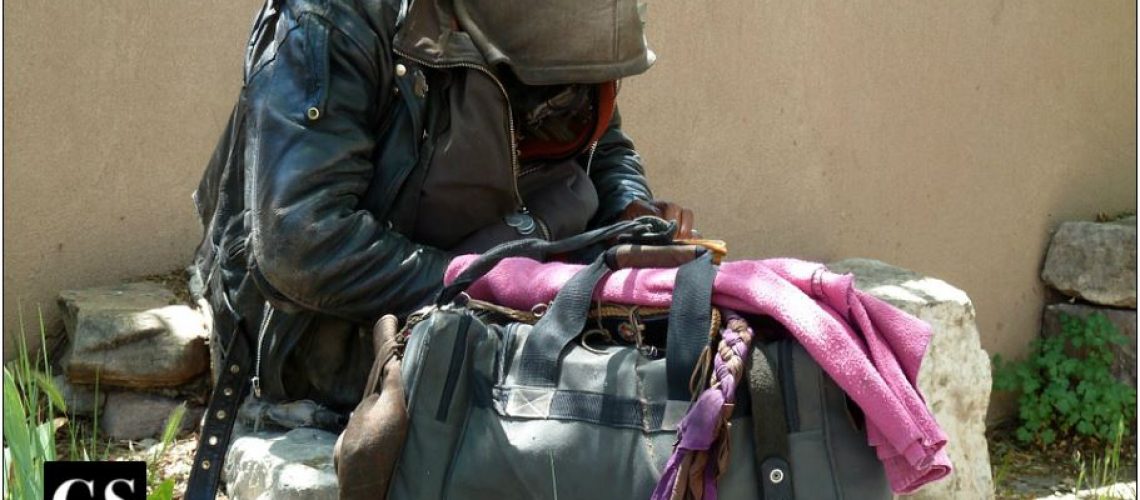
As Catholics, we have an obligation to engage in the Spiritual and Corporal Works of Mercy. Pope Francis in particular talks regularly of giving to the poor. But what does it really mean to give to the poor? And what shall we give the poor?
Food?
Giving the poor poison would be a really bad, idea. This is NOT what is meant by giving to the poor. So how about if we give the poor food? I think that is a great idea. But how much food should we give them? How about food for a day? One day is not very much.
How about meals for a week? A week is not really that much time either. I have another idea. How about we give the poor a way to feed themselves?
Jobs?
Maybe we could get the poor employment so they can buy their own food. What if we were able to give the poor a career? With a career, the poor would be able lift themselves out of poverty and feed themselves as well as their families. As Pope St. John Paul II wrote in Laborem Exercens, “The Church is convinced that work is a fundamental dimension of man’s existence on earth.” There is dignity in work.
I wish I could provide work for someone but I do not own a business. I do not have the ability to give someone a job let alone a career. Is it not ironic, that the people in our society who create the most employment and careers are demonized in our society as malevolent and greedy?
Some poor say they are incapacitated and cannot work. That is true for some. But is it really as many as claim to be unable to work? What should we do then? I know. How about we give the poor low expectations? After all, contributing to society is hard work. Giving out low expectations is easy. Maybe 2 Thessalonians 3:10 just does not apply anymore.
Housing?
I have another idea. The poor need shelter. How about if I give a poor family a home to live in? This is a problem for me, as I do not even own my home yet. I am still paying off the mortgage.
Maybe we should take the second home from some rich guy, maybe his weekend home on a lake, and give it to a poor family. I think that is a bad idea. That would be stealing, and stealing is a sin.
God believes in property rights so much so that he defines stealing as a sin in The 10 Commandments. I know. Maybe we should vote for government officials who will take from people wealthier than us and redistribute that wealth to the poor. That is still stealing, and I would be an accessory to that sin.
But how about if instead of calling it stealing, we call the stealing part “taxes” and the giving of the stolen goods a “program?” Then the government would not be stealing, right?
I do not t think that is what is meant by giving to the poor. Coveting someone else’s goods to give to the poor, no matter how noble the intention, is not what God asked us to do. He asked us to give to the poor. He did not say we should get someone else to take from the rich and give to the poor on our behalf.
Who are the ‘Poor’?
And just who are the poor? In Jesus’s time, people around him were starving. Widows were often forbidden from working. People were outcasts from society because they were bind, lame, or sick. All of these were excuses to spurn a person and deny them employment or way of life.
I look around my city and the people I am pointed toward as poor are living in low-cost housing. The buildings are often aging and in need of upkeep. However, there is often a cluster of new satellite TV dishes outside. Compared to Jesus’s time, these are extraordinarily rich poor people. They have a home, food, and entertainment. They have access to doctors and schooling. Are you really poor if you have satellite TV, but live in low cost housing?
I do not have satellite TV, but I do not think I am poor. I choose not to have satellite TV. Instead, I chose to save that money and use it to send my children to a Catholic school not run by the government. Even so, the government has already stolen taxed me to support the government-controlled public schools.
Yesterday and Today
This begs the bigger question; do we really have poor in the United States? Our poor have places to live, with heat and air conditioning. They have food and they have leisure time. They are given free education and hospitals are required to serve them. If forced to make a choice between “rich” in 1776 or a being a “poor” American citizen today, would not one pick a poor American today every time?
We as American’s have access to safer, better, and a larger variety of food at the corner convenience store than any nobleman 200 years ago. I saw the rope bed the king of England slept on in 1776. I would take a sleeping bag over that any day. Over the counter medicine is amazing in comparison to the bloodletting given to monarchs 200 years ago. Which makes me wonder, are there still poor among us?
The answer is an emphatic, YES. However, not in the way most people think.
Not Poor in Spirit but Spiritually Poor
We, as a society in the United States, are so prosperous, that people are not really poor in the material things of this world. People are spiritually poor.
In our Society, people are encouraged to abandon thought, reason, truth, character, responsibility, self-reliance, their children, and God. Correction: people are not encouraged to abandon their children. They are encouraged to execute them for the crime of being inconvenient. Of course, execution is not the word used. We call it abortion.
So, what can we give the spiritually poor? I would start by giving the example of a Christian Life. I would offer the example of courage to speak truth and values that we as Catholics believe even when it is not popular. We should stand firm to these truths, I would suggest, even as ‘the collective’ stones us with a barrage of outrage in comments to a blog or from other forms of social media.
Children in Need
There is one other group of poor, however, that does stand out among the poor in the United States and in other countries as well. This group is all the children in the world who have no parents. Why not give one of these children parents? Let me rephrase this last statement. Why not give yourself as a parent?
If every Catholic household in the world that was able to do so took in one child in need, the world would transform.
Adopting a child is much more than providing a place to live and a meal. Adoption provides a child with a family, stability, a nurturing environment, and morality. One can give a child the Catholic Faith.
Closing Remarks
As I am concerned that the point of this article will be lost on some, I feel the need to add some closing remarks.
My intent is for readers to question their own premise of what poor means as well as what effective giving means.
The poor, throughout most of history, were people who were starving and without shelter. However, the definition of poor seems to have shifted greatly with our prosperity.
While living in Asia during the 2000’s, my Putonghua teacher shared with me a list of seven things you needed to own to be considered “successful.” Included on the list were a bicycle and an electric fan. Four years later, the list had changed. The bicycle was replaced with a car. The fan was replaced with air conditioning.
Does this mean that if you only have a bicycle and not a car you are not doing well?
I would argue that the definition of poor is unchanging. There are still people who are starving and who are without shelter, but we live in a blessed time where so many are very well off, even “successful” by some Chinese standards.
With respect to giving, it is easy to throw a few bills into a basket or send money through PayPal. However, is throwing money at something an effective solution?
The danger of giving money is the illusion of involvement it creates.
Giving of yourself of donating your time is an alternative that cannot have a percentage taken off the top for administrative fees. When you offer your time, you know exactly where it goes, whom you affect, and if you are making a difference.
And, yes, there are still poor in the world.





9 thoughts on “What Shall We Give to the Poor?”
Pingback: Failure, Humility, and Repentance - Catholic Stand
Pingback: 5 Inspiring Streaming Options Every Catholic Man Should Watch, and More! – christian-99.com
I would give them the graces to always be truthful.
The poor are the face of Jesus, even the junkie loser; I’m curious; how prepared does your advice leave me when I come to discover whether I am sheep or goat (Matt 25). No one makes you write these words, but there will come a day when He asks you to explain the pedestal you stand on. Tell me what you know of drunks and hookers; they dined with your Savior, and Lazarus, you somehow presume he wasn’t a drunk bum letting the dogs lick his sores but our bums need to get a job. Repent and be faithful to the Gospel, and try for goodness sake to remember that the poor are your judge; you are not their judge
Thank you for the comment. However, I politely ask that you reread this article. The intent of this article is not to judge the poor, but to challenge our own often superficial ways of giving to the poor.
Telling “bums” (your words) to get a job, although easy, is not effective. Just giving away food and money is not effective either. What is hard is to risk hiring an addict and training him when you are not sure he will pass his next drug test. What is hard is getting ridiculed by other employees for taking the risk and hiring the person. What is hard and extremely uncomfortable is coaching him when he is not performing. What is hard is working extra hours to cover his shifts when he gets his meth teeth fixed. What is hard is trying to figure out a way to ink over gang and prison tattoos so he can leave that world behind. However, what is easy is losing that same person to another company for a better job because he stayed clean, became skilled at his trade, and now commands a better salary. What is hard is starting that all over again.
Thought provoking article.
However like many who mention conditions in ancient Israel, there is a touch of anti semitism.
Widows were not “forbidden to work”. In Judeo-Christian societies the first ever laws against women working werea result of the so-called “Reformation” and the so-called “Enlightenment”.
95% of work in ancient Israel was hard manual labour which most women were unable to do, with the rest skilled trades which they probably had no training in.
Again, the blind, lame and sick were not “outcasts from society” in ancient Israel. Just that they were usually physically unable to work. As there were no pensions, unless they had relatives or friends who provided for them, and refused to turn to immoral means such as prostitution, they had to beg for a living. Only lepers had to live in separate settlements, but they could still work and earn a living until the disease got to an advanced stage.
Pingback: VVEDNESDAY EDITION – Big Pulpit
True Story: Margaret (not her real name) has a baby boy with hydrocephalus. His head had swollen until he had the characteristic downward focused eyes. The medical procedure cost $3,000, so the mother organized a gambling game – she was able to raise about $20 per week … … the boy is now 9 months old, and has finally had the procedure.
True Story: Martha (not her real name) had an eye infection. The suggested ground onion therapy was somehow not successful, so her cheek continued to swell to half the size of a grapefruit before arrangements were made for her to see a doctor … 10 days later. The 8 hour trip to the doctor was successful and she is now back to normal with the $75 antibiotics.
True Story: Maria (not her real name) received a call from her relative last month. Maria was working (as always) in her small convenient store. She was wearing flip-flops and says its been 30 years since she last wore a pair of shoes. Maria’s is 50 years old, but lost her husband a few years ago. She is raising her 3 sons alone. The boys are late 20s, early 20s, and high school. During this call, a number of red flags were raised. The most notable was that early 20s boy was told to cut the hard boiled egg in half and share it with the high school boy. Maria was forthcoming with the relative and explained that she had 3 loans through predators (not her word). Each loan was “for $200”, but she only receives $160. She has 60 days to pay each loan ($200) back, and then she starts over again…if she can…other predators will no longer loan her money because she had a bad history with them…
She explained she usually buys items, for example cigarettes, for $2.40 per pack. She resells each pack at $3, but more likely, resells each cigarette for $0.16. She insists she cannot raise her prices. Even a universal 30% mark-up on all items would result with $8 profit for the $160/60 day loan (after the loss of $40). In other words, Maria was living on roughly $8-$12/month.
Is that a lot? …her 2 sons were sharing a hard boiled egg.
At the time of the call, Maria had 45 more days to re-pay…and the shelves of her store were empty. Customers would walk-up during the call and ask for staples such as rice, or pop…she “was out.” They would turn and leave. Maria’s brother advised her, “you should close that store!”
Maria’s oldest son was a cook but lost his job due to COVID. The middle son owns a 3 wheel motorcycle (taxi) but lost most his fares due to the schools being closed (due to COVID). The middle son was able to find a recent fare, and returned home with 1 pound of rice.
Maria was lucky because the caller sent a loan for $600 to restock the shelves. Any repayment was not to begin until after she had settled the other loans first. The additional terms of repayment have yet to be decided, only that Maria has agreed to find 1 hour every Sunday to attend Mass (which she understandably never had time for).