
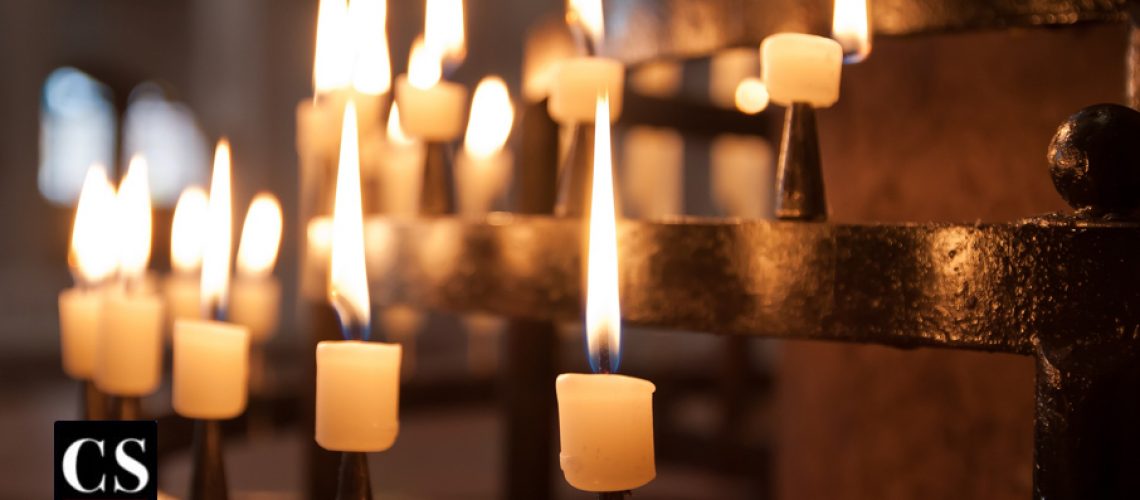
Candles play such an important role in the life of the Church. When you enter a church, candles can be seen everywhere. They can be found on the altar, flickering before statues, and placed beside the Tabernacle. They play a prominent role during Advent, with the lighting of the Advent candles, but also during the Easter Vigil with the lighting of the Paschal Candle.
Candles most likely served a practical purpose in churches before electricity was commonly used. Candles are no longer used to simply to light a darkened room, yet they are still required during the liturgy. Their use has a much deeper biblical and symbolic meaning.
The Symbolism of Light and Candles
Light indicates God’s presence and glory. Both the Old Testament and Jewish tradition are filled with references to light and to candlelight. God’s presence was revealed in a burning bush, luminous clouds, and a pillar of fire.
A perpetual light was kept burning in the Temple and the synagogues using only the finest oil (Exodus 27:20–21). It showed God’s presence and helped to make sure that other candles or oil lamps could be lit in the evening. Later the Talmud instructed that a lit lamp be kept near the Ark of the Covenant. The Ark contained the Torah and other writings of Sacred Scripture, which is God’s presence in the written word. The lamp was a sign of reverence for the Word of God.
In Catholic tradition, candles represent the light and presence of Christ, the perfect candle. Christ and true life are associated with light in the Gospel of John: “What came to be through him was life, and this life was the light of the human race” (John 1:4). Jesus spoke of himself as being the true light: “I am the light of the world. Whoever follows me will not walk in darkness, but will have the light of life” (John 8:12). By Jesus’ words, we see how candlelight symbolizes Jesus himself, the Savior of the World and the presence of God among us.
Candles in Church Tradition
Candles are essential in the life of the Church. Their use dates back many centuries. Candles were lit and oil lamps were burned at the tombs of saints, especially martyrs, by the 200s and before sacred images and relics by the 300s.
The early Church Fathers mention the use of candles in Christian worship, such as St. Jerome who refers to the practice of using numerous candles during Christian worship and also mentions that many candles were burned at the shrines of the martyrs. St. Athanasius of Alexandria called the lighting of votive candles an “offering” of the faithful. He said, “When many of them are alight – whether before an image of Jesus, or Mary, or the saints – it gives great glory to God, who has shared his glory with us.”
The lighting of candles began for practical purposes, as many liturgical practices do. Early Christians used candlelight as their only source of light while celebrating Mass at night or in the catacombs. Candles also had a profound symbolic meaning. For example, they were used to show reverence for the Blessed Sacrament or they were placed on the tombs of martyrs or near the images of saints to signify that their lights now continue to shine in heaven.
After electricity was commonly used in churches, candlelight continued to be used in both liturgy and devotions for symbolical purposes.
The Use of Candles in the Church Today
There are different types of candles used for devotions and different parts of the liturgy. Altar candles symbolize Christ as the light of the world, as well as reminding us of the early persecuted Christians who were forced to celebrate Mass secretly by candlelight. They may be used in the entrance and recessional processions of the Mass and are carried to where the Gospel is read to indicate the profound joy and reverence for the words of the Lord. The number of candles used indicates which Mass is being celebrated and even who the main celebrant is.
A lit candle is kept burning near the Tabernacle. It shows the real Eucharistic presence of the Lord in the Blessed Sacrament, as well as being a sign of reverence. Very much like a beacon, the sanctuary lamp shines day and night near the Tabernacle. It is extinguished only on Good Friday when the Body of Christ is removed from the main church and relit on Easter Sunday.
Votive candles are the candles we light for our intentions. The term “votive” is derived from the Latin votum and means “promise,” “dedication,” or “prayer.” These candles represent our prayers, offered in faith and love, entering God’s eternal light. Most churches place votive candle stands near statues or sacred images of Jesus, the Blessed Mother, or one of the saints. After someone lights a candle, they may linger, looking at the religious image or statue close by. They quietly pray for their intentions and ask for their heavenly aid. The flickering light of the candle symbolizes the prayer and love of the person who lit the candle and the desire to remain present to the Lord in prayer throughout the day.
At the Easter Vigil, the Paschal candle is lit and the priest proclaims “Christ, our light” three times. This candle, which is several feet tall, represents the light of the Risen Lord and is a symbol of hope, beauty, and joy. This candle is placed next to the ambo during the Easter Season and then placed near the baptismal font. The candles of the faithful are lit from this Paschal candle, indicating that our own light is united with the light of Christ.
Candles During Advent and the Christmas Season
During Advent, the season of light, Advent candles are lit to count down the weeks to the birth of Jesus. Each of the four candles in the Advent wreath traditionally represents a thousand years in salvation history, beginning from the time of Adam and Eve until the birth of the Savior. Three of the candles are purple, representing prayer, penance, and the sacrifices and good works performed during this period. One of the candles is rose-colored, lit on the third Sunday of Advent, Gaudete Sunday, symbolizing joy. A fifth candle which is white in color called the “Christ” candle is lit on Christmas Eve or Christmas Day and symbolizes purity.
On February 2, we celebrate the Feast of the Presentation of the Lord, also called Candlemas, forty days after Christmas. Candles are blessed and parishioners carry lighted candles on this feast, which marks the end of the Christmas cycle according to tradition. Candles represent the light of the Lord whose birth illumined the world and recall the presentation of the Infant Jesus in the Temple. On this day, Simeon took the Baby Jesus in his arms and called him “a light for revelation to the Gentiles, and glory for your people Israel” (Luke 2:32).
Christ, Our Light
Candles always play a special role in our churches, but especially during Advent and the Christmas season. They represent Jesus’ light, the true light, who is ever-present in our lives, illuminating even our darkest moments.
Candles also remind us that the Lord’s light shines within us. We are all invited to reflect Christ’s light in our own lives and to share it with those around us. As Jesus has told us: “You are the light of the world…. Your light must shine before others, that they may see your good deeds and glorify your heavenly Father” (Matthew 5:14, 16).


[…] Which Donors Are Best, Older Or Younger People? – Brice Sokolowski at CatholicFundraiser.net Jesus, the Perfect Candle – The Use of Candles in Church – Nada Mazzei at Catholic Stand Nigerian Priest Was Killed On Christmas Eve – Catholic […]