
Is the Gospel of Matthew anti-Semitic? You may have never thought about this question before, but it is an important one that we need to be able to answer. Throughout history, many Christians have used Matthew to justify anti-Semitic acts and attitudes, and while most people today would consider that just a perversion of its true meaning, not everyone agrees.
Some argue that Matthew really is anti-Semitic, so interpreting it that way is more than just a misrepresentation of its real meaning. Rather, according to these people, that is its real meaning. So how can we respond to this point of view? What can we say about the alleged anti-Semitism of the first Gospel? We do not have room here to go over all the passages in Matthew that are used to support the anti-Semitic view, but let’s look at some of them and see how we can respond to these charges.
Harsh Criticism
To begin, let’s look at the criticism that both John the Baptist and Jesus levied against some of their opponents. The language they used was pretty harsh, and some contend that this harshness against their Jewish contemporaries was anti-Semitic:
But when he saw many of the Pharisees and Sadducees coming for baptism, he said to them, “You brood of vipers! Who warned you to flee from the wrath to come?” (Matthew 3:7)
Woe to you, scribes and Pharisees, hypocrites! for you are like whitewashed tombs, which outwardly appear beautiful, but within they are full of dead men’s bones and all uncleanness. So you also outwardly appear righteous to men, but within you are full of hypocrisy and iniquity. (Matthew 23:27-28)
While these criticisms are definitely harsh, they are not anti-Semitic. The key is that neither John nor Jesus was criticizing all Jews; rather, they directed their comments towards certain groups within Judaism. John the Baptist was criticizing “many of the Pharisees and Sadducees,” and Jesus was criticizing the “scribes and Pharisees.” To conclude that this is anti-Semitism is simply to ignore what the texts actually say.
Moreover, what we see here is really no different from what we find in the Old Testament. For example, take a look at what the prophet Isaiah said about his contemporaries:
Ah, sinful nation,
a people laden with iniquity,
offspring of evildoers,
sons who deal corruptly!
They have forsaken the Lord,
they have despised the Holy One of Israel,
they are utterly estranged.Why will you still be smitten,
that you continue to rebel?
The whole head is sick,
and the whole heart faint.
From the sole of the foot even to the head,
there is no soundness in it,
but bruises and sores
and bleeding wounds;
they are not pressed out, or bound up,
or softened with oil. (Isaiah 1:4-6)
Isaiah clearly wasn’t anti-Semitic; he was a Jew himself. He was simply criticizing his countrymen for being unfaithful to God, and that is exactly what John and Jesus did. They were also Jews, and like the prophets of old, they too criticized their countrymen for being unfaithful to God. Simply put, the Gospel of Matthew’s harsh criticism of certain groups within Judaism is simply intra-Jewish polemic, a debate within Judaism itself, rather than a criticism of the Jews as a whole.
Rejection of the Jews?
The same principle applies to other passages as well. For example, we have the parable of the wicked tenants (Matthew 21:33-44), in which a vineyard, which represents the kingdom of God, is taken away from its current tenants and “given to a nation producing the fruits of it” (Matthew 21:43). At first, the word “nation” may seem to imply that the Jews as a whole are no longer God’s people, and many argue that this is anti-Semitic.
However, if we read the passage carefully, we can see that this is not at all the case. A few verses later, the text tells us that the story is about “the chief priests and the Pharisees” (Matthew 21:45), so Jesus could not have been saying that the Jews as a whole would be displaced. The chief priests and Pharisees were not the only Jews around. Instead, he was saying that the leadership of God’s people would be taken away from these groups and given to others (and those “others” ended up being the leaders of the Church).
Plus, if we keep in mind that Jesus and the first generation of Christians were all Jews, the anti-Semitic interpretation of this parable is flat out wrong. It is simply not true that the Jews as a whole were displaced as the people of God. Rather, only the ones who rejected Jesus were removed from God’s people (as St. Paul confirms for us in Romans 9:6-13, 27; 11:1-6, 17-24), but the ones who accepted him remained as the first generation of the Church. As a result, this is just another example of the intra-Jewish polemic we saw before. Jesus, a Jew, was criticizing some (but not all) of his fellow Jews for rejecting the Messiah that God had sent them.
The Most Famous Case
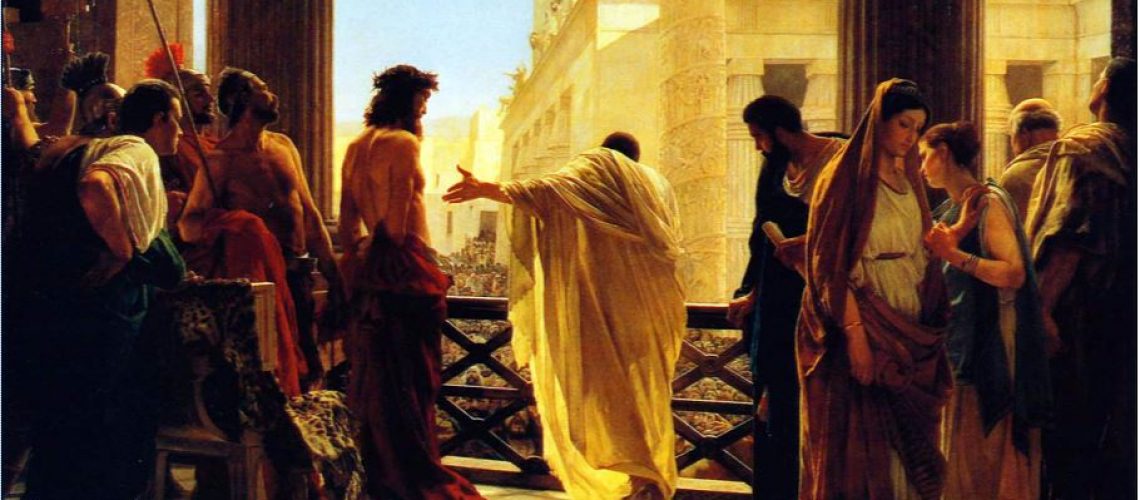
Finally, we have what is quite possibly the most famous and most abused allegedly anti-Semitic verse in all of Scripture. When Jesus was on trial before Pontius Pilate and the crowd was calling for his death, Matthew tells us that they even went so far as to say, “His blood be on us and on our children” (Matthew 27:25). Some people think this verse shows that Matthew really did believe that Jesus’ blood (in other words, guilt for his death) was on all Jews throughout history, and that would definitely be anti-Semitic if it were true.
However, a closer look shows that it is not. Not everything that every character in Scripture says is true. For example, just one chapter before this, we read the high priest say of Jesus, “He has uttered blasphemy. Why do we still need witnesses? You have now heard his blasphemy” (Matthew 26:65). Does this mean that Jesus really did utter blasphemy? Of course not! Just because someone is quoted as saying it doesn’t mean it is true.
And the same applies to the words of the crowd here at Jesus’ trial. Just because they said that Jesus’ blood would be on them and their children doesn’t make it true. They did not have any sort of magical power to make all Jews throughout history guilty of something that happened before they were even born.
In response, someone might try to argue that Matthew must have included these words in his Gospel because he agreed with them, but there is no reason why this has to be true. It is just as possible that Matthew was simply showing how hardened these people’s hearts were against Jesus. In fact, that is a much better interpretation; the anti-Semitic understanding doesn’t make much sense when we really think about it. Matthew was Jewish himself, as was the entire first generation of Christians (including Mary and the other Apostles), so it is just about unthinkable that he would consider all Jews guilty of Jesus’ death.
Not Anti-Semitic
All in all, when we look at Matthew’s Gospel closely, we can see that it is by no means anti-Semitic. While it contains some passages that may at first glance give the impression of promoting hatred of the Jewish people, a closer look shows that this is actually not the case. For instance, it contains some very harsh criticism of certain groups of Jews, even going so far as to say that the kingdom of God is no longer theirs, but this is simply a criticism of some Jews by other Jews, a debate within Judaism, rather than a criticism of the Jews as a whole.
Jesus, John the Baptist, and the first Christians, who were Jews themselves, criticized their countrymen for failing to live up to their calling as God’s people and for failing to accept Jesus as the Messiah, thereby cutting themselves off from God and forfeiting their membership in his people. That is definitely harsh, but it is no different from what the Old Testament prophets said to their contemporaries, and they were definitely not anti-Semitic. As a result, if we take into account all the evidence rather than simply look at the bits that support one side of the debate, we can see that there is simply no legitimate reason to consider the Gospel of Matthew anti-Semitic.


The concept of anti semitism can be subtle or overtly, we have no absolute idea what Matthew had in his mind in that period of time, but it depends on people how interpreted. In the modern civilized world there is no room for such hate language.
There is nothing wrong in expressing our individual views but not necessarily to defend a posture.
Thanks
“[B]ut now the Christians are [antisemitic]?” I need to get this out of the way: Christians aren’t antisemitic NOW; Christians have been accused of antisemitism for A VERY LONG TIME. In fact, several Popes have acknowledged and apologized for the Catholic Church’s historical and text-based antisemitism. These are facts based in truisms, not a lack of patience with “nonsense.”
“The old Testament uses ‘stiff-neck’ people 19 times, while the new Testament uses ‘stiff-neck’ only ONCE…” So? What is your point here? First, you need to understand that the Tanakh (the entire Jewish Bible) is not what Christians refer to as the Old Testament. The wording and translations are not the same, the books of the Tanakh and the Old Testament are not the same, and the books that the two texts DO share are not arranged in the same order. Using the Christian term “Old Testament” to mean “Jewish Bible” is based on two false premises — that the two books are one in the same, and that there is a NEW, updated, better, completed version of the Tanakh. Second, the Tanakh predates the Christian Old and New Testaments by several millennia. What is happening for the Israelites (we’re not even known to ourselves as Jews yet!), is not the same as what is happening to the now-Jewish people thousands of years later during the time of Jesus. If you’re looking to make a viable argument about the “nonsense” that is identifying antisemitism, then you’ll need to understand context and, well, history. Third, “stiff-necked” means “stubborn.” G-d is speaking DIRECTLY to the Jewish people with whom G-d literally had a DIRECT relationship. You admonishing your child for misbehaving wouldn’t be the same as some random stranger admonishing your child for misbehaving, because you don’t know that stranger. G-d CAN tell the Israelites that they’re stubborn because G-D is G-d. The writers of the Christian Bible are not.
“Furthermore, doesn’t [antisemitic] mean anti-[J]ewish? Or, in other words, anti-tribe-of-Judah?” No, it doesn’t, and no, it doesn’t. Whatever points you’re attempting to make after your first two sentences are moot since they’re based on a false premise.
Finally, just so you’re aware, Christians don’t get to dictate what is and isn’t antisemitic. If you want to avoid the “nonsense” of being labelled an antisemite, then don’t make antisemitic claims and attempt to support them using erroneous, presumptive, antisemitic evidence.
[…] few months ago, I wrote an article about some allegedly anti-Semitic elements in the Gospel of Matthew, and I would like to revisit […]
Also Matthew originally wrote his gospel in Hebrew (a version known and used by St Jerome, but apparently all copies were destroyed by the Moslem conquest of the holy land). A pretty odd thing to do for an “anti semite”. And almost certainly before St Peter at the Council of Jerusalem in 49-50 AD decided that gentiles no longer had to be circumcised and eat kosher food to become Christian. Even after that gentile Christians (who were the minority) thought of themselves as adopted Jews. Matthew is in fact the most overtly Jewish of the new testament authors. The other evangelists sometimes explain Jewish customs and practices for the benefit of gentile readers. Matthew NEVER does this, he apparently assumes all his readers are Jews. The idea that he was “anti Semitic” is ludicrous.
You missed the main point about “his blood be on us” that it’s a very obvious reference to the Passover lamb and the other Jewish sacrifices prefiguring Christ’s, when the Jewish priests sprinkled the blood of the victim on the people IN ORDER TO SAVE THEM FROM THEIR SINS AND BIND THEM IN COVENANT WITH GOD. Of course the mob howling for His death didn’t realise this meaning themselves, just like Caiaphas didn’t realise the real meaning of his “it is better for one man to die for the sake of the people”. We are ALL the children of the crowd in Jerusalem.
You’re saying that the Church Fathers and upwards of two hundred Popes misinterpreted Matthew.
Captcrisis, you’re obviously way out of your depth here.
Who was Matthew, At any moment a roman soldier could have killed him if he was not able to satisfy the roman demands to justify his collecting as honest. He kept record on wax tablets, Archeologists wondered until just recently what small wooden frames found in many roman digs were used for. He must have therefore recorded many of Christ’s words recorded after he had heard them, As a tax collector he must have had the same lack of trust in his Hebrew brothers as many of tax collectors do today. His dealings with them, who hated tax collectors never showed in his writings.
Quite correct. Although a Jew, Matthew was essentially an agent of the Roman occupation. His gospel records the actions of both Jews and Romans, good and bad. For that reason his writings carry much weight in reflecting the tenor of the times.
I found Anti- semitic , or Anti- Jews phrases in Romans Letter .
At least 85 or more .
Additional points re: the biblical line His-blood-be-upon-us-and-our-children line. In the fully developed faith over time, we know the precious blood is sanctifying, redemptive. Maybe the speaker did not realize the double meaning but it is undeniably present. Forgive them for they know not what they do dovetails with that — result cannot be anti-Semetic.
Frankly, I would have guessed they were talking about the Gospel of John being anti-semitic. Now it is the Gospel of Matthew? It is hard for me to have patience with this nonsense – I immediately just want to poke them in the eye…but you handle it much better than me…
The old Testament uses “stiff-neck” people 19 times, while the new Testament uses “stiff-neck” only ONCE, but now the Christians are anti-semitic?!
“The Lord spoke to Moses: Speak to the Israelites: You are a stiff-necked people. Were I to go up in your company even for a moment, I would destroy you.” …so I suppose now the Lord is anti-semitic?
Furthermore, doesn’t anti-semitic mean anti-jewish? Or, in other words, anti-tribe-of-Judah? However, we know the Pharisees were not exclusively from Judah. Saint Paul says, “I ask, then, has God rejected his people? Of course not! For I too am an Israelite, a descendant of Abraham, of the tribe of Benjamin.” Romans 11:1
Thank you JP, for handling this with grace.