

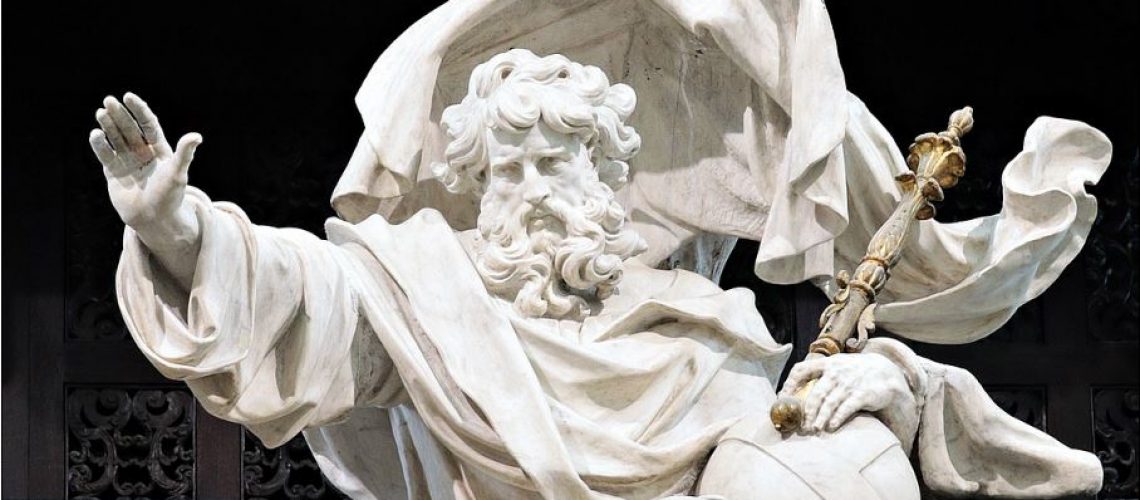
A couple of months ago, U.S. Representative Eric Swalwell, while addressing the House of Representatives about a second President Trump impeachment trial and the GOP’s unwillingness to convict him, stated, “So we could have called God herself [as a witness], and [the impeachment trial] would not have happened.”
An article posted on the website, Christian Feminism Today (CFT), asserts God can be referred to as “she/her” because God is pure spirit and does not have a gender. Referring to God using feminine pronouns, it continues, “serves as a bit of an antidote to the venomous anti-female bias inherent in Judeo-Christian history.”
No Gender Fluidity in God
What Swalwell fails to see, and the CFT article fails to explain, is that God reveals Himself to us as Father, not as male or female. His Son, incarnate with a male body, exclusively refers to God as “Father”. The pronouns we use when referring to God are the result of His revealed Fatherhood rather than His gender or lack thereof.
God is pure spirit and does not have a gender. God the Son assumed a male human nature because the male body reflects His eternal Sonship, not a preexisting gender. Thus, gender, as it relates to this discussion about God, has nothing to do with using masculine pronouns. Rather, God’s self-revealed Fatherhood is why we refer to Him using masculine pronouns.
St. Thomas Aquinas, in his Compendium of Theology, articles 37-42, aptly explains why God reveals Himself as Father.
Why God Is Father
Using bodily conception as an analogy for mental conception, Aquinas begins with explaining how humans conceive. He states,
A being is said to be conceived in a corporeal way if it is formed in the womb of a living animal by a life-giving energy, in virtue of the active function of the male (sperm actively entering the female) and the passive function of the female (ovum passively receiving the sperm) in whom conception takes place. The being conceived shares in the nature of both parents and resembles them in species.
Similarly, as humans begin to learn about and understand the world around them, countless objects enter their minds through their senses, and their minds form mental conceptions. Like bodily conception, an object (active principle) enters our intellects, and our intellects (passive principle) receive the object.
When we receive the object, we form a spiritual image and generate a concept. The mental conception has qualities of both the object understood (e.g., shape, color, etc.) and the mind that understands (i.e., an understanding of the object’s essence through the spiritual image generated).
For example, when a child sees a bird for the first time, that bird actively enters the child’s intellect and his/her intellect passively receives the bird. The child wonders what the bird is and observes its behavior. Through observation and reasoning skills, the child’s intellect begins to understand what the bird is, what it does, and why it does it (i.e., its purpose and essence).
Consequently, the child conceives a spiritual image and understanding of the bird, which is a conception. This newly formed concept is a likeness of the bird in the child’s intellect.
Aquinas explains that the object understood is a kind of “father”, analogously, and the human intellect is a kind of “mother” to the newly formed conception. This is due to their respective active and passive qualities. In the above example, the bird, due to its act of imprinting its image on the child’s intellect, is the concept’s father. The child’s intellect, due to its passive receiving of the bird’s image, is the concept’s mother.
At this point we are discussing objects outside the understanding mind. But what happens to this mother/father relationship when the intellect understands itself?
The Intellect Understanding Itself
Aquinas explains that “when the intellect understands itself, the [concept] conceived is related to the understanding person as offspring to father,” not mother. When this occurs, the passive principle does not exist because the intellect actively engages and understands itself as the active object of its own conception. In other words, the intellect causes itself to be understood. As such, there is no passivity in this act.
When understanding your own intellect, your intellect causes itself to understand itself. You do not need to wait for your intellect to enter through your senses to initiate conceptualization. Consequently, by understanding your own intellect, your intellect generates a conception of itself and is the “father” of its own conception.
Although humans cannot perfectly understand their own intellects, God can perfectly understand His. Therefore, God’s intellect eternally generates, or begets, a perfect spiritual conception of His perfect spiritual self, which is why He is the Father. This eternally generated Concept of all that God knows, including Himself, is the eternal Image of the Father. Since He is the perfect Image conceived, He is fittingly called Son, and is distinct, yet not different, from the Father.
Consequences of Calling God Mother or Using Feminine Pronouns
Feminism is fundamentally an ideological/political movement, which doesn’t see the philosophical implications of its insistence on God as feminine or even “gender-neutral”.
The erroneous use of “mother” or the pronouns “she/her” when referring to God changes God into a passive thinker; namely, one who thinks as “she” receives new information. It turns God into a being who learns new things versus the eternally all-knowing God. Consequently, God becomes a being who changes and is, therefore, subject to time.
This forming of God into one’s own image is idolatry. It is the ultimate error of feminism.
The Right Response to God’s Revelation
We are called to love God as He has revealed Himself. We are not called to idolatry. Do not fall for the idiotic assertions emanating from the Swalwells and anti-God feminists who are ever present and growing in our post-modern culture.
Love God as He has revealed Himself to us and joyfully submit to His eternal love and truth. Only in this way can you become the truly human version of yourself.





12 thoughts on “Is God He or She?”
It has become fashionable to claim falsely that people have a “choice of gender and pronouns” which must be respected, in denial of the obvious biological fact that our sexual identity is immutable from our conception. Yet ironically now some people (probably the same ones pushing this “choose your own gender” nonsense) refuse to accept the choice of the one Person Who actually does have the power to choose His own gender!
Thanks Peter! Very ironic indeed. It’s as if these people believe their opinion is above reality. Of course I’m saying this tongue in cheek because they DO believe their opinion is above reality and want to force their nonsense on everyone else. This liberal garbage is an example of why I love Jesus’ words, “The truth shall set you free.” I am so glad we are set free from the lies of Satan and the world.
Also, I need to correct one point you made in your last sentence. I know what you mean, but I don’t want readers to think God can change from Father to mother and back again as if He is somehow subject to His own arbitrary whims. Due to His perfection, he can’t change Himself nor can He contradict Himself. Therefore, God does not choose His own gender (He doesn’t have one to begin with); He simply communicates His eternal Fatherhood to us and we are called to believe this revelation. I suppose God could have created a world in which rational beings generate conceptions by the active power of the female and the passive power of the male. He could have then revealed Himself as Mother and we would be using feminine pronouns. But that’s not what He did. He created a universe that reflects His active power of generation and communicates His Fatherhood within the language and system He created. In other words, God reveals Himself as Father because He created us to know that the active principle of conceptual generation is father and the passive is mother. Accordingly, since He is pure act, He is Father. Thanks for reading my article and for your comment!
Hmmm…Our Father, who art in Heaven…
The feminists hate that. Feminist theologians will go into theological contortions in order to get around God being masculine.
And, of course, the Blessed Mother of God is just a bit too subservient to satisfy the feminists. Oh, sorry, change that to…“much too subservient” to a masculine God.
Sad.
Thanks Mark! Your right. What strikes me as hypocritical is that feminists want to refer to God as “she” and “mother,” but they don’t want boys who identify as girls playing female sports. That’s going too far according to them. Can they not see that their subjective approach to God’s identity is at least partially responsible for the transgender movement? A movement that is utter garbage, by the way. I guess when one is blinded by hate and lies, one can’t see the effects of his/her false ideologies.
Also, is anyone more feminine than the Blessed Mother? I don’t think so. She exercised true feminine qualities during her life and continues to care for us like a good mother would do. Feminists simply redefine femininity as being more male and then say the rest of humanity got it wrong. Absolute nonsense!
Pingback: Is God He or She? | Newsessentials Blog
I don’t understand why active necessarily means male, and passive necessarily means female.
Excellent question, Capt! First, we begin with God’s self-revelation, namely, His paternity.
Then we try to understand why God reveals Himself in such a way. That’s all that’s happening in Aquinas’ explanation and my article. Second, active and passive in general do not necessarily translate to male and female. Active vs. passive intellectual conception, however, bears likeness to physical conception in which man and woman join together to generate offspring who are like his/her mother and father. Like the article says, the male is the active agent and the female is the passive agent. In a similar way, our intellects (mother) form conceptions by passively receiving objects, the active agents (father), detected by the senses and understanding them. God is an essentially intellectual Being who eternally conceives His self-understanding. This understanding is His Conception/Word of all He knows. Therefore, we should not refer to God as she or mother, but He and Father. Thank you for your question!
In the English language, the generic definitions of male and female are, respectively, giver and receiver, which as such are active and passive. As receiver and giver, we call an electrical power device in a wall a receptacle and female, while we call its electrical mate, male. Admittedly, in this case active and passive, apply mechanically, not on the basis of electrical power.
Calling God a ‘she’ could also express the view that God’s creation is god (mother nature). This negates the Biblical view of God as Creator and transcendent.
I like this conclusion. We don’t want to make ourselves pantheists who believe all creation equals God. Although God is in creation, He also transcends creation. Creation is an effect of God’s eternal act. Thanks Peter!
Thanks for an excellent exposition of the topic, especially for clarifying the active and passive roles of the human intellect.
God is pure Act. God is I AM. Everything else receives existence from God.
Thanks you, sir! You’re exactly right. God is pure act regardless of creation. But even as He relates to creation, God is the active principle for all being.