
Mary, the Mother of God, was immaculately conceived and remained immaculate all her life, and is so now in heaven. In human terms “immaculate” means:
pure, perfect, innocent, faultless, spotless, impeccable, unblemished, unsullied, untainted, sweet, unsoiled, intact, beyond all praise, clean, stainless, guiltless, faultless, sinless, spotless, undefiled, blameless, and virtuous
“Immaculate” is the word we use to describe her; but, taking into account God’s perfection and love, this word does not, and cannot, fully convey the perfection of this creature of God.
God made Mary, and only Mary, all these things and more. Try to imagine you are God and you are going to make the woman within whom your Son will be conceived, will grow, and within whom He will live for the first nine months of His existence on earth. This is the woman whose voice your Son will hear, in her womb, until He is born. Her heartbeat will be His constant lullaby. This is the woman who will be with Him until He dies, and as He dies. This is the first person He will come to the moment after His resurrection. Of course, His Father is going to make her immaculate, and so much more.
God’s Son will not be a homeless orphan. God sends the archangel Gabriel not to ask Mary if she will accept a child already born to care for until He is an adult. He asks her if she will provide a human tabernacle, a place of motherly warmth, comfort, and love, a germ-free, antiseptic, safe place of purity, for a baby to live and thrive in, within her. Gabriel invites Mary to “house” the Son of God:
And the angel answered and said unto her, The Holy Ghost shall come upon thee, and the power of the Highest shall overshadow thee: therefore also that holy thing which shall be born of thee shall be called the Son of God (Luke 1:35).
In short, God made Mary holy because she was to mother the Holy of Holies.
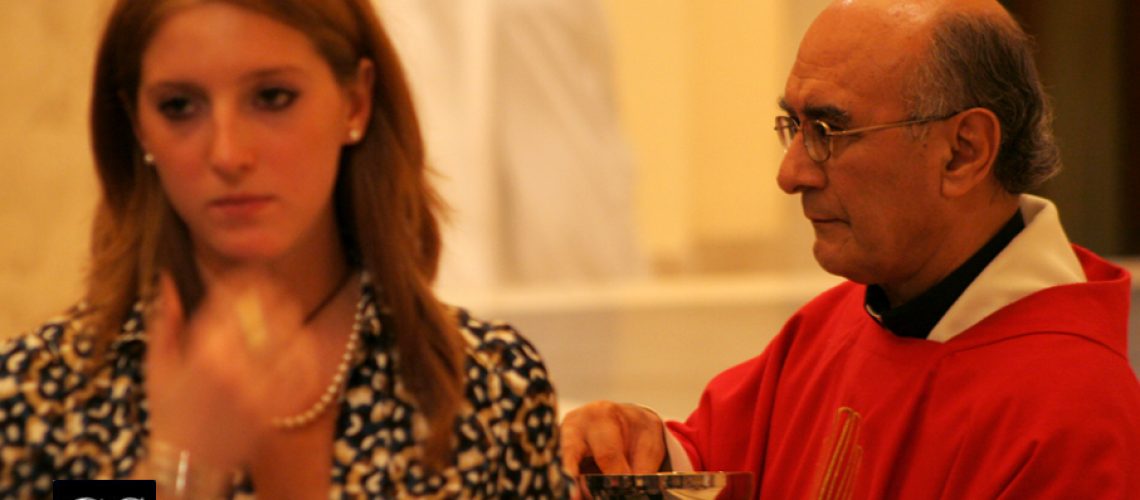
When one receives Holy Communion, one becomes, for a short time, a God-bearer, not identical to, but like Mary, the God-bearer, the Mother of God. Although no one else has been immaculately conceived and everyone is a sinner, the church realizes that one receiving Jesus in the Eucharist should, at least for that moment, be without sin:
What is necessary to receive Holy Communion worthily? To receive Holy Communion worthily it is necessary to be free from mortal sin, to have a right intention, and to obey the Church’s laws on the fast required before Holy Communion out of reverence for the body and blood of Our Divine Lord. However, there are some cases in which Holy Communion may be received without fasting (No. 367, Lesson 28, The Baltimore Catechism).
To respond to this invitation we must prepare ourselves for so great and so holy a moment. St. Paul urges us to examine our conscience: “Whoever, therefore, eats the bread or drinks the cup of the Lord in an unworthy manner will be guilty of profaning the body and blood of the Lord. Let a man examine himself, and so eat of the bread and drink of the cup. For any one who eats and drinks without discerning the body eats and drinks judgment upon himself.”218 Anyone conscious of a grave sin must receive the sacrament of Reconciliation before coming to communion. . . . Anyone who desires to receive Christ in Eucharistic communion must be in the state of grace. Anyone aware of having sinned mortally must not receive communion without having received absolution in the sacrament of penance. (1385 and 1415; Catechism of the Catholic Church).
Jesus cannot be received by and into a person in sin. Holy Communion is so powerful, and the reception of His body, blood, soul, and divinity are so efficacious, that venial sins are forgiven when one receives:
Communion with the Body and Blood of Christ increases the communicant’s union with the Lord, forgives his venial sins, and preserves him from grave sins. Since receiving this sacrament strengthens the bonds of charity between the communicant and Christ, it also reinforces the unity of the Church as the Mystical Body of Christ (1416; Catechism of the Catholic Church).
The United States Conference of Catholic Bishops has provided us with an instruction for receiving Holy Communion:
Those who receive Communion may receive either in the hand or on the tongue, and the decision should be that of the individual receiving, not of the person distributing Communion. If Communion is received in the hand, the hands should first of all be clean. If one is right handed the left hand should rest upon the right. The host will then be laid in the palm of the left hand and then taken by the right hand to the mouth. (USCCB, The Reception of Holy Communion at Mass)
At least for some moments, receiving Him, also becoming His tabernacle, each of us being a Theotokos like Mary, a God-bearer, we too are without sin.
If as we are instructed our hands should be clean when receiving in the hand, how much more should our tongue be clean? Part of my own “Lord, I am not worthy that thou shouldst enter under my roof” before Holy Communion is to extend the Munda cor meum ac labia mea, cleanse my heart and my lips, said before the Gospel, and the Offertory’s Lavabo, cleanse me of my sins, to cleanse my tongue; and to express contrition for all the sins I have committed with it.
Even imperfect contrition requires a firm purpose of amendment, and this means intending and then trying not to sin again with words, the verbo of the Confiteor, in the Mass’s penitential rite, when we say, “peccavi nimis cogitatione, verbo, et opere,” I have greatly sinned in my thought, word, and deed.
The grace of this sacrament is infinite. This is certainly sufficient so that after Mass one is spiritually impelled to use words of charity and virtue simply by recalling to mind that Jesus Himself was here, on my tongue, within me, me a God-bearer, although I am not perpetually immaculate, but, for some moments, sinless.


[…] Immaculate Reception – Guy McClung, PhD, JD, at Catholic Stand […]
[…] of the Eucharist: Immaculate Reception – Guy McClung, Ph.D., J.D., at Catholic […]
https://pdf.cgg.org/Berean126NKJVMark-16-9.pdf
An interesting perspective to consider.
Conjecture and assumption vs. statement?
Scripture vs. tradition and magisterium?
Truth vs. myth?
Happy NYE! from Pa.
Actually,”godma” is a pretty cool misspelling!
Robert, You have put me to work and I will research all. Happy New Year! Guy
Guy:
I just want to know the Truth. We all need to know the Truth.
Time is short for all of us. Whether we die in the near future, or experience the upcoming Tribulation, or the Wrath of God before the return of Jesus Christ. Happy NYE 2023?
Listening to secular experts, as well as prophecy presenters, it appears that 2030 is a year of reckoning. Sir Issac Newton wrote down that 2060 would be the year of Christ’s return, but was he correct?
In any event, it could be almost 2,000 years since Jesus ascended to His Father in Heaven.
Time to research the prophecies in the Bible???
Guy:
I believe that you are absolutely wrong. Pick up your Bible. Read the two verses that I mentioned.
Mark clearly states that Jesus first appeared to Mary Magdalene.
Matthew mentions Mary Magdalene and the other Mary (does not say his mother) meeting Jesus after fleeing from the tomb in verse 9 of Chapter 28.
Luke does not indicate that the women at the tomb saw Jesus.
John also identifies Mary Magdalene as the first to see Jesus.
Nothing in the Bible to indicate that Jesus went to his mother first.
Why do you accept this non-infallible tradition (your words) over the Gospels?
What is the source of this tradition?
Robert-This is a partial reply, replying to: “Why do you accept this non-infallible tradition (your words) over the Gospels? What is the source of this tradition?”
I have read many sources for the tradition, and in some cases the studied opinion, that Jesus first appeared to His Mother before any others on Easter Sunday. Below is one example. There is no proclaimed doctrine or godma on this – this means we can discuss this one til the cows come home.
“Author: Pope John Paul II
MARY WAS WITNESS TO WHOLE PASCHAL MYSTERY
Pope John Paul II
” . . . .How could the Blessed Virgin, present in the first community of disciples (cf. Acts 1: 14), be excluded from those who met her divine Son after he had risen from the dead?
Indeed, it is legitimate to think that the Mother was probably the first person to whom the risen Jesus appeared. Could not Mary’s absence from the group of women who went to the tomb at dawn (cf. Mk 16: 1; Mt 28: 1) indicate that she had already met Jesus? This inference would also be confirmed by the fact that the first witnesses of the Resurrection, by Jesus’ will, were the women who had remained faithful at the foot of the Cross and therefore were more steadfast in faith”
Whole “catechesis” of JP II: https://www.ewtn.com/catholicism/library/mary-was-witness-to-whole-paschal-mystery-8071.
Still working on studying Holy Scripture quotes.
Happy 2023! Guy, Texas
As a Catholic, I find myself frustrated by statements made that are not fully supported by the scriptures.
I have no doubt that God “creates” every human being. But to then pronounce that He created Mary without original sin seems to contradict her own canticle in Luke 1. Why should we believe the dogma proclaimed by a pope more than 1,800 years after the event?
Where does it say that Mary was “This is the first person He will come to the moment after His resurrection.”? It seems that my Catholic Bible indicates Jesus first appeared to Mary Magdalene (Mark 16:9 and John 20:16-18).
Robert, Thank you for reading this. As catholics we do not beleive in “scripture alone” or “sola scriptura” : ” Catholics, on the other hand, recognize that the true “rule of faith”—as expressed in the Bible itself—is Scripture plus apostolic tradition, as manifested in the living teaching authority of the Catholic Church, to which were entrusted the oral teachings of Jesus and the apostles, along with the authority to interpret Scripture correctly. (Catholic Answers).
The bible does not say God created Mary without original sin; but this has been infallibly declared by the church to be a truth with the very highest status of the magisterium – dogma. We believe that when as you say 1800 years later this is declared by a pope that, even though not in the bible, this is true.
The bible does not say who was the very first person Jesus came to after His resurrection. Nor does it say that he appeared first, of all people, to Mary Magdalen or to any of the apostles. It is a non-infallible tradition of the church that He appeared first to His mom. If I was Jesus, that is exactly what I would have done – appear not to the Mary M who comes to the tomb, unbelieving, to anoint a dead body and mary M who reports to the apostles that they have taken Jesus’s DEAD body; but to my Mother who birthed me and stood by me all the way to Calvary – and who knew, beyond belief, that I was going to rise from the dead. Guy, Texas
The Catholic Encyclopedia:
“The doctrine
In the Constitution Ineffabilis Deus of 8 December, 1854, Pius IX pronounced and defined that the Blessed Virgin Mary “in the first instance of her conception, by a singular privilege and grace granted by God, in view of the merits of Jesus Christ, the Saviour of the human race, was preserved exempt from all stain of original sin.”
“The Blessed Virgin Mary…”
The subject of this immunity from original sin is the person of Mary at the moment of the creation of her soul and its infusion into her body.
“…in the first instance of her conception…”
The term conception does not mean the active or generative conception by her parents. Her body was formed in the womb of the mother, and the father had the usual share in its formation. The question does not concern the immaculateness of the generative activity of her parents. Neither does it concern the passive conception absolutely and simply (conceptio seminis carnis, inchoata), which, according to the order of nature, precedes the infusion of the rational soul. The person is truly conceived when the soul is created and infused into the body. Mary was preserved exempt from all stain of original sin at the first moment of her animation, and sanctifying grace was given to her before sin could have taken effect in her soul.
“…was preserved exempt from all stain of original sin…”
The formal active essence of original sin was not removed from her soul, as it is removed from others by baptism; it was excluded, it never was in her soul. Simultaneously with the exclusion of sin. The state of original sanctity, innocence, and justice, as opposed to original sin, was conferred upon her, by which gift every stain and fault, all depraved emotions, passions, and debilities, essentially pertaining to original sin, were excluded. But she was not made exempt from the temporal penalties of Adam — from sorrow, bodily infirmities, and death.
“…by a singular privilege and grace granted by God, in view of the merits of Jesus Christ, the Saviour of the human race.”
The immunity from original sin was given to Mary by a singular exemption from a universal law through the same merits of Christ, by which other men are cleansed from sin by baptism. Mary needed the redeeming Saviour to obtain this exemption, and to be delivered from the universal necessity and debt (debitum) of being subject to original sin. The person of Mary, in consequence of her origin from Adam, should have been subject to sin, but, being the new Eve who was to be the mother of the new Adam, she was, by the eternal counsel of God and by the merits of Christ, withdrawn from the general law of original sin. Her redemption was the very masterpiece of Christ’s redeeming wisdom. He is a greater redeemer who pays the debt that it may not be incurred than he who pays after it has fallen on the debtor.
Such is the meaning of the term “Immaculate Conception.” “
Why is it so important that Mary was conceived without sex? Why can’t she be just as “immaculate” if she was the product of sexual intercourse? What is it about sex that soils a person?
And as to how Jesus got conceived, what is it about having sex that soils a woman? Why is being conceived without sex “immaculate”?