

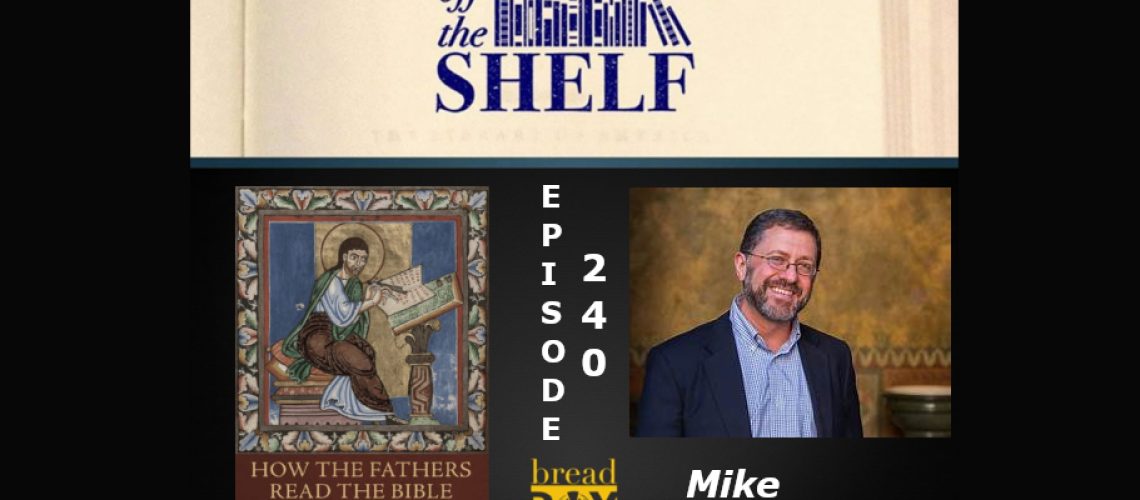
Off the Shelf 240 – Mike Aquilina
Understanding Scripture can be a challenge but it doesn’t have to be. All we have to do is take a look at how the Early Church read the Bible and we can learn a LOT! Join Mike Aquilina and I as we discuss his latest book How the Fathers Read the Bible: Scripture, Liturgy, and the Early Church. Get your copy here.
From the publisher Emmaus Road Publishing
“You search the Scriptures, because you think that in them you have eternal life; and it is they that bear witness to me.” —John 5:39
It takes some real imagination to go back fifteen or twenty centuries to an age when ordinary people didn’t have Bibles. But if we don’t put in that work, we’ll misunderstand the early Christians completely.
The early Christians didn’t live in our world, and their encounters with Scripture happened in one main context: the liturgy. That was where they heard Scripture. And just as important, that was where they heard Scripture interpreted.
In How the Fathers Read the Bible: Scripture, Liturgy, and the Early Church, Mike Aquilina takes readers back to the first centuries of Church life to show how the liturgy became the home of—and the interpretative lens for—Scripture. Aquilina shows how, both then and now, Scripture is only understood through the life of the Church—and in particular, through the liturgy.
Bio
Mike Aquilina is executive vice-president of the St. Paul Center and a contributing editor for Angelus News. He is author of more than fifty books, including The Fathers of the Church and The Eucharist Foretold.



16 thoughts on “How the Fathers Read the Bible: Off the Shelf 240 with Mike Aquilina”
CCC100 says: “The task of interpreting the Word of God authentically has been entrusted solely to the Magisterium of the Church, that is, to the Pope and to the bishops in communion with him.”
V2’s Dei Verbum 10 says: “But the task of authentically interpreting the word of God, whether written or handed on, (8) has been entrusted exclusively to the living teaching office of the Church”.
Is the teaching office of the Church only the Magisterium? There are teachers in the Church who are not in the hierarchy. There is also the gift ministry of teaching that comes from Christ (see Ephesians 4:11).
V2’s Dignitatis Humanae 1 says: “On their part, all men are bound to seek the truth, especially in what concerns God and His Church, and to embrace the truth they come to know, and to hold fast to it. This Vatican Council likewise professes its belief that it is upon the human conscience that these obligations fall and exert their binding force. The truth cannot impose itself except by virtue of its own truth, as it makes its entrance into the mind at once quietly and with power.”
Dignitatis Humanae 2. Says: “It is in accordance with their dignity as persons-that is, beings endowed with reason and free will and therefore privileged to bear personal responsibility-that all men should be at once impelled by nature and also bound by a moral obligation to seek the truth, especially religious truth. They are also bound to adhere to the truth, once it is known, and to order their whole lives in accord with the demands of truth However, men cannot discharge these obligations in a manner in keeping with their own nature unless they enjoy immunity from external coercion as well as psychological freedom.”
We can all contribute to tradition. V2’s Dei Verbum 8 states: “This tradition which comes from the Apostles develop in the Church with the help of the Holy Spirit. (5) For there is a growth in the understanding of the realities and the words which have been handed down. This happens through the contemplation and study made by believers, who treasure these things in their hearts (see Luke, 2:19, 51) through a penetrating understanding of the spiritual realities which they experience, and through the preaching of those who have received through episcopal succession the sure gift of truth.”
V2’s Lumen Gentium 12 says: “The entire body of the faithful, anointed as they are by the Holy One, (111) [cf. 1 Jn 2:20, 27] cannot err in matters of belief. They manifest this special property by means of the whole peoples’ supernatural discernment in matters of faith when “from the Bishops down to the last of the lay faithful” (8*) they show universal agreement in matters of faith and morals. That discernment in matters of faith is aroused and sustained by the Spirit of truth.”
Lay people also have the responsibility to make use of the Spirit of Truth within them.
Peter,
You still haven’t gotten the point, we have now gone full circle. You ARE defending beliefs against divine revelation. See CCC77, CCC88, CCC100, and continue to refer to it for any future question you have for me. You will find it there.
Victor De Sardis: Actually, we can live with corrupt bishops. Look at what is said of the Sardis Church in Revelation 3:1, 4: “And unto the angel of the church in Sardis write; These things saith he that hath the seven Spirits of God, and the seven stars; I know thy works, that thou hast a name that thou livest, and art dead…Thou hast a few names even in Sardis which have not defiled their garments; and they shall walk with me in white: for they are worthy.”
I guess that we don’t have to leave an imperfect Church. I don’t; but, I don’t defend practices or beliefs in the Church that I believe to be against Divine Revelation.
Victor De Sardis: Would you follow the lead of some of the German bishops and of other bishops in the world who think as they do?
Peter,
I will joyfully die if necessary to defend the Catholic Faith.
Peter,
You define the Church so broadly that it now means an individual. That should be a clue that your Theology has a hole in it. I thought JP Nunez answered this well on 20MAR2022, but if I were to add one thing, I like the saying of ‘being within the guardrails” – meaning some scriptural interpretations must be believed and others must NOT be believed, but ultimately we submit to the Church:
“We read in Leviticus of the lepers, how they are commanded to show themselves to the Priests; and if they have the leprosy, then they are made unclean by the Priest; not that the Priest makes them leprous and unclean, but that the Priest has knowledge of what is leprosy and what is not leprosy, and can discern who is clean, and who is unclean. In the same way then as there the Priest makes the leper unclean, here the Bishop or Presbyter binds or looses not those who are without sin, or guilt, but in discharge of his function when he has heard the varieties of their sins, he knows who is to be bound, and who loosed.”
Saint Jerome (AD 342 – AD 420)
The Church is the Body of Christ. Each individual part communes with the Head. This is how the Body works in unison. Christ, the Head, is the one who knows who is a part of His Body. When we appear before Him, the excuse that the pope made me do it won’t fly (see Matthew 7:23). We are all required to “Prove all things; hold fast that which is good” (1Thessalonians 5:21). We primarily have responsibilities to our own conscience and supernatural discernment.
“Whoever listens to you [Catholic Bishops] listens to me. Whoever rejects you rejects me. And whoever rejects me rejects the one who sent me.” Luke 10:16
“Whoever will not receive you [Catholic Bishops] or listen to your words—go outside that house or town and shake the dust from your feet.” Matthew 10:14
“Whatever place does not welcome you or listen to you [Catholic Bishops], leave there and shake the dust off your feet in testimony against them.” Mark 6:11
“And as for those who do not welcome you [Catholic Bishops], when you leave that town, shake the dust from your feet in testimony against them.” Luke 9:5
“Wherever the bishop appears, there let the people be, even as wheresoever Christ Jesus is, there is the catholic church.” Ignatius of Antioch (AD 35 – AD 108)
“You must all follow the lead of the bishop, as Jesus Christ followed that of the Father; follow the presbytery as you would the Apostles; reverence the deacons as you would God’s commandment.” Ignatius of Antioch (AD 35 – AD 108)
Victor De Sardis: The Holy Spirit is resident in the Church. This means that the Spirit of Truth is resident within individuals in the Church regardless of rank. We are in the best position to interpret Scripture when we have the Spirit of Truth within us. There are those outside of the organization of the Catholic Church who also have the Spirit of Truth. If the Church includes them, they can also interpret Scripture correctly.
It depends upon how broadly you define the Church.
Pingback: TVESDAY EDITION – Big Pulpit
Victor De Sardis: The issue of privately interpreting Scripture is interesting. The meaning of 2Peter 1:20-21 changes depending upon the translator of a particular Bible.
The old Catholic Douay Bible renders it: “Understanding this first, that no prophecy of scripture is made by private interpretation. For prophecy came not by will of man at any time: but the holy men of God spoke, inspired by the Holy Ghost”.
The Catholic version of the Living Bible says: “For no prophecy recorded in Scripture was ever thought up by the prophet himself. It was the Holy Spirit within these godly men who gave them true messages from God”.
It looks like the passage has nothing to do with not be being able to interpret Scripture for ourselves. It applies to the writers; not us. The word “interpretation” can also be translated as “unloosing”. The Living Bible and the old Catholic Bible translations make more sense because of verse 21.
Anyway, how can you read something without interpreting it?
Peter,
You mention the Douay Bible. In 1811, Fr. George Leo Haydock (1774-1849) published a version of the Douay Bible with extended commentary (based on the Fathers of the Church), and this is what it has to say about 2 Peter 1:20-21:
“The Scriptures cannot be properly expounded by private spirit or fancy, but by the same spirit wherewith they were written, which is resident in the Church.”
“…men were inspired who wrote them; therefore they are not to be interpreted but by the spirit of God, which he left, and promised to his Church to guide her in all truth to the end of the world. Our adversaries may perhaps tell us, that we also interpret prophecies and Scriptures; we do so; but we do it always with a submission to the judgment of the Church, they without it.
Likewise, in his commentary on 2 Timothy 3:14-17, Thomas Aquinas writes of Timothy remaining steadfast and unmovable in his teachings:
‘’ the teachings of faith are entrusted in a special way to prelates, inasmuch as they must dispense them to others:
when they had seen that to me was committed the Gospel of the uncircumcision (Gal 2:7).
And why ought he continue in them? Because I have obtained them from the Master of knowledge who cannot err:
Christ speaks in me (2 Cor 13:3).
And so, continue in them firmly, knowing of whom you have learned them, for he learned them from Paul, who learned them not from man nor by men, but by the revelation of Jesus Christ (Gal 1:12).”
The Fathers read Scripture as endorsing misogyny and anti-semitism. At least one gathers that, from their surviving writings. The Church has different positions now, which leaves it open to charges of moral relativism (to today’s progressives, misogyny and anti-semitism were always wrong). If this impression of the Fathers is incorrect, then it should be shown why.
First it should be shown where.
Things change. When there were no private Bibles, the message was generally heard through a preacher or during the liturgy. Now that there are private Bibles for practically anyone who wants one, we can read Scripture for ourselves. There is no longer any necessity for being limited to only what is read in the liturgy or to what is preached in the homily; and there is no longer any necessity to rely on the interpretation of the few.
Those who have the Spirit of Truth are at an advantage in interpreting Scripture because they have an insider’s perspective of its contents.
Know this first of all, that there is no prophecy of scripture that is a matter of personal interpretation, for no prophecy ever came through human will; but rather human beings moved by the holy Spirit spoke under the influence of God. 2Peter 1:20-21