

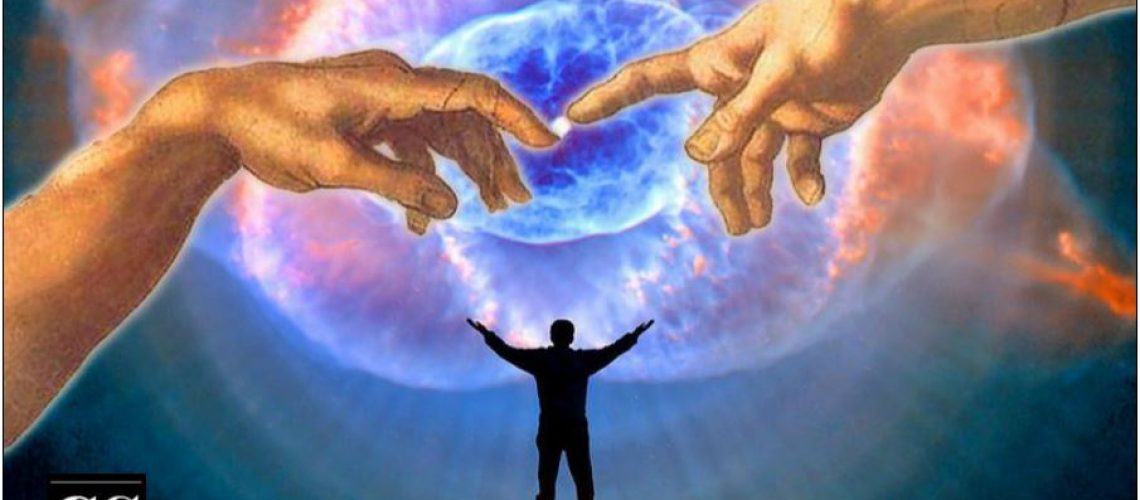
As there is a multiplicity of creatures on earth, so there may be other beings, intelligent, created by God. This does not conflict with our faith, because we cannot put limits on the creative freedom of God…How can we rule out that life may have developed elsewhere? Just as we consider earthly creatures as ‘a brother,’ and ‘sister,’ why should we not talk about an ‘extraterrestrial brother’? It would still be part of creation. Rev. Jose Funes (2008, then Director of the Vatican Observatory), “The Extraterrestrial is My Brother“
INTRODUCTION—”THE GOD OF THE GAPS” ARGUMENTS
If I judge correctly from comments on the previous two articles in this series (see here and here), some faithful Catholics will strongly disagree with Fr. Funes. And, as I’ll explain below, I myself have reservations about the existence of “ET brothers.” In this third article, I’ll present some theological considerations, taken from the 2021 SCS Conference and from my own reflections.
Before discussing theology, let me summarize some of the information from the previous articles on the likelihood of life outside the earth. In arguing questions like this, materialists tell us not to invoke a “God of the Gaps.” That is to say, if there is no apparent “natural” mechanism to explain some phenomenon, we should not, therefore, ascribe it to a miracle wrought by God. In general, I agree with this limitation. Nevertheless, the gaps are there. So, I’ll start by listing some of these apparent gaps, bottlenecks in our understanding of where life (and intelligence) comes from.
ORIGIN OF LIFE BOTTLENECKS
As several of the SCS talks showed¹, simple molecules are present in interstellar space. Prof. Shingledecker termed these (see figure below) “pre-biotic molecules.”
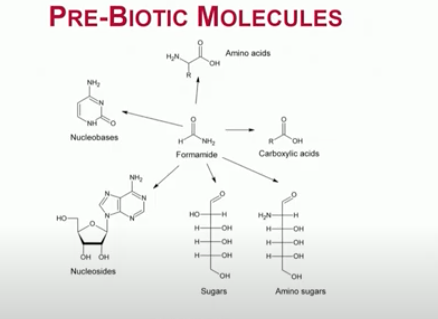
from Shingledecker, SCS 2021
These simple molecules are the biotic building blocks—amino acids, sugars, nucleotides—which form the larger molecules, biopolymers: proteins, DNA, RNA, lipids, that are molecular biology. How this step might occur is still a mystery at this time.
The next step is assembling these biopolymers into a cell, biopolymers enclosed by a wall, a membrane of phospholipids, and protein channels. The mechanism for this step is also a mystery, and in my opinion, likely to remain one. Are there other bottlenecks? In her talk, Prof. Karin Oberg suggested there might be one more, the formation of animals from single cells. Here’s the reasoning: it took only about 700 million years for the first life to be formed after earth became a planet (from about 4.5 billion to 3.8 billion years ago). On the other hand, several billion years elapsed before that first life developed into the wealth of animal forms arising in the Cambrian explosion (approximately 520 million years ago).
And there is, I suggest, another bottleneck: a rational being capable of wondering about origins and purpose in life. Let’s discuss that below.
THE GAP BETWEEN ANIMALS AND HUMANS
“Speak, and I will baptize thee.” The Bishop of Polignac on seeing a live chimpanzee (early 17th century); from “The Gap,” by Thomas Suddendorf.
Even though we classify humans as animals, there are still gaps between them, of kind, not degree. Language is one such. And by “language,” I do not mean simply communication. Rather, there is grammar, syntax, and semantics. One speaker at the SCS conference put the difference succinctly: animals communicate by imperatives, humans by declaratives. Moreover, in language, humans use reference elements, recursive modes, and abstractions. For a clear and complete description of the differences between animal communication and human language, see “Do Dolphins have a language?” Also, there is a genetic marker for the language gap, the FOXP2 gene.. Family disorders in talking and understanding speech are correlated with genetic mutations of this gene. FOXP2 genes similar to those for homo sapiens have been found in Neanderthal DNA, but not in that of other humanoids or primates.
Besides language, there is art. Prof Oberg pointed out that during the 200,000 years when several homo (humanoid) species were present when tools were used and very possibly a primitive language existed, there was no art. The first art, the pictorial reference of reality, came about 40,000 years ago. In children, the ability to picture and represent develops in the first two or three years, a little later than language. Animals do not have this capability, despite publicity about abstract paintings by chimpanzees.
And with the capacity for art, what other particularly human traits arise? The ability to raise questions about existence and meaning? Why am I here? What will happen to me and those I love when I die? Who made all this? We can only say, I believe, that these are the questions God gave to man, with the gift of a soul. So this leads then to the meat of this piece, the theology of ETR life.
ETR THEOLOGY 1: ARE THERE MANY ETRS?
In a general way, we can imagine two schemes which God might choose to create:
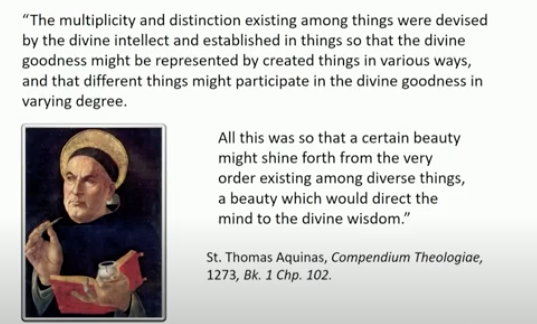
1. God yields a plenitude (as in the featured quote) or, as St. Thomas Aquinas would say;
2. Or, God focuses on man as His image. as the creation story in Genesis says:
“So God created man in his own image, in the image of God created he him; male and female created he them.” Gen. 1:27 (KJV)
Now this “image” of God need not be a physical one. Indeed, since the Trinitarian God exists in all His attributes and infinite qualities, He does not have a reproducible physical image. Accordingly, a cephalopod “human” would be as much an image of God as a primate “human.” So, this line in Genesis does not really exclude ETRs.
What mode does our Trinitarian Creator use? Does He set a frame of universal laws such that life and intelligence occurs by a so-called natural process? Or does He, every now and then, give a nudge, a push to squeeze through the bottlenecks: life, animal forms, rationality? If the former, one would expect life and intelligence to be abundant. If the latter, probably not. Which of these ways we credit will be a matter of personal bent; neither dogma nor fact give a definitive answer. If the many-worlds QM theorists have it correctly, it might even be that in some universes there is only one rational species, in others many. Let’s leave this as an open question, then, and turn to another.
ETR THEOLOGY 2: THE FALL AND SALVATION OF ETRS?
Assume for the sake of argument, that in this universe there are many ETRs. Will each of these or some of these undergo a Fall, as did Adam and Eve? And will the Son of God come to save them, in the form of their kind? In the first of his science-fiction trilogy, “Out of the Silent Planet,” C.S. Lewis dealt with these questions. Only on earth did the Fall occur, with a consequent crucified Savior. On Mars, three sentient species exist in synergistic cooperation, not fallen. Each member of the three species anticipates a heavenly hereafter.
In thinking about these two theological questions, I myself wonder: is the Fall an inevitable consequence of free will and of the presence of the Tempter, the Evil One? If so, then it would be the case, if there be other ETRs in our universe, that they would Fall. And it would also be the case that God the Father in His infinite mercy would send His son, in the form of that ETR, for its salvation. But that’s an opinion, not backed up by theology or dogma, to my knowledge.
So this is still one more question for which, I believe, there is not a definite answer. But to build on my own reflections on this, let me discourse on what I perceive to be our unique and favored situation, our privileged place in a universe governed by the so-called Anthropic Principle.
AREN’T WE SPECIAL!!¹ THOUGHTS ON THE ANTHROPIC PRINCIPLE
The fundamental laws of physics, the parameters that set their operation, in sum, the nature of the universe, seem to be designed to make it hospitable to carbon-based life. This favoritism, the Anthropic Principle, should be familiar to the reader, so I won’t expound on it at length in this piece. See footnote 2 below for a brief account, and these articles for more details (here and here). However, I do want to remark on one particular aspect of God’s creation: the vastness of the universe and our insignificance. For me, this is an occasion of wonder and marvel.
For I will behold thy heavens, the works of thy fingers: the moon and the stars which thou hast founded. What is man that thou art mindful of him? or the son of man that thou visitest him? Psalm 8:4,5
But this isolation, the smallness, and bigness³, also has a purpose. From the smallest (quarks) to the biggest (the universe) there are 40 powers of ten on the scale, and a human’s size is more or less in the middle. But to God, size is irrelevant. If there are vast distances to the nearest stars, that serves to isolate us from harmful radiation, such as would be present in the center of our galaxy, where there is a black hole and stars are denser. If we are 15 powers of ten bigger than quarks, that enables particle physics and chemistry to be the bricks of life.
All these coincidences lead me to believe that we are unique, that humankind is God’s special creation. Perhaps in other universes, He created many species in His image, some fallen, some not. But in this universe, we are, I believe, His sole creation.
Finally, I again urge the reader to go to the videos of the Conference (here and here) to get other (and probably wiser) discourses on this matter.
NOTES
¹ You old-timers might remember the Church Lady on Saturday Night Live, and her expression, “Now, isn’t that special…!!!”
² The unlikely conditions (Anthropic Coincidences) that enable the universe to exist and to be a place for carbon-based life.
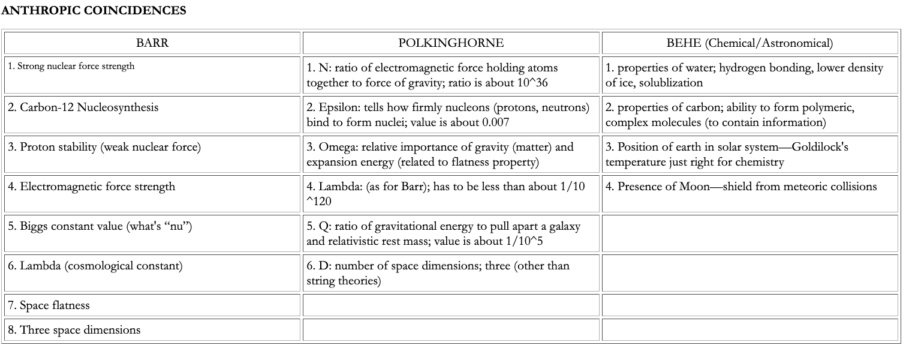
Possible Reasons for Unlikely Anthropic Coincidences:
- That’s just the way it is—we wouldn’t be here if the coincidences weren’t there (not a satisfying explanation).
- An infinity of universes—if there are an infinite number of universes, even a highly improbable universe will occur, including duplicates (this is an act of faith even more demanding than a belief in God).
- A basic “Theory of Everything” requires the values of the constants and force laws to be as they are—the universe is not a contingent entity but a necessary entity (and Who created such a “Theory of Everything”?)
- The Fine-Tuning set by a loving, all-powerful Creator.
³ The scale of man in the universe and with respect to smallest particles is given in the classic film, Powers of Ten (Eames, 1977) and in a more recent version (1997). One comment to the latter video is pertinent: “Damn no wonder aliens haven’t found us yet or vise versa.”




4 thoughts on “Extraterrestrial Life, Part 3:<br>A Catholic Perspective;<br>Theology: A God of the Gaps?;<br>SCS Conference 2021”
Some of the biggest blowhards who complain that many arguments in support of the basic premise that God exists are simply “God of the Gaps” arguments are the very same people who invoke a “science of the gaps” argument by declaring without any sense of irony or shame that when something cannot be explained scientifically that ‘it’s just a matter of time before science will be able to explain it.’ In other words, the gaps that currently exist will ultimately be filled by science. This is nothing but a pure faith in science (a form of scientism) without any evidence to support the nonsense claim regarding the alleged omnipotence of science despite the inherent, universal, and absolute limitations that science possesses for all time. 🙂
Thanks Mike, for the comment. I agree.
Pingback: SATVRDAY EDITION – Big Pulpit
I wonder what power of faith you would need to make a mountain move.