
INTRODUCTION
Does life, intelligent or not, exist anywhere other than on earth? And if such extraterrestial life be intelligent, how does Catholic teaching take it into account? Speakers at the 2021 Conference of the Society of Catholic Scientists addressed these questions, along the following lines:
- What kind of chemistry does life (as we know it) require in order to exist?
- Outside the earth, either in our solar system or in planets of other stars (exoplanets), are conditions for such chemistry present?
- If intelligent extraterrestial life exists, could we detect its presence by radio or other signals?
- Should such life exist, what are the implications for Catholic theology?
Rather than summarizing each of the SCS talks, I’ve decided to give an overall summary. I urge the reader to go to the talks themselves (I’ve provided Youtube links at the end of this article¹) In this article I’ll focus on the first question. In a second piece. I’ll cover the second and third, and in a third, the fourth question.
Let’s look first at Question 1.
CHEMISTRY OF LIFE (AS WE KNOW IT)
If we restrict our discussion to life based on molecular biology and chemistry as we know it on earth, then we’ll be talking about life based on molecules containing carbon.² These biological building blocks, the molecular constituents of carbon based life, reside in liquid water. In order that complex biological molecules not break up, the water temperature shouldn’t be too high. Also, it should not be so low that chemical reactions occur too slowly. Thus there is a so-called “Goldilocks” temperature zone in which extraterrestial life must reside.
In other articles I’ve speculated about how life might have begun (see here). Because of God’s marvelous gift to molecular biology, the hydrogen bond, biological molecules can undergo weak interactions. The zipper-like action of such hydrogen bonding enables DNA molecules to form helices and to unfold and to be copied. It facilitates the folding and unfolding of proteins. Because the hydrogen bonded association of protein and substrate molecule is not too strong, enzyme catalyzed reactions can proceed readily.
CHEMICAL EVOLUTION
We can imagine a sequence of chemical evolution as illustrated in the diagram below:
elements (H,C,N,O,P,S)→ small molecules (H2O,HCN,CO2,CH4,NH3…)→ building blocks (amino acids, sugars, nucleic acids, phosphates,…) → biopolymers (RNA, DNA, proteins, lipids)
The final step, the assembly of these biopolymers into a cell with the formation of a cell wall is, at this time, a mystery.
how the first cell came into being are matters of speculation, since these events cannot be reproduced in the laboratory. The Cell: A Molecular Approach (2nd Ed.)
How the changes from one stage to the other might occur is known only in part or not at all (The arrows hide a lot that is not known). Nevertheless there is evidence from astronomical observations that some conditions in early stages might obtain for earth-like exoplanets and for some satellites of giant planets in our solar system.
Let’s look at the first transition, from elements to simple molecules. Is there evidence that such molecules exist outside the earth?
SIMPLE MOLECULES IN EXTRA-STELLAR DUST CLOUDS
According to Prof. Karin Oberg (Harvard), there is strong evidence from astronomical spectra that H2O, HCN, CH4, and other simple molecules are present in exoplanets and dust clouds in which such planets form. Exoplanet spectra show the presence of such molecules:
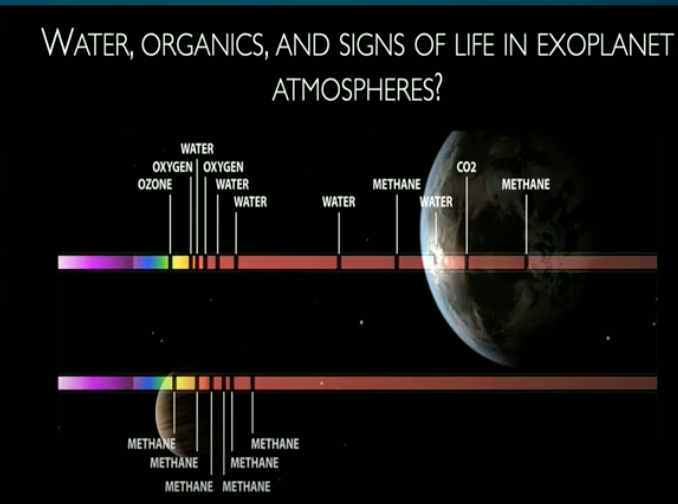
From SCS 2021 talk, Prof Karin Oberg
As shown in the image below, the spectra of HCN (cyanic acid) is present in dust clouds surrounding stars. Planets are formed in such dust clouds.
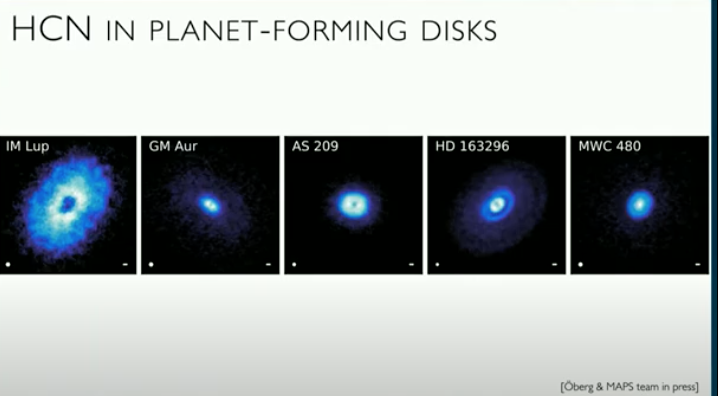
From SCS 2021, Prof. Karin Oberg
Besides the simple molecules listed above, astronomical microwave spectra provide evidence for many other simple molecules that combine to form biological building blocks. (See here and here for examples.²) Such molecules form by the action of interstellar radiation (UV and higher energies) and through short-lived intermediates. Although their concentration is low, the volume of space dust clouds is large enough that the total amount is not negligible. Even though the reaction schemes that scientists propose to yield biological building blocks are reasonable (see here and here for examples), papers do not always give the laboratory experiments that would replicate these schemes.
SIMPLE MOLECULES IN METEORITES, COMETS
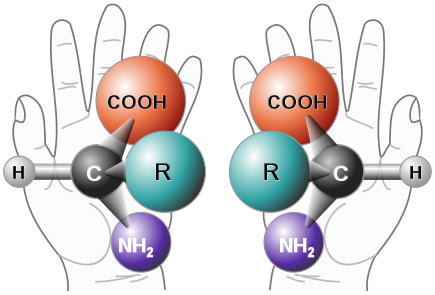
In his talk, Prof. Christopher Shingledecker gave a clear account of how prebiotic molecule and biotic building blocks might form on cosmic dust. Meteorites give evidence of this. And what is the most interesting feature of such evidence? Biotic building blocks are chiral, that is to say, they have a symmetry difference like that between left and right hands, as the figure below shows:
(from Wikimedia Commons)
Since all naturally occurring proteins have a left-handed symmetry, one might expect the same handedness or chirality for the amino acid building blocks. And in fact, the amino acids found in meteorites do show a slight excess of such L-handed amino acids. Where does this natural chirality come from? One possible mechanism is polarized radiation acting on only right—handed molecules, leaving an excess of left-handed, but this explanation is speculative. It’s one of the mysteries in how such molecules are formed.
Professor Shingledecker proposed a reaction scheme for the formation of prebiotic and biotic molecules shown in the diagram below:
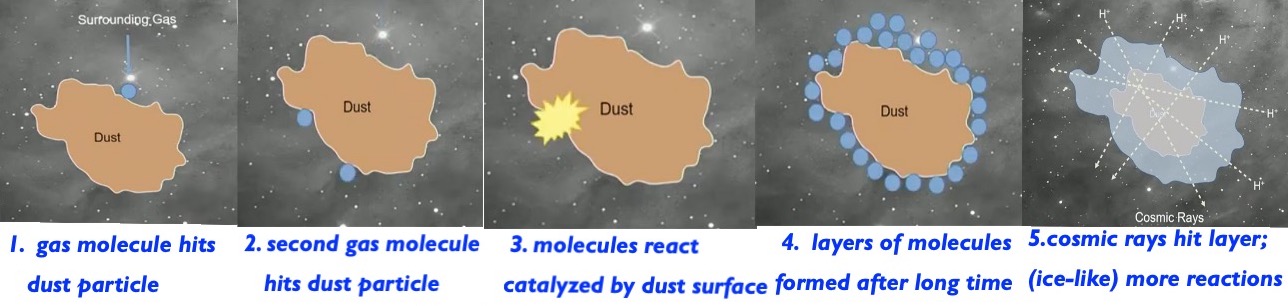
from SCS 2021, Prof. Shingledecker
Laboratory work replicating interstellar space conditions supports the scheme in the picture above.
IS THE PROBLEM OF CHEMICAL EVOLUTION SOLVED?
So then, how much do we know then about the formation of biotic molecules? As Prof. Shingledecker pointed out, we know a lot about the first step in evolution of life’s chemistry:
- pre-biotic molecules and biotic building blocks form from the elements;
- large molecules, polymers (proteins, polynucleotides, phospholipid chains), form from the building blocks;
- self-replicating molecules (RNA, DNA) are among such polymers;
- cell walls (phospholipid assemblies) form to enclose these self-replication molecules.
But at this time, steps 2-4 are still a mystery, a matter of speculation, according to John Sutherland, a prominent researcher in the chemistry of life:
Demonstrating such a process [the steps above] in the laboratory would show how life can start from the inanimate. If the starting materials were irrefutably primordial and the end result happened to bear an uncanny resemblance to extant biology.. .We are not yet close to achieving this end, but recent results suggest that we may have nearly finished the first phase: the beginning. [Emphasis added. ]ohn D. Sutherland, “Studies on the origin of life — the end of the beginning,” Nature Reviews Chemistry, Vol. 1:12 (2017))
Accordingly, since the scientific genesis of life chemistry is, to a major degree, still a mystery, let’s turn to theological implications.
THE THEOLOGY OF CHEMICAL EVOLUTION—PRELIMINARY REMARKS
Before discussing this topic at greater length in a future article, let me remark on a few pertinent observations made by Prof. Karin Oberg. She mentioned two possible Scriptural arguments against the possibility of extraterrestial life:
- Scripture does not mention extraterrestial life;
- God’s reveals His governance through miraculous acts; one such is the creation of life.
Answering the first objection, Prof. Oberg noted that dinosaurs (among other species) were not mentioned in Scripture, so this cannot be a valid objections. With respect to the second, Catholic teaching generally points to God as setting an ordered universe through His laws. It is the order of His creation that is the occasion for glory. As Psalm 19A has it: “The Heavens declare the glory of God and the Firmament shows forth the work of His hands.”
And here’s one other question posed by Prof. Oberg: should we choose a God who makes us unique in the universe or a God who fills the universe with a plenitude of life, life that as in the last chapter of C.S. Lewis’s Perelandra, is ecstatic in a dance of adoration?
In a second article I’ll discuss technology: how do scientists search for evidence of extraterrestial life and (if they’re there) ETR’s—ExtraTerrestial Rational beings. And in the third, I’ll give my own views and those of the Conference speakers on the theological implications of all this.
NOTES
¹ Go here for SCS Conference Program. Go here for the Youtube recordings of the Saturday lectures and here for those of the Sunday lectures.
² Being a science fiction fan, I’ve read about life based on electric plasmas, ammonia seas, and silicate rocks. In fact, the last was my first encounter with alien life (fictional, that is). In Stanley Weinbaum’s “A Martian Odyssey,” (1937? 1938?) the silicon based life-form excretes bricks, builds them into a pyramid, and when one pyramid is finished moves on to the next.


[…] I judge correctly from comments on the previous two articles in this series (see here and here), some faithful Catholics will strongly disagree with Fr. Funes. And, as I’ll […]
[…] extraterrestrial life. And by “life,” I mean life based on carbon compounds (see Part 1). Moreover, there are two types of searches for extraterrestrial life: one, simpler, for […]
[…] extraterrestial life.. And by “life,” I mean life based on carbon compounds (see Part 1). Moreover, there are two types of searches for extraterrestial life: one, simpler, for […]
Hi,
IF (emphasis added) there is life outside this world, it will be subject to the devil. If it is not subject to the devil, they are already living in a continuous state of grace, i.e. Heaven.
So, if they are not immaculately conceived, they sin. If they sin, they need a Saviour, and if they need a Saviour, Christ will have to suffer twice: once for humans, and once, AS A HUMAN, for the ‘ET’s.
This does not make sense. What if Christ was born as an Alien and appeared to us as the Saviour who died for aliens as an alien, and also for us? (Reversing the logic) would we believe???
I believe the whole ET business is spiritually not sound, not logical and utter nonsense.
Most respectfully,
PeterV.
This discussion has been going on since I was in grade school in the 1950’s with allowances for changes from “War of the Worlds” to “Star Trek: Next Generation”. I see no theological implications as all scriptural references speak of the world, presumably this one. Given the physical limitations of light speed and the presumed nearest earth type planet being 18 plus light years away, I doubt there will be any need for concern on this matter regardless of various possibilities.
[…] Insider: Pope Francis ‘Will Never Be the Same’ After Colon Operation – Th Williams PhD Extraterrestrial Life: A Catholic Perspective; Chemical Evolution – B Kurland PhD/Catholic Stand Where to Find Donors? . . . Try Here – Brice Sokolowski at […]
We are alone in the universe. Jesus’ death and resurrection was a one-time event that redeemed the entire universe. We are special, made in the image and likeness of God, and our redemption required a Being with the nature of God and the nature of a human. Moreover, the entire universe was made for us so that God could share his Goodness with us humans.
Do your science and search the skies, but you will all go to your graves without contact ever having been made with creatures from another planet.
Wow ! This takes being a NIBY to a whole new level
That’s NIMBY (not in my backyard)