

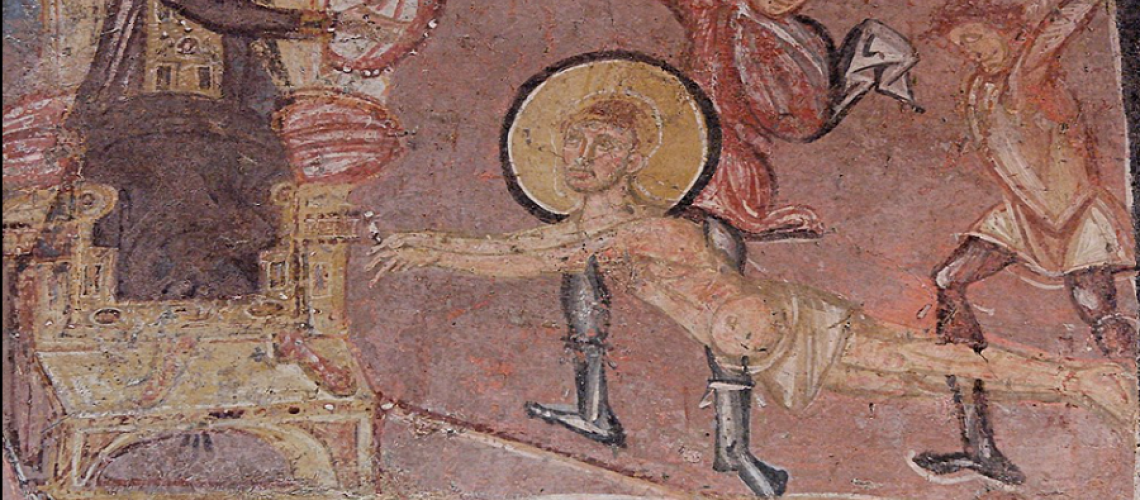
If we are going to embrace Christ and His call to share Him with the world, we will encounter persecution. Not only does Jesus promise this (“In the world you will have trouble”) but He teaches that it is a blessing (“blessed are they who are persecuted because of me”).
For some of us the persecution is somewhat subtle. Family or friends may snub us if we talk openly about our Catholic faith.
But for some, defending the faith has material consequences, like losing a business for not providing homosexual or transgender services. Some may even lose their jobs for not taking a mandatory shot. And some are attacked or arrested for counseling at abortuaries.
More and more, defending Christ will get you incarcerated or martyred. The issue isn’t whether persecution will come our way – rest assured, it will. The issue is how we respond to it.
For many Catholics, curiously, persecution seems to be coming from the Catholic hierarchy. Which brings us to Bishop Strickland and his removal from leading the Tyler diocese. Based on what has played out in the public sphere, my personal assessment is that Bishop Strickland has been a fine example of how to conduct ourselves in times of trial and persecution. Your assessment of Bishop Strickland in particular, and the current state of the Church in general, may be different. But there are spiritual lessons here nonetheless.
Bishop Strickland – A Public Face in Challenging Times
The current leadership of the Church has become increasingly intolerant to those of us who hold closely to sacred Tradition, synonymous with “the deposit of faith.”
First there was a sort of name-calling with Pope Francis’ description of “rigid” Catholics and Fr. Dominic Spadaro’s insinuation of conservative Catholics being part of an “ecumenism of hate.” Then came demotions and early acceptance of retirement of bishops and cardinals who did not share Pope Francis’ vision for the Church.
But now, with Bishop Strickland, comes the second removal of a sitting Bishop with little justification. (Bishop Daniel Fernández Torres from Puerto Rico was first.) Two issues seem to be at the heart of the matter. The first is that Bishop Strickland has publicly criticized the Pope (for example, his tweeting, “I reject his program of undermining the Deposit of Faith. Follow Jesus.”). The second is his cautious approach to implementing Pope Francis’ Latin Mass restrictions in “Traditionis Custodes” (read Bishops Strickland’s position on this and assess for yourself).
Some people might agree with the judgement of the hierarchy to remove Bishop Strickland. But even the liberal and dissident National Catholic Reporter disagreed with Pope Francis’ removal of Bishop Strickland from his Diocese. I would ask those who agree some questions. Where is the dialogue? Where is the celebration of diversity? And where is the accompaniment?
The Church hierarchy is increasingly promoting an agenda that is disturbingly akin to the values of the fallen world. Some in the hierarchy embrace transgenderism. Even more have no problem with homosexual behavior. Many recklessly call for government overreach in the name of a ginned-up climate crisis. Some pushed a dangerous and immoral “vaccine.” And far too many are cracking down on traditional liturgy and piety despite its fruits.
Devotion to Jesus and Our Blessed Mother
Bishop Strickland is being punished for not falling in line with that agenda. There is a word for that – persecution. Let’s look closer at illuminating aspects of Bishop Strickland’s approach to his situation.
To my ears, Bishop Strickland’s messages to the faithful have always focused on remaining steadfast in devotion to the Catholic Church and growing ever closer to our Eucharistic Lord and Blessed Mother, especially by praying the rosary and spending time in Eucharistic adoration.
Adoration and the Rosary are spiritually akin to taking a daily multivitamin, eating well, getting a good night’s sleep, and getting exercise. They are basic preventative care. They are much more than that, to be sure, but they certainly cure many spiritual ills. And they help us avoid errors, and keep us close to what is true.
A spiritual life grounded in relationship with Christ and our Blessed Mother is always mandatory. But such grounding is particularly important when we are discerning how to respond during times of persecution.
Devotion to Truth
Bishop Strickland has, on many occasions, declared it his duty to defend the truth (on occasion he has also described it as the “deposit of faith”).
We all have a sacred duty to defend the truth, because the truth is a Person (“I am the Way, the Truth, and the Life”). We must be deeply formed and convicted in Christ’s truth. Such formation and conviction is necessary so we can share it with others and respond properly if and when persecution comes our way.
Devotion to Jesus and our Blessed Mother will naturally lead us to desire Christ in the Truth that is revealed through His Church. This is what happens when you fall in love with someone – you want to know everything about them.
The Truth that we fall in love with is known, first and foremost, through our hard-won Catholic Tradition (aka the deposit of faith). But there are many in the Church who seem to want to change the Church’s traditional teaching of the Truth.
Doctrine and Truth
John Henry Newman, in his authoritative essay “The Development of Christian Doctrine,” distinguishes two types of change – development and corruption.
Newman likens the development of Church teaching to the growing of a seed into a tree – the doctrine deepens and expands. The corruption of Church teaching occurs when men attempt to turn it into something it is not (or do away with it all together).
We all have a duty to form ourselves with the great writings of the Saints as well as the Catechism. On a side note, we owe a tremendous debt of gratitude to Pope John Paul II for authorizing the compilation of the “Catechism of the Catholic Church” and authoring the “Theology of the Body.” Imagine where we would be now if we did not have those treasures as a “sure norm” for understanding and passing on the deposit of faith?
Pray for Your Persecutors – and Yourself
Jesus calls us to “pray for those who persecute you.” Which is exactly what He did, “Father forgive them, for they know not what they do.” In like manner, Bishop Strickland has repeatedly called on the faithful to pray for our Pope, Bishops, and Priests.
This is sublime prayer when done in the right spirit. We are imploring God for the highest and best things for people we are at odds with.
I humbly suggest that we pray not only for healing of the minds and hearts of those we disagree with, but also, “Lord, correct me where I am wrong, and remove all bitterness and rancor from my mind and heart.” And we are particularly well-served to join that prayer with the offering of some small sacrifice for God’s mercy on them and ourselves.
Serve Where You are and Where You are Sent
For each of us, our vocation is our primary mission field. For those called to family life, for example, that means serving our spouses and children and the various people and responsibilities God gives us in our state in life. But in a very practical way, it means being available to serve God in the exact details of the present moment.
Bishop Strickland consistently maintained that his priority was serving the Diocese of Tyler. But he gained a degree of national attention (and perhaps the ire of some in the hierarchy) by serving God in the present circumstances with his attendance at the 2018 Fall USCCB meeting. It was there that he voiced candidly and charitably to his brother bishops his concern that recent events, including the McCarrick scandal, revealed a problem in how the hierarchy was addressing homosexuality and transgenderism.
During that meeting he also stepped outside the hotel and led an impromptu Rosary. He did this at the request of a crowd gathered on the sidewalk. They witnessed and prayed for the bishops.
It is a more delicate matter to discern when God is calling us to step out of our ordinary role to serve in a more extraordinary way. An example of this is when Bishop Strickland joined in the Eucharist Procession in response to the LA Dodgers honoring the deeply disturbed Sisters of Perpetual Indulgence.
These types of decisions are exactly why we need to remain close to our Eucharistic Lord and Blessed Mother. Closeness helps us discern with confidence when God is calling us to serve beyond our ordinary circumstances.
“Die” Joyfully
Bishop Strickland is now in a time of transition. Presumably he is discerning where and how he will serve since being removed from leading the Tyler diocese.
He is reportedly on an extended silent retreat. This is an excellent example of what to do when we find ourselves in a time of unexpected change and are waiting on the Lord for direction.
Bishop Strickland has said he is prepared to lay down his life to serve our Lord. To one degree or another we’re all called to die for our faith; particularly death to self. Jesus tells us plainly, “Whoever wishes to come after me must deny himself, take up his cross, and follow me.
The key is to “die joyfully” (Bishop Strickland is consistently joyful in his public appearances).
In times of genuine persecution, we will certainly experience sorrow for the cause of the persecution. But sorrow is not our baseline, it is not the default disposition of our soul. As has been said, we are an Easter people, even if at times it seems we are mired in Good Friday.
Joy is a disposition of the will as much as anything. It is what we experience when our will has achieved its desired end. If we have a deep desire to share in Christ’s passion, then there will be a certain sort of joy even amid persecution. St. Ignatius of Antioch, for one, provides testimony to this.
Persecution and Union with Christ
Those are some observations that stand out to me from Bishop Strickland’s response to persecution. Ultimately the same practices that lead us into holiness (mental prayer, a Sacramental life, growing in virtue, conquering vice, serving our neighbor) are what will guide us in persecution, because it is all in the service of growing in relationship with Christ.
St. Alphonsus Liguori (one of the great contributors to our priceless Tradition) was no stranger to persecution, from within the Church and without. He offers a stunningly concise response to persecution, and all of life’s trials, “A soul who loves Jesus Christ desires to be treated the way Christ was treated; poor, despised and humiliated.”
But we know how the story ended for Christ. So whatever persecution may come our way, those united to Him will be transformed to a source of grace.


9 thoughts on “Embracing Our Inner Bishop Strickland”
Thanks for this article. I am in agreement regarding the treatment of Bishop Strickland and indeed many American Catholics in disagreement with Rome. If there was any kind of fair treatment or dialog with Bishop Strickland, I never saw it. Mr. Smith then ties it into the many difficulties of living in faith. That was well done. I also agree that we are entering tough times, as culture is infecting both scripture and tradition. Normal in Protestant denominations, but alarming in Catholicism.
I appreciate that non-Catholics are allowed to make comments on this site, apparently not comprehending the gist of the article. Evidenced by the acidic replies regarding Mr. Smith’s notes on climate and ‘vaccine’ issues. These mean-spirited comments are a window into the world of politics, medicine and climate that the Vatican is dancing with (the faithless are leading the dance). I am old enough to have seen climate emergencies ‘evolve’ over many decades, never ending and never given serious public scientific debate. Pointing out the fact that the Vatican approved a dangerous and immoral ‘vaccine’ is not a criticism of Mr. Smith’s perspective, but rather the proof of it.
Finally, regarding Climatologists and universal opinions: After consulting a team of Cryptozoologists, the universal opinion is that Bigfoot exists, though the oil industry hasn’t weighed in on it yet.
Pingback: VVEDNESDAY AFTERNOON EDITION • BigPulpit.com
“Many recklessly call for government overreach in the name of a ginned-up climate crisis. Some pushed a dangerous and immoral ‘vaccine.'”
In its attempts to discredit a vaccine of which the Vatican approves, this site has touted an ophthalmologist instead of an actual infectious disease expert, and a doctor (Immanuel) who believes that illness is caused by evil spirits entering us while we sleep.
And man-made global warming has been the universal opinion of climatologists for years. But the oil industry doesn’t like the idea.
Your post should be called “Embracing Our Inner Trump”. Because that is where your loyalty really lies.
I wondered if this author also wrote those ridiculous anti-vaccine articles. Curiously, his author profile does not list them… however, his article dated 9/13/2023 contains links to them. Looks like they were published under a second author profile “truth-for-health”.
cc: Just for the record, yes, CS did run an article featuring Dr. Gonnering, a Professor of Ophthalmology who is also a Researcher in computational analysis of health disparities and Complexity and Systems Sciences in healthcare and healthcare education, and Dr. Stella Immanuel, who successfully treated Covid patients with hydroxychloroquine. CS also ran an article quoting:
Professor Beda M. Stadler, PhD, former director of the Institute for Immunology at the University of Bern in Switzerland;
Dr. Mike Yeadon, former Vice President and a Chief Scientist of vaccine manufacturer Pfizer;
Dr. Peter McCullough, cardiologist and former vice chief of internal medicine at Baylor University Medical Center, and a professor at Texas A&M University;
Dr. Robert W. Malone, American physician and biochemist whose early work focused on mRNA technology, pharmaceuticals, and drug repurposing research;
Dr. Sucharit Bhakdi, MD, who has published over three hundred articles in the fields of immunology, bacteriology, virology, and parasitology, and received numerous awards and the Order of Merit of Rhineland-Palatinate;
Dr. Vladimir Zelenko, MD, Nobel Prize nominee and an advisor to several governments and published in top peer-reviewed journals;
Dr. Larry Corey, who oversees the National Institutes of Health,
and Dr. Pierre Kory, MD and Dr. Martin Kulldorff MD.
Such articles provided CS readers with positions and perspectives the mainstream media refused to acknowledge even existed.
And please stop repeating the left-wing lie that “man-made global warming has been the universal opinion of climatologists for years.” It’s fallacious statements like this that get comments deleted.
Steve Smith: Even determining who has the proper understanding of Scripture is a challenge. It would be those who are guided by the Spirit of Truth; but this requires us to know who is actually guided. We will know them by their fruits.
The best that we can do for ourselves is to be guided by the Spirit of Truth when doing our own inquiries; but this requires us to be properly instructed in how to be guided. If we are not, we will be in no better shape than the Protestants.
Hi Peter – you’re spot on about being guided by the Spirit of Truth – that comes directly from p81 of the Catechism: “And [Holy] Tradition transmits in its entirety the Word of God which has been entrusted to the apostles by Christ the Lord and the Holy Spirit. It transmits it to the successors of the apostles so that, enlightened by the Spirit of truth, they may faithfully preserve, expound and spread it abroad by their preaching.”
Paragraph 82 emphasizes that it is to the Church that the transmission and interpretation of scripture has been entrusted.
So “the best that we can do for ourselves when doing our own inquiries” is to ground those inquiries in the authoritative teaching of Tradition – then we’re on firm ground. This is why, for example, the Catechism is such a gift.
Speaking of gifts – Christmas blessings to you and yours – Steve
Dear Peter –
Thank you for your comment – and pointing out a foundational principle that I should have explicitly stated in the article. The primary purpose of Tradition is the proper understanding of Sacred Scripture. We are lost without God’s as revealed in His divine Word.
But we are also lost without the understanding of the divine Word as given to us through sacred Tradition. Exhibit A are the myriad Protestant heresies. All of which are steeped in cherry-picked and misinterpreted verses of scripture.
As Exhibit B I present “Fiducia Supplicans.” It is notably light on scripture references (and references to Tradition) – but heavy on Bergoglio citations – but there are some cherry-picked passages. Such as twisting St. Paul’s observation that God blessed us ‘while we were still sinners’ (Rom. 5:8) to justify blessing same-sex unions (I know, I know – they dance all around whether they are permitting the blessing persons or unions … which is exactly why that document is a spiritual/pastoral disaster in the making).
Scripture and Tradition – both indispensable. Just as we have two lungs – we need to be breathing in both each day.
Christmas blessings – Steve
Unlike Scripture, tradition is not as clearly defined. How much of it is corruption of doctrine, and how much is true development? How do we decide? Is it sufficient to form ourselves with the great writings of the Saints as well as the Catechism? I think that we should always include Scripture, which needs to regulate all Catholic teaching, and our own spiritual discernment.