

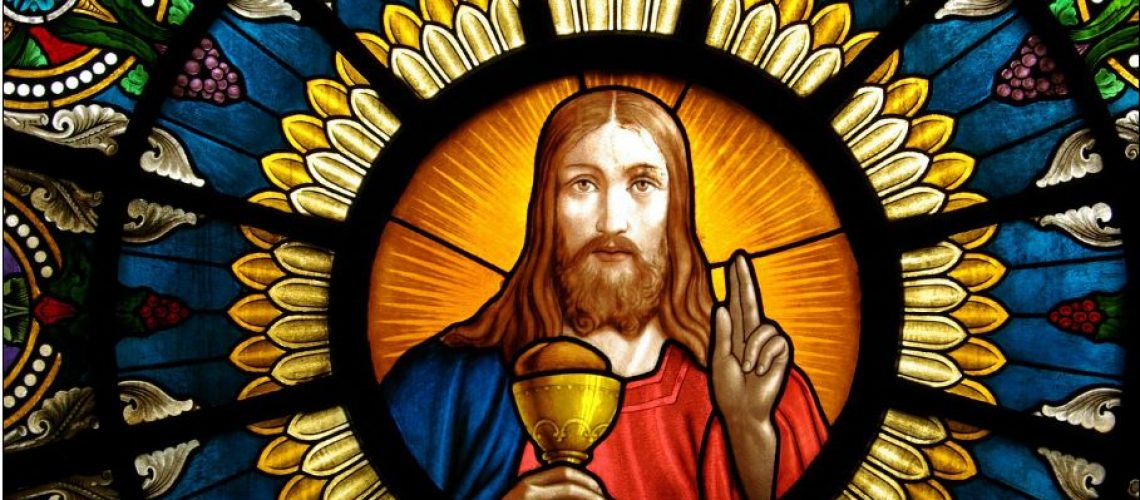
The word dogma upsets some people. It does so because it appears to threaten the spirit of the age (which, of course, is a kind of dogmatic reaction in itself).
A dictionary definition states that dogma is:
1: a: something held as an established opinion
especially: a definite authoritative tenet
b: a code of such tenets: pedagogical dogma
c: a point of view or tenet put forth as authoritative without adequate grounds
2: a doctrine or body of doctrines concerning faith or morals formally stated and
authoritatively proclaimed by a church
Our Catholic dogma, however, is more than just established opinion. It is divinely revealed truth. These truths include such things as definitive statements issued by the great ecumenical councils. They include the following:
- Ephesus: Mary is the Mother of God
- Chalcedon: Jesus is true man, with a human body and a human soul
- Constantinople: Jesus is true God and has a human will and a divine will
Science too has dogmas, especially those that meet the 1-a definition:
- Nothing can exceed the speed of light
- Gödel’s incompleteness theorems
- The conservation of mass/energy
The difference between dogma and doctrine
To understand this we need to look at the magisterium. In the Church magisterium has a few different meanings. It refers to the teaching authority of the Church, given to the Church by Christ. It is also the official body of teaching of the Church.
There are three levels of authoritative teachings:
- Extraordinary and universal teaching of the Church
- Ordinary and universal teaching of the Church
- Ordinary teaching of the Church
The first two are considered infallible and require the full assent of our faith; the third is considered authoritative but not infallible. However, these teachings still require our religious assent and submission.
Teachings in all three categories are doctrine, but only divinely revealed truths are dogma. Doctrine can possibly evolve; dogma is fixed and finished (infallible and irreformable).
The terms doctrine and dogma are sometimes used as synonyms and were even used interchangeably in the early Church. But over time these terms have differentiated. In our times, dogma can be thought of as doctrine which has been established as authoritatively and divinely revealed. As the “Catechism of the Catholic Church” says:
The Church’s Magisterium exercises the authority it holds from Christ to the fullest extent when it defines dogmas, that is, when it proposes truths contained in divine Revelation or also when it proposes in a definitive way truths having a necessary connection with them (CCC 88).
Opposed To The Spirit Of The Age
The very concept of authoritative and established truth is definitely opposed to the spirit of our times. The spirit of our times is fractious, divisive, and, paradoxically proclaims itself to be uniformly opposed to uniformity. This means that the word dogma has come in for some abuse in recent years. Accusing someone of “dogmatic opposition” is close to an accusation of arguing in bad faith. It carries overtones of bigotry and unthinking prejudice.
Never mind that actual dogma arises from years – centuries! – of thought and consideration; the rhetorical accusation carries a large caliber emotional bullet.
And this is evidence of the persistence of Original Sin in our lives and in the world around us.
“You’re Not The Boss Of Me!”
My grandparents liked to tell of a time when one of my cousins – about 4 years old at the time – responded to their attempt to prohibit some activity by saying firmly “You’re not the boss of me.” (They never said so, but my own experience with my grandmother makes me suspect that my cousin was quickly persuaded otherwise.)
Over the years, though, this has become my go-to approach to understanding the reality of Original Sin. Whether it is a 55 MPH speed limit (a nationwide law that was probably even more widely disobeyed than Prohibition), a ban on chewing gum in class, or an injunction to avoid the fruit of a particular tree, humanity resents authority.
Recently the City Council where I lived passed a ban on something that I never much thought about. But their ban on it almost made me want to try out the forbidden activity. (I don’t remember what it was now. This is probably just as well, because if I did I would also probably be battling – or surrendering to – the temptation to prove that they are not the boss of me.)
The forbidden tree was the Tree of Knowledge of Good and Evil. Some say this was knowledge in the biblical, generative sense. Regardless, it led to disaster. It led us to the illusion that we could authoritatively decide for ourselves, as individuals, what is right and wrong, good or evil, bad or blessed.
From this flawed and incorrect presumption flows all the misery, degradation, wickedness, and sorrow of human history.
Why The Hackles Raise
And this is why the hackles rise when we use the term dogma (and sometimes even the less weighty term doctrine). We all still have an inner 4-year-old stamping his foot in defiance of authority, determined that nobody else will be our boss.
And yet, when the substance of our discomfort is examined closely, there is usually very little actual reason for it. Are we really unwilling to admit that Mary is the mother of God, or that Jesus is both true man and true God?
If we are unwilling to embrace those statements as true, maybe we should consider joining a community that does not hold those beliefs. If we do, we will surely find that they have beliefs that are just as definitive for their community. We will be forced to accept or reject these beliefs if we are truly to belong. But is that not part of the price of belonging to a group? To hold in common with them the things they find definitive?
Our hackles do not rise from the dispassionate reality of what membership in a group requires. They arise from our sinful natures that are too often invested in doing precisely what we have been told we cannot do.
Fences Exist For A Reason
I cannot think of a time that I have walked or driven by an elementary school which did not have a playground surrounded by a fence. This is mere common sense. Children at play are not aware of traffic passing by. They also do not notice strangers who are excluded by a fence but who might wander among the children unnoticed for some time if the effort of climbing a fence were not so noticeable.
Dogma and doctrine are the fences for our lives, keeping us inside the playground of orthodoxy. The adventurous and rebellious who want to leave the safety of the protected grounds will always exist. The protected land, however, is always there to return to . . . and always welcoming to those who return.
Prayer
Lord, grant us the grace of knowing the doctrine and dogma of Mother Church as a guide and a hedge of defense, and giving us comfort and consolation when we strive to live within those bounds. Defend us from the spirit of pure rebellion, and grant that when we question and test we do so with the desire to learn and explore and strengthen our foundations within the mighty structure of our home in this life, the community of those who believe in and follow the Word made flesh.


23 thoughts on “Dogma Doesn’t Bite”
Thank you so much for your article Sir Mark! It enlightens me of the role of doctrines and dogma in our lives as Catholic Christians. God bless!
Thank you!
MB
I would suggest that the problem with the ‘church’ , speaking as one who left that institution and now counts himself as a none and never been happier, is that dogma nor doctrine for that matter, has no ‘bite’ at all! That is to say that such human intellectual constructs of theology no longer speak to either reason, heart or soul. And lack neither the authority or credibility that should rightly come from God. The fact that an institutional ‘orthodoxy’ or ‘magisterium’ has proclaimed and demands adherence to such ideas no longer hold any moral or spiritual weight and accomplishes nothing! And that bodes ill for the future of the church.
I agree with what Dr John Bergsma wrote for Trinity Sunday Year A, “Pope Emeritus Benedict XVI explained that dogmas are nothing other than authoritative interpretations of Scripture. Another way to look at dogma would be as truths one must assume in order to make sense of all Scriptural data. The doctrine of the Trinity helps us make sense of this threefold blessing in 2 Corinthians 13 and many other passages as well.”
Pingback: FRIDAY EDITION – Big Pulpit
Euclid’s axioms and common notions are the equivalent of dogma; Lobachevsky made substitutions and created a whole new geometry. The assertion that information cannot be transmitted faster than the speed of light is, for now, scientific dogma.
Newton’s general formula calculation for gravitational attraction,:
F=G {{m_{1}m_{2}}{r^{2}}},} is also scientific dogma, and it is unlikely to be overturned any time soon.
Both fit the dictionary definition of dogma. Saying that science does not have dogma is a rhetorical effort to avoid facing the the reality that the intellectual discipline of serious theology is no less substantial and exacting than the discipline of physics or mathematics, requiring both disciplined formal thought and substantial education–at least auto-didactic if not formal.
Original Sin is listed as a part of a number of dogmas, but is not listed as an item of dogma, at least that I have found. (see this list as a starting point:
https://cc.catechismclass.com/files/pdf/The_255_Dogmas_of_the_Catholic_Church.pdf )
I agree with Mr. Aiello that Original Sin is a fundamental reality that we must account for and deal with–like gravity itself. The Church does so both doctrinally and dogmatically.
Rejecting the idea of Original Sin is Pelagianism, a heresy long since disposed of intellectually, but which springs up anew with each generation of wishful-thinking bootstrap perfectionists and mystical humanists.
Dogma is damaging only to those without the spiritual and intellectual maturity to work toward obedience to the Magisterium of the Church in their quest to understand it well enough to suggest enhancements to it.
Finally, for choice to have moral meaning it must be made freely with an understanding of consequences. I agree that one should follow his conscience…but the duty to have a well informed conscience (and to seek the counsel or authority of the Church in the event that there is some doubt in a particular case as the to maturity or fidelity of one’s conscience) is prior to acting with such freedom.
In order to have a well-formed conscience, we need to have spiritual discernment from the Holy Spirit. If we are lacking in it, I think that we could end up more confused if we seek guidance from others in the Church who may or may not even have it. How will we even know if they have it any more than we do? If we have spiritual discernment, then we need to use it. If not, we need to figure out how to get it for ourselves. Scripture is always a good place to start looking.
I did not specify but will–seek aid from a priest, a recognized spiritual director, or a Religious who does that sort of work.
I DO NOT recommend seeking guidance from “others” in a general sense. You should have some reason to think they know whereof they speak.
As for myself, I have 3 years of formal study in theology, biblical exegesis, and ecclesiology through a post-graduate extension course from the Seminary of the South at Suwanee, and formal education in the classics from St. John’s College (SF). I also studied anthropology at the University of Texas, Permian Basin. People can–and surely do–decide for themselves whether I know what I am talking about; obviously people’s mileage appears to differ on this.
Rejecting the idea of Original Sin is Pelagianism, a heresy long since disposed of intellectually, but which springs up anew with each generation of wishful-thinking bootstrap perfectionists and mystical humanists.
It will always spring up anew because the CC itself has flaws in its theology – see Limbo, perpetrated for years at untold anguish to innumerable parents, but now ‘disposed’ It won’t go away because you can’t weed out its kernel of truth that, despite a ‘perfectionist’ Council 1600 years ago, is present. The genealogy of Jesus in Luke 3:23 is allegorical because Adam never existed in reality and will not be validated in a future where science ends up over turning itself in a terminal pursuit for the TOE. No Adam, no OS, just ever flawed humans dealing with mortality; which makes all of us ( even the best theologians) a little crazy, all of the time.
In Vatican II’s Dignitatis Humanae 2 and 3, the Council speaks of psychological freedom and immunity from external coercion, and that man is bound to follow his conscience; therefore, it follows that he is not to be forced to act in a manner contrary to his conscience; nor, on the other hand, is he to be restrained from acting in accordance with his conscience, especially in matters religious.
Doesn’t this affect the way that we respond to Church teachings and dogma?
In Acts 15:29, the letter to the Gentiles said that they would do well in adhering to the instructions from the Council of Jerusalem. This does not sound like there was required assent or that there was a price for belonging to the Christian group at that time.
Paul’s letters imply that there are consequences for departing from received teachings, but the references are admittedly vague.
It took time for imagination and the rebellious human spirit to really begin to work on creating heresies and nonsense around the Gospel…but it happened then and continues today.
Science doesn’t have dogmas.
Science does claim that there is settled science which, at times, gets unsettled.
Yes that’s a good way to put it.
It would seem that ‘original sin’ is more theory than doctrine.
Original sin is neither theory nor dogma.
It is the reality of the human weakness that we all have to deal with.
The most damaging dogma of all.
Chesterton famously said that Original Sin is the only dogma for which no proofs are necessary, for the proof us so obvious all around us in every man we meet and most of all in ourselves. Denying the reality of Original Sin is even more blatantly contrary to observed facts than the recent fad for claiming to be unable to say what a woman is.
If Chesterton could look at a newborn baby and see evidence of sin . . . well . . . I’m glad he was never a parent.
Capt. Crisis, if you ever heard a 6-month old baby squall out of sheer rage and pique and even spite, then you would know that Original Sin is alive and unwell even in the youngest of us.
Original Sin is, simply, radical moral autonomy, the illusion that we can decide–even create–right and wrong for ourselves. The “knowledge” in the tree of knowledge of good and evil is generative knowledge, of the biblical sort–to “know” morality and thereby generate one’s own morals.
Never works out well, in the long run.
By “original sin” you don’t mean “original” and you don’t mean “sin”.
Or if you do . . . a parent who thinks a 6-month-old baby is being sinful, should not be a parent.
Capt. Crisis, my daughter is now 34, and would likely disagree with you as to my qualifications as a parent–as wold the dozen or so young adults who have held me in their lives as a parental supplement or substitute over the years.
I am intrigued by your apparent claim to telepathy, though, in that you feel capable of telling me what I do and do not mean.
Perhaps you should write your own columns, given your many insights?
CAPTCRISIS: There are sin actions, and then there is the state of sin even prior to sin action which is our human weakness. The actions do not cause the state of sin. The actions result from it. The baby eventually finds that out.