
Prayer might seem simple, yet it actually is something rather mysterious, serving as a bridge between two worlds. Sometimes prayer is easy, other times very difficult. There are moments when I need to pray but can’t get started; that’s when I seek help, first by asking for the grace to pray. Usually, God directs me towards a sacramental for additional assistance. This article is focused on one sacramental, the Stations of the Cross, specifically Stations # 7, #8, #9, and #10. I often use the Stations of the Cross as a guide for deeper, more meaningful prayer.
Station 7: Jesus Falls the Second Time
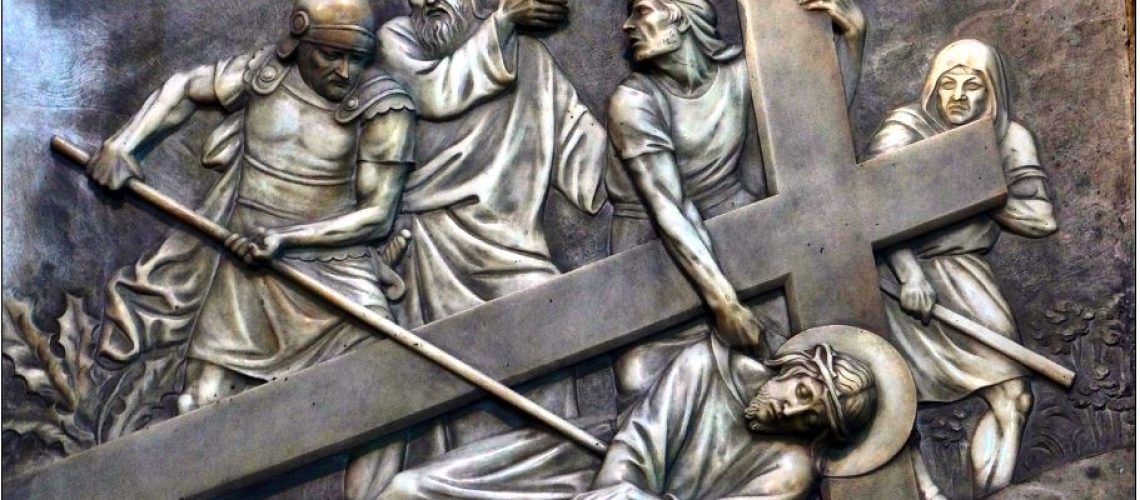
What do I see? No pity and no compassion are coming from the Roman soldier holding on to the cross with one hand and pointing ahead with the other, as if he were saying to Jesus: “Get up and keep moving.” Jesus looks helpless with the weight of the cross upon his back. A second person, not a soldier, appears very silent and passive, almost afraid as he grabs the cross with both hands and discreetly lifts it assisting our Lord.
What’s going on with Jesus as he kneels under his cross? Is He discouraged? I don’t think so.
Is He defeated? Not at all. I believe that our Lord was suffering in his human nature just as you or I would suffer if we were carrying that cross. In His will and His resolve, He remained strong and silent, determined to accomplish His task.
As I look upon the image of Christ, I am trying to better understand why he is burdened with my cross; it brings to mind more questions than answers. I am referring to the cross that our Lord carried as my cross because that the cross represents my sins. And he, our Lord, is taking my sins to Calvary purified through his bleeding body as an offering to God the Father. It is a sacrifice offered on the altar of the cross; a sacrifice for all my sins, redeeming me, cleansing me, through the blood of Jesus.
Questions come to mind:
If I had sinned less, would Christ have suffered less? If every man and woman had sinned less, would Jesus have suffered less? If none ever sinned going back to Adam and Eve, would Jesus still be carrying a cross? However, that is not the reality; that’s not how it is. We have sinned, we continue to sin, and all sin causes suffering. Suffering for Jesus and suffering in the world today.
Station # 8: Jesus Encounters the “Daughters of Jerusalem”
Jesus is standing straight and strong, calmly bearing the weight of the cross on his shoulder as he addresses the women and a child. I don’t see any soldiers, and He seems to be at ease in his walk. What did the women say to Him? We really don’t know but we know from His response that they showed compassion and sorrow:
A large crowd of people followed Jesus, including many women who mourned and lamented him. Jesus turned to them and said, Daughters of Jerusalem, do not weep for me; weep instead for yourselves and for your children, for indeed, the days are coming when people will say, ‘Blessed are the barren, the wombs that never bore and the breasts that never nursed.’ At that time people will say to the mountains, ‘Fall upon us!’ and to the hills, ‘Cover us!’ (Luke 23: 27-30).
His response was most certainly unexpected; some may say that He was rude, ungrateful, and even inconsiderate in his sharp and cutting response to the daughters of Jerusalem.
Jesus doesn’t want or need to be comforted; He had chosen the cross, and it is the necessary path that only he can walk. Very few people are able to understand or accept that He was the sacrifice for our sins and the cross was His altar. They were the holy women, yet they did not understand that the cross was the cost for their redemption. If there is any sorrow, it should be sorrow for their sins; if we are trying to understand Jesus’ suffering, then let’s be honest and admit that we have put him there; we have scourged him at the pillar, and we have handed him the heavy cross. The question that comes to mind is: “Have we stopped doing this”?
Station #9: Jesus Falls the Third Time
At the Ninth Station, I see Jesus lying flat on the ground as if he had just collapsed from exhaustion. Another person holds his cross, keeping it from falling upon him. A second man, a soldier, , is pulling on a cord or rope tied around Jesus’ waist in an attempt to pull him up. There is no time to rest, no pity, no sorrow, no compassion, only a sense of duty imposed on Jesus to bring him closer to Calvary.
Can Jesus get up? Will He be able to complete his mission? Perhaps he prayed, not for a miracle, nor for a band of angels to carry him to Calvary, which was entirely possible. Because he suffered as you or I would have suffered, He endured His passion and death completely in His human nature; this was the debt that had to be paid to balance God’s justice and mercy. The price that had to be paid was God sacrificing himself for our redemption.
Station # 10: Jesus is Stripped of His Garments
At this station, I see two men, probably soldiers, removing Jesus’ tunic. Perhaps Jesus’ clothing had monetary value because later, at the foot of the cross, the Roman guard cast lots for it fulfilling one of the Old Testament Messianic prophecies.
When the soldiers had finished crucifying Jesus, they took his clothing and divided it into four shares, one for each soldier. His undergarment was seamless, woven in one piece from neck to hem; So they said to one another, ‘Instead of tearing it, let’s throw dice to decide who is to have it.’ In this way the words of scripture were fulfilled: ‘they divide my garments among them and cast lots for my clothes.’ [psalms 22:18], This is exactly what the soldiers did (John 19:23-24).
However, that’s not the reason why his clothing was removed. It was removed to inflict emotional pain on the victim, to add shame, disgrace, and dishonor to the already disfigured and suffering victim on the cross.
Meditating on this image brings to mind the realization that this event in the life of our savior can be used as a petition and offering to divine judgment to bring back a sense of modesty in dress and speech in our culture today, to bring back that sense of right and wrong in the way some of us, our children or grandchildren present themselves to the world, to bring back that sense of shame, dishonor, and disgrace that goes with inappropriate dress or speech which has become all too prevalent and acceptable in our society today.
Endnotes
The term “sacramental as a prayer guide,” refers to using sacred scripture, the holy rosary, prayer in the presence of Jesus in the Most Blessed Sacrament, group prayer, Divine Mercy prayer, the Stations of the Cross, religious statues, candles, or almost anything Holy which complements our prayer life.
This article is the third meditation from the Stations of the Cross. The first was published May 26, 2021, titled: “Our Creator on the Cross.” The second was published July 4, 2021, titled: “Meditations on the Passion of Christ: The Stations.”


[…] True, The Good, & The Beautiful: Do My Sins Cause Suffering? – Richard Auciello at Catholic Stand Which Donation Ask is Best – Soft or Hard? – Brice […]