

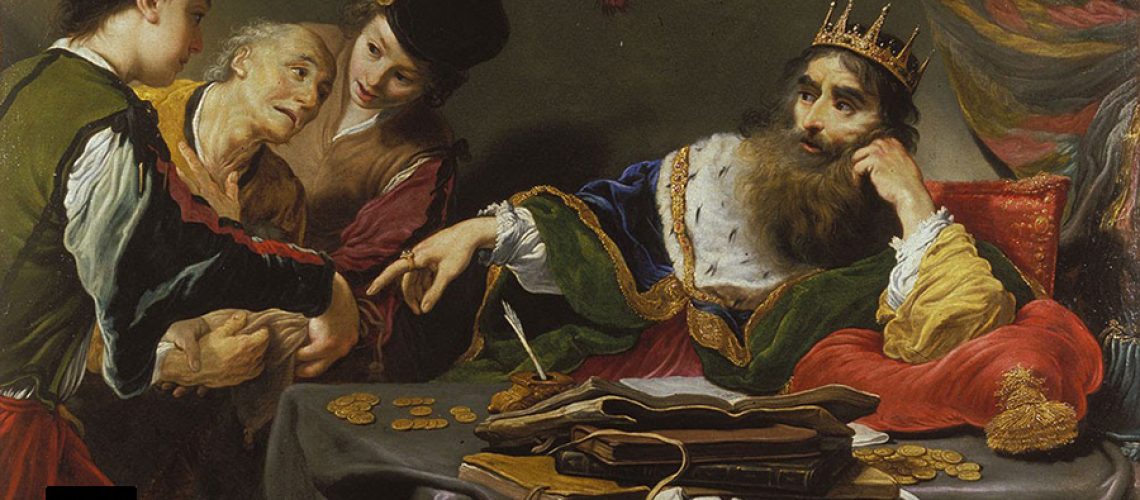
Forgiveness, both extended and received, is at the heart of the Lord’s Prayer and the Gospel message itself. We ask God’s forgiveness while forgiving others in the continuum of reconciliation that exists within agape love. The giving and receiving of forgiveness in, with, and through Christ cannot be bracketed if we are to understand the dynamic that is inherent in this powerful expression of the Paschal Mystery.
Jesus, as we have come to know, had the power to break free from the cross and save himself while retaliating with devastating force against his adversaries. Instead, he prayed for his accusers and forgave them. The divine power of forgiveness transcends what can be readily apprehended in the temporal realm and is only available to us by God’s grace. The “closed loop” of forgiveness involves giving and receiving in an uninterrupted flow. In the Parable of the Unforgiving Servant, Jesus explains how the circle of forgiveness must remain unbroken:
Then Peter approaching asked him, “Lord, if my brother sins against me, how often must I forgive him? As many as seven times?” Jesus answered, “I say to you, not seven times but seventy-seven times. That is why the kingdom of heaven may be likened to a king who decided to settle accounts with his servants. When he began the accounting, a debtor was brought before him who owed him a huge amount. Since he had no way of paying it back, his master ordered him to be sold, along with his wife, his children, and all his property, in payment of the debt. At that, the servant fell down, did him homage, and said, ‘Be patient with me, and I will pay you back in full.’ Moved with compassion the master of that servant let him go and forgave him the loan. When that servant had left, he found one of his fellow servants who owed him a much smaller amount. He seized him and started to choke him, demanding, ‘Pay back what you owe.’ Falling to his knees, his fellow servant begged him, ‘Be patient with me, and I will pay you back.’ But he refused. Instead, he had him put in prison until he paid back the debt. Now when his fellow servants saw what had happened, they were deeply disturbed, and went to their master and reported the whole affair. His master summoned him and said to him, ‘You wicked servant! I forgave you your entire debt because you begged me to. Should you not have had pity on your fellow servant, as I had pity on you?’ Then in anger his master handed him over to the torturers until he should pay back the whole debt. So will my heavenly Father do to you, unless each of you forgives his brother from his heart.” (Matthew 18:21-35)
It has been said that withholding forgiveness and holding a grudge is like drinking poison to hurt someone else. The power that Jesus extended from the cross by forgiving his persecutors is the ultimate example of divine love in action and the purest expression of agape love on Earth. The suffering, death, and resurrection of Christ that is celebrated at every Mass is bound up in the death to self-will, and the rising of new life in the Spirit. It is through our participation in the Paschal Mystery that we bear the good fruit Jesus promises in our lives.
There is a cost involved when it comes to dying to the harsh dictates of self-love. Loving life as it pertains to the good things given to us for building up the Kingdom is good and holy while loving life as it pertains to the riches of this world will result in great loss. Jesus explains in the Gospel of John:
Amen, amen, I say to you, unless a grain of wheat falls to the ground and dies, it remains just a grain of wheat; but if it dies, it produces much fruit. Whoever loves his life loses it, and whoever hates his life in this world will preserve it for eternal life. Whoever serves me must follow me, and where I am, there also will my servant be. The Father will honor whoever serves me. (John 12:24-26)
Let us pray for the humility to ask God’s forgiveness, and the grace to extend that forgiveness to others within the continuum of divine love and mercy.





8 thoughts on “The Divine Continuum of Repentance and Forgiveness”
We need to stop theologizing our way around what the Scriptural text actually says. It says “brothers” both before and at the end of the parable. That word “brothers” means something in the New Testament; we must not supply a preferred meaning and forget the original intent. And the fellow-servants in the parable really do represent contrite fellow Christians. It’s not me who is (deliberately) missing the point here.
The word “brothers” in Scripture can mean other believers, just as it can mean kinsmen. But it can also refer to other members of the human race. Steve Shirely (a Christian but not a Catholic) provides some perspective on this at his website Jesus Alive — https://jesusalive.cc/unbelievers-called-christians-in-bible/.
Pingback: Remembering the Humility of Pope Benedict XVI, What Will You Leave Behind to Follow Jesus, and More Great Links!| National Catholic Register - My Catholic Country
Pingback: Remembering the Humility of Pope Benedict XVI, What Will You Leave Behind to Follow Jesus, and More Great Links! - JP2 Catholic Radio
Pingback: FRIDAY AFTERNOON EDITION • BigPulpit.com
Can you elaborate on the relationship between repentance and forgiveness within the context of the divine continuum? Greeting : Telkom University
The parable is about the forgiveness due to repentant fellow-disciples. The fellow servants of the parable represent fellow Christians who acknowledge their debts and intend to make good on them. Too often, we use this passage to invent an all-purpose principle of universal forgiveness due to everybody regardless of circumstances. We need to pay more attention to what the Scriptural text actually says: “brothers”, not “others”.
G. Poulin, with all due respect, I think you might have missed the point…
When Jesus said “Father forgive them, for they know not what they do” – just before He drew His final breath on the cross, He obviously did not exclude anyone. “They” covers us all – not just brothers as you have pointed out…
In “claiming” ignorance of our actions (all of us), Jesus opened up a flood tide of mercy beyond anything we puny humans can possibly comprehend. When we do the same for others, claiming ignorance for the sinful actions committed against us, we carry on and pass on that very same mercy to others.
However, we must first “receive” that mercy, and it is ONLY in being mindful of our own sins (and dire need of mercy) that we are “able” to do so.