

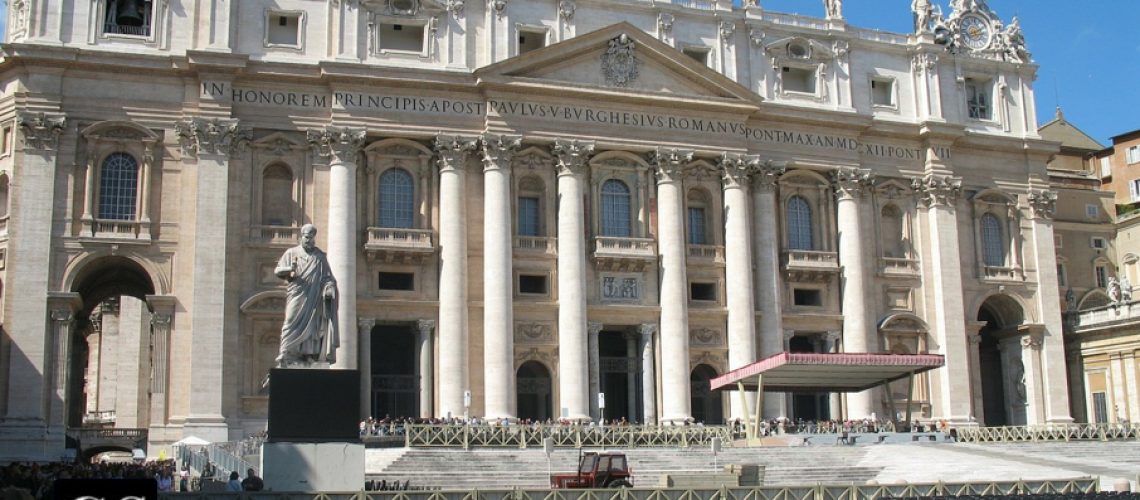
Some people say that:
the Modernist heresy triumphed over eternal Rome at Vatican II. (One Hundred Years of Modernism)
Comments like that raise a question about whether, and to what extent, Vatican II accepted Modernism, and thus committed itself to its tenets.
To explore that question we will take Pope Pius X’s 1907 encyclical Pascendi Dominici Gregis as a description of what constitutes Modernism. This is because the 15,000 words of that Latin document (21,000 words in English translation) represent one of the most detailed and thorough expositions of what the Church meant by “Modernism.”
1. Agnosticism
In Pascendi Pope Pius X characterized Modernism as starting from a (Kantian) principle of agnosticism, which he summed up as claiming that:
reason is confined entirely within the field of phenomena, that is to say, to things that are perceptible to the senses… it has no right and no power to transgress these limits. (Pascendi, 6)
Limiting reason had practical implications for theology. It led Modernists to deny that God can be known by natural reason (i.e., by natural theology). That is a conclusion which conflicted with the teaching of Vatican I.
Vatican II rejected that Modernist viewpoint. It explicitly cited and endorsed the teaching of Vatican I. Dei Verbum stated:
As a sacred synod has affirmed, God… can be known with certainty from created reality by the light of human reason. (DV, 6)
Modernists also drew other theological conclusions from their principle of agnosticism. For example, they denied that it was possible to know that Christ instituted the Church (Pascendi, 20).
Vatican II directly contradicted that Modernist claim. Lumen Gentium stated:
This Sacred Council, following closely in the footsteps of the First Vatican Council… teaches and declares that Jesus Christ… established His holy Church. (LG, 18)
2. Atheistic Interpretation
In Pascendi Pope Pius X also stated that Modernism moved from its principle of agnosticism to a principle of atheistic interpretation. He said:
Starting from ignorance as to whether God has in fact intervened in the history of the human race… [Modernists] proceed… to ignore God altogether, as if He really had not intervened. (Pascendi, 6)
That atheistic approach led Modernists to deny the reality of supernatural acts in the Bible (such as miracles). It also led them to deny that God had acted in history to disclose a Revelation.
Vatican II rejected those Modernist ideas and clearly affirmed that God has acted in history. Dei Verbum stated:
This plan of revelation is realized by deeds and words…; the deeds wrought by God in the history of salvation manifest and confirm the teaching and realities signified by the words. (DV, 2)
Another consequence of the principle of atheistic interpretation is that Modernists denied the historical truth of the Gospels. They said that the Early Christians had an enormous esteem for Jesus which led them to “transfigure” and “disfigure” history by inventing fantastic (and miraculous) stories to show how highly they esteemed Jesus (Pascendi, 9).
Vatican II rejected that Modernist attack upon the historicity of the Gospels. Dei Verbum stated:
The four Gospels… whose historical character the Church unhesitatingly asserts, faithfully hand on what Jesus Christ… really did and taught… They… [tell] us the honest truth about Jesus. (DV, 19)
Another Modernist conclusion which followed from the principle of atheistic interpretation, was a distinction between the “Jesus of history” and the “Christ of faith” (Pascendi, 30). That distinction led Modernists to deny the divinity of Jesus. Pope Pius X described their position as claiming that:
In the person of Christ… whatever there is in His history suggestive of the divine, must be rejected. (Pascendi, 9)
Vatican II rejected that Modernist attack upon the divinity of Jesus. Lumen Gentium illustrated this point when it stated:
Christ Jesus, though He was by nature God… (LG, 8)
3. Immanence
Due to the principle of agnosticism and the principle of atheistic interpretation, Modernists believed in a principle of theological immanence. That principle claimed that Revelation and Faith can only exist in the innermost recesses of the human heart or mind (Pascendi, 19).
This perspective led Modernists to a subjectivist view of faith and revelation, viewing it as a private experience. Pius X described their position as claiming that:
Faith is a ‘sentiment’ seeking God… Modernism finds in this sentiment not faith only, but [also] … revelation. (Pascendi, 7–8)
In the religious sentiment one must recognise a kind of intuition of the heart which puts man in immediate contact with the very reality of God. (Pascendi, 14)
The fundamental problem in this model of faith is illustrated particularly clearly in the 1910 Anti-Modernist oath. That oath was worded carefully to exclude Modernism, and so it stated:
I… confess that faith is not a blind sentiment of religion welling up from the depths of the subconscious… but faith is a genuine assent of the intellect. (Oath Against Modernism)
The wording of the oath rejected the Modernism model of faith by insisting that faith is an “assent of the intellect.” Vatican II followed that same model of faith. Dei Verbum stated:
The obedience of faith… is to be given to God… offering the full submission of intellect and will… freely assenting to the truth revealed by Him. (DV, 5)
4. Evolutionist Thinking
Pope Pius X described Modernism as including what he called “evolutionist thinking.” He said that:
it is quite clear that the criticism [which] we are concerned with is an agnostic, immanentist, and evolutionist criticism. (Pascendi, 34)
This is because Modernism viewed religious ideas as simply expressions of a “common consciousness” (Pascendi, 21). That “common consciousness” evolves from generation to generation, as people’s views change over time. And so religious ideas must also change and evolve over time. That meant that Modernism was claiming (in the words of Pius X) that:
To the laws of evolution everything is subject – dogma, Church, worship, the Books we revere as sacred, even faith itself. (Pascendi, 26)
Vatican II rejected the idea that all religious ideas can evolve and change. Lumen Gentium insisted that there were “irreformable” Church teachings. It said:
Therefore… [Papal] definitions… are justly styled irreformable. (LG, 25)
Modernists also concluded that the Church’s constitution should evolve, and that it should move away from an obsolete model of autocracy. Pius X described them as saying:
In past times it was a common error that authority came to the Church… directly from God… But this conception had now grown obsolete. (Pascendi, 23)
Some people might argue that Vatican II’s approval of collegiality (Lumen Gentium, 22) is effectively a changing of a previously obsolete model of Church governance. But the collegiality approved by Vatican II is not replacing a previous teaching which (in the words of the Modernists) “has now grown obsolete.” On the contrary, Vatican II reaffirmed the teaching of Vatican I and the two Councils are logically consistent on the matter of Church governance. (For details see “Does Vatican II’s Collegiality Conflict with Vatican I’s Papal Supremacy?”).
Modernists also concluded that there should be an evolution towards a separation of Church and State. Pius X described their position as claiming that:
every Catholic, from the fact that he is also a citizen, has the right and the duty to work for the common good in the way he thinks best, without… paying any heed to… (the Church’s) wishes. (Pascendi, 24)
That Modernist viewpoint is a version of Liberalism. However, Vatican II rejected Liberalism. (For details see “Did Vatican II Accept Liberalism?”). We can see that rejection of Liberalism in the following words of Gaudium et Spes:
Nor… are they any less wide of the mark who…imagine [that] they can plunge themselves into earthly affairs in such a way as to imply that these are altogether divorced from the religious life. This [view]… deserves to be counted among the more serious errors of our age. (GS, 43)
5. Symbolism
When Modernists combined the principle of agnosticism, the principle of atheistic interpretation and the principle of immanence, they ended up with a radically subjective view of religion. Truth became whatever people found meaningful in their own immanent subjective experiences. Pius X summed up the Modernist perspective as the claim that:
life has its own truth and its own logic. (Pascendi, 36)
If people have their own truth, and that truth can clash with Church teaching, then the Modernists concluded that all Church teaching must be fallible. As Pius X put it:
Hence it is quite impossible to maintain that… [dogmas] express absolute truth: for, in so far as they are symbols, they are the images of truth, and so must be adapted to the religious sentiment. (Pascendi, 13)
Even though the Modernists thought that Church teaching was fallible, and that it needed to be regularly changed, they also recognized that people could become attached (sentimentally) to the wording of creeds and dogmas. So, the Modernists viewed the words as having a symbolic role. They thought that Christians can stick with their ancient formulas of faith, but if the words themselves are not going to change, then the meaning of those symbolic words must be constantly changed, to keep Church teaching up to date with the ever-changing truth within people’s subjective feelings.
Vatican I rejected that view in 1870, when it stated:
That meaning of the sacred dogmas is ever to be maintained which has once been declared by holy mother church. (Dei Filius, 4.14)
Vatican II aligned itself with the teaching of Vatican I, especially when Lumen Gentium stated that the Council was:
following faithfully the teaching of previous councils. (LG, 1)
From their theory of symbolism, the Modernists also concluded that all religions must be largely saying the same, as they are just using different sets of (symbolic) words to express what must be essentially the same immanent and subjective experience of God. And the implication of that is, as Pius X put it, that:
every religion, even that of paganism, must be held to be true. (Pascendi, 14)
Nor is the Catholic religion an exception; it is quite on a level with the rest. (Pascendi, 10)
Vatican II completely rejected those Modernist conclusions. It explicitly insisted upon the uniqueness and necessity of Catholicism. Lumen Gentium stated:
This Sacred Council… teaches that the Church… is necessary for salvation. Christ… is the one Mediator and the unique way of salvation. (LG, 14)
6 Rejection of Scholasticism
A key feature of Modernism was its antagonism towards the Church’s traditional scholastic philosophy. Pius X described Modernists in the following words:
For scholastic philosophy and theology they have only ridicule and contempt… There is no surer sign that a man is on the way to Modernism than when he begins to show his dislike for this system. (Pascendi, 42)
What the Church understood as Scholasticism was defined by the encyclical Aeterni Patris (1879) as the theology of St. Thomas Aquinas (d. 1274). The 1917 Code of Canon law (#1366) even prescribed this as the only acceptable style of theology.
Vatican II recommended that theological studies should be broadened to include new elements, such as Liturgical studies (see Sacrosanctum Concilium, 16). But the Council refused to combine that attitude with a Modernist negativity about Scholasticism. On the contrary in Optatam Totius Vatican II stated:
Students [for the priesthood] should learn to penetrate… [the mysteries of salvation]… under the guidance of St. Thomas. (OT, 16)
In Gravissimum Educationis, Vatican II said that university courses should include:
[Studies]… made according to the example of the doctors of the Church and especially of St. Thomas Aquinas. (GE, 10)
7. Rejection of Tradition
Pius X also noted that Modernism was waging “unrelenting war” against the Church’s Tradition. He said:
But this [Modernist] doctrine of experience… is… applied to tradition… and destroys it…Tradition is understood [by Modernists] as a communication to others… of an original experience. (Pascendi, 15)
Modernists rejected Tradition as a source of authoritative information about God. This is because they thought that believers can encounter God for themselves, in their own private subjective immanence. That direct inner experience of God is always of far greater value and authority for a believer, than a Tradition, which (for Modernists) merely records other people’s subjective experiences of God.
While Modernism disparaged Tradition, Vatican II took a completely opposite view. Dei Verbum stated that:
The Church has always venerated the divine Scriptures… together with sacred tradition, as the supreme rule of faith. (DV, 21)
8. Rejecting Magisterium
Another element of Church teaching which Modernists rejected was the Magisterium. Modernists insisted that each person had a Revelation of God in their own inner private religious consciousness, and so no external (magisterial) authority could ever override that experience. Pius X summed up their view as claiming that:
religious consciousness is… the universal rule, to be put on an equal footing with revelation, and to which all must submit, even the supreme authority of the Church. (Pascendi, 8)
The implication of that approach is that each person effectively becomes their own pope with their own personal magisterial authority to interpret Revelation for themselves.
Vatican II explicitly rejected that Modernist approach. Dei Verbum stated that
the task of authentically interpreting the word of God, whether written or handed on, has been entrusted exclusively to the living teaching office of the Church. (DV, 10)
And Lumen Gentium added:
In matters of faith and morals, the bishops speak in the name of Christ and the faithful are to accept their teaching and adhere to it with a religious assent. (LG, 25)
9. Conclusion
Besides its specific claims, Modernism was also a “system of thought.” Pius X explained what that meant by stating:
Their system does not consist in scattered and unconnected theories but in a perfectly organised body, all the parts of which are solidly joined so that it is not possible to admit one without admitting all. (Pascendi, 39)
What Pius X is saying is that Modernism is a system of belief, with claims which are logically linked to each other. People (or Church Councils) cannot be merely a bit Modernist. If they succumb to some Modernism, then their Modernism will be evident by a commitment to all the other logically implied tenets of a Modernist worldview.
What we have seen in the sections above is that Vatican II explicitly rejected the central principles which constitute Modernism (sections 1-5). And Vatican II explicitly approved and reaffirmed precisely those elements which Modernism rejected (sections 6-8).
If Vatican II contradicted key Modernist claims, then Vatican II cannot also have (somehow) committed itself to the Modernist system of belief, which logically includes the very claims which Vatican II rejected.
What this means is that the documents of Vatican II provide evidence to show that Vatican II did not commit itself to the Modernist system which Pius X describes and condemns in his 1907 encyclical Pascendi Dominici Gregis.




4 thoughts on “Did Vatican II Commit Itself to Modernism?”
If V2did not take place ( I’m sure P. Leo never imagined needing another one) I believe the exodus of the majority of faithful through the window that P. John opened to let in fresh air, would have happened anyway- the reason and cause of which could be styled: Ancient-ism. The rubrics of the Mass, the need (threat) to observe under pain of damnation, and most importantly, the impact of other-than- Christian theology, resonated specifically to each and every Catholic of the day. So they rode the wings of Faith, flew ad orientum out that window, to practice the corporeal and spiritual works and live the beatitudes as Jesus instructed.
It is difficult to predict the future, and even harder to predict counterfactuals of the past. I explored some of the issues of whether it is fair to blame Vatican II for decline, in an earlier piece – https://catholicstand.com/did-vatican-ii-cause-the-catholic-church-to-decline/ The issues are extremely complicated….
Mighty fine words from Vatican 2. Now let’s have a look at what actually happened in the real world, starting immediately at the close of the council. Disaster upon disaster upon disaster. When are the apologists for that worthless council going to admit the truth of what happened, and the role of the council in bringing it about? Or are they ever going to point at the words and tell us what fine words they were?
Yes there is an important distinction to be made between what the Council said, and what followed it by way of implementation. That is because an identification of problems in the implementation does not mean that there were (necessarily) problems with the Council itself. All that the piece above has suggested is that on the specific issue of Modernism it is potentially inaccurate to blame the council itself.