
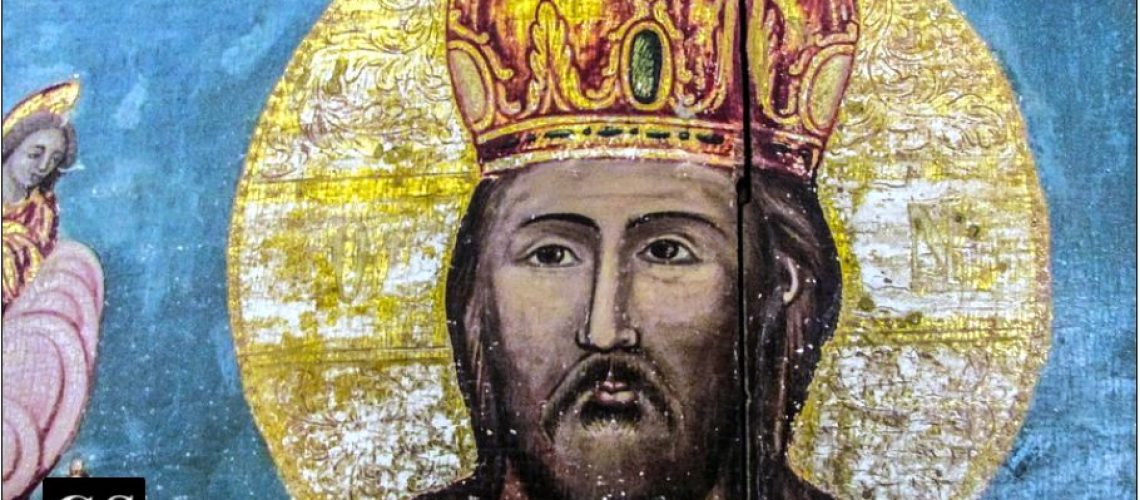
In 1965 Vatican II stated that there is a
Religious freedom… [which] leaves untouched the traditional Catholic doctrine on the moral duty of men and societies toward the true religion and toward the one Church of Christ. (Dignitatis Humanae 1)
This traditional doctrine is sometimes known as the “Social Kingship of Christ.”
Archbishop Marcel Lefebvre said:
The document on Religious Freedom… carries within itself a certain intrinsic contradiction… Nothing in the text squares with tradition. (A Bishop Speaks, 1979)
If Religious Freedom doesn’t square with the traditional doctrine of the Social Kingship, then it raises the question whether Vatican II has changed, or rejected, that doctrine.
1. The Common Good as the Purpose of Society
The doctrine of the “Social Kingship of Christ” states that society exists for both the earthly and the heavenly Common Good of human beings.
A treatise attributed to St. Thomas Aquinas (d. 1274) sums up the core idea:
It pertains to the king’s office to promote the good life of the multitude… He should command those things which lead to the happiness of Heaven and, as far as possible, forbid the contrary. (De Regno, 1267, #115)
This means that a good government will enable humans to achieve a social Common Good of health and prosperity, but it must also help people to achieve their spiritual Common Good of salvation.
The Church teaches that “outside the Church there is no salvation” (CCC 845). So Aquinas’ views have traditionally meant that a good government was one that enforced laws which promoted (only) the Catholic Church’s vision of morality, and how to achieve salvation.
2. Papal Teachings on the Social Kingship
Pope Leo XIII’s (d. 1903) encyclical Immortale Dei (1885) states:
One of… (the ruler’s) chief duties must be to favour religion, to protect it, to shield it under the credit and sanction of the laws. (Immortale Dei 6)
This means that:
It is not lawful for the State… either to disregard all religious duties or to hold in equal favour different kinds of religion. (Immortale Dei 35)
Summing up his views a few years later, Leo XIII stated:
Therefore, the law of Christ ought to prevail in human society and be the guide and teacher of public as well as of private life. (Tametsi Futura 8)
Concerned that this teaching was being neglected, Pope Pius XI (d. 1939) instituted the feast of Christ the King. He wanted to remind the world that:
If… the rulers of nations wish to… promote and increase the prosperity of their countries, they will not neglect the public duty of reverence and obedience to the rule of Christ. (Quas Primas 1)
These comments show that nineteenth and early twentieth-century papal teaching followed the views explained in Aquinas’ thirteenth century De Regno. They were affirming the “traditional Catholic doctrine” of the Social Kingship of Christ.
3. Papal Condemnations of Religious Freedom
A commitment to the Social Kingship of Christ means that it makes no sense to advocate Religious Freedom, Freedom of Conscience or the Separation of Church and State.
All those ideas are inconsistent with, and contradictory of, a model of government which thinks rulers should be enacting Catholic doctrine to ensure that all their citizens can get to heaven.
As a result of this implication, popes did not hesitate to condemn Religious Freedom and the separation of Church and State.
Pope Gregory XVI (d. 1846) condemned:
that absurd and erroneous proposition which claims that liberty of conscience must be maintained for everyone. (Mirari Vos 14)
Reiterating those views in Quanta Cura (1864), Pope Pius IX condemned the ideas that:
it is no longer expedient that the Catholic religion should be held as the only religion of the State, to the exclusion of all other forms of worship. (Syllabus 77)
He also condemned the idea that:
other religions have a right to worship (Syllabus, 78).
One of the clearest summaries of the Church’s traditional teaching is provided by Pope Pius X, who insisted:
That the State must be separated from the Church is a thesis absolutely false, a most pernicious error… This thesis… limits the action of the State to the pursuit of public prosperity during this life only, which is but the proximate object of political societies; and it occupies itself in no fashion… with their ultimate object which is man’s eternal happiness after this short life shall have run its course. (Vehementer Nos 3)
4. What Did Vatican II Say?
The draft documents for Vatican II (1962–65) included a statement reaffirming the Social Kingship of Christ. (See Chapter 9 in the Draft Schemata on the Constitution on the Church.) But the Council never approved that document.
Instead, the Council focused upon articulating a view of Religious Freedom. It said:
The council… declares that the right to religious freedom has its foundation in the very dignity of the human person as this dignity is known through the revealed word of God and by reason itself. (Dignitatis Humanae 2)
This is a strong claim that Religious Freedom is taught by Scripture and by Reason. To the extent that Religious Freedom is inconsistent with the Social Kingship of Christ (see section 3), then this seems to lead to a problem.
Either Vatican II must be rejecting the previous “traditional Catholic doctrine” of the Social Kingship of Christ. Or, Vatican II has committed the Church to contradictory doctrines, which would conflict with Vatican I’s (1870) insistence that faith and reason must be in harmony (Dei Filius 4).
5. Vatican II Avoids a Contradiction
Vatican II avoids both horns of the dilemma. It neither rejects the doctrine of Social Kingship, nor does it contradict it. Instead, it redefines its model of the Common Good, which is the basis for determining the applicability of the doctrine of Social Kingship.
Vatican II stated:
The function of government is to make provision for the common welfare. However, it would clearly transgress the limits set to its power, were it to presume to command or inhibit acts that are religious. (Dignitatis Humanae 3)
This passage contains a subtle reinterpretation of the concept of the Common Good. It is difficult to see it clearly in the words of this (Vatican) English translation. The phrase rendered as “common welfare” is “bonum commune temporale” in the original Latin. That phrase would be better translated as a “social Common Good.” It is the Common Good but only in so far as it relates to earthly health and prosperity.
The traditional doctrine of the Church insisted that governments should be working to achieve a Common Good which included both a social and a spiritual dimension (see section 1).
Vatican II has split the concept of the Common Good, and then focused governments on just one aspect of it, the social common good. As that involves no specifically spiritual responsibilities, there is no longer an obligation for a government to promote and support the Church, as per the doctrine of the Social Kingship.
6. Differentiating the Common Goods
Separating the differing social and spiritual aspects of the Common Good occurs in the thinking of Vatican II, but it is not clearly explained. Post conciliar documents are more explicit.
In 2009 the Church stated that there are two levels of the Common Good (In Search of a Universal Ethic, 85). There is the “social Common Good” which consists of the socio-economic factors relevant to a healthy and prosperous life on earth. That is the Common Good which Vatican II says governments should focus on.
But there is also the spiritual Common Good, which is also referred to as a “transcendental Common Good” (Compendium of the Social Doctrine of the Church, 2004, #170). This is the second level of the Common Good. It is the spiritual perfection of people, enabling them to achieve heavenly salvation.
Historically the Church combined both levels of the Common Good into a single model, and it was that which gave governments their spiritual responsibilities, within the doctrine of the Social Kingship.
Vatican II split the concept of the Common Good into two levels.
Can the Church do that?
The Church has traditionally taught that governments receive their spiritual powers from the Church. Pope Leo XIII said:
No one can… without risk to faith, foster any doubt as to the Church alone having been invested with such power of governing souls, as to exclude altogether the civil authority. (Sapientiae Christianae 27)
So, governments have spiritual responsibilities because the Church delegates the necessary powers. What the Church gives (by uniting the two levels of the Common Good), it can take away (by separating the two levels).
7. Why Did Vatican II Split the Levels of the Common Good?
When Archbishop Marcel Lefebvre asked the Vatican about the doctrine of the Social Kingship, he was told that “it is no longer feasible” (A Bishop Speaks, 1979; Lille Sermon, 1976).
The Vatican was telling him that circumstances had changed.
At the time of Vatican I (1870), the Church had governmental agreements (Concordats) which enforced Church rights in many political domains.
By Vatican II (1965) almost half of the world’s nations had become, or were becoming, democracies, which were answerable to increasingly pluralistic electorates (see Our World in Data). Up to a quarter of the world was influenced by antagonistic communism and there were new transnational political and economic powers, which were subtly pressuring developing states towards secularism.
The Vatican realized that Communism and Secularism were better fought with Religious Freedom, than with a Social Kingship which was also becoming less and less feasible in pluralistic democracies. A new approach was needed, even if that meant giving up “certain rights which have been legitimately acquired” (Gaudium et Spes 76).
At the heart of the Church’s ability to function in the modern world was its redefinition of its relationship to modern nation states. And at the core of that redefinition was a distinction which split the Common Good into a Social Common Good for governments to focus on, and a Spiritual Common Good which the Church would focus upon.
8. Is There a Contradiction?
Archbishop Marcel Lefebvre said:
Read the Declaration on Religious Freedom and compare it with the Encyclical Mirari Vos of Gregory XVI, or with Quanta Cura of Pius IX, and you can observe the contradiction, almost word for word. (A Bishop Speaks, 1979)
Yes, there is an appearance of a contradiction between those documents.
But there is no contradiction if the Church’s traditional teaching is understood as a conditional statement. In context A (where the Social and Spiritual Common Good are united) then the traditional doctrine of the Social Kingship applies. But, in context B (where the Social Common Good is separated from the Spiritual Common Good) then Religious Freedom applies, and states are explicitly forbidden from dabbling in spiritual matters.
Context A applied for the roughly 1500 years of mainly monarchical governments. In the pluralistic democratic world of 1965, it was recognized that context B now applies. If the world were to change radically enough in the future, then perhaps some people might even claim that context A should apply again (?).
To see why there is no contradiction between Social Kingship and Religious Freedom, consider an analogy. The Church says that Catholics must attend Mass on Sundays. But in a pandemic Catholics are told that they must not attend Mass. Is that a contradiction? No, the Mass duty applies in context A. But it does not apply in context B. Opposite duties in contrasting circumstances do not constitute a contradiction.
In a similar way there is no contradiction between the Social Kingship of Christ applying in one set of historical circumstances, but not applying in another set of historical circumstances.
9. Conclusion
Vatican II did not change or abolish the doctrine of the Social Kingship of Christ. It simply clarified the circumstances where the doctrine applies.
Perhaps the doctrine of the Social Kingship of Christ can be viewed as the Church’s ideal scenario? If the world was running as the Church wished, then perhaps the Common Good should include both the social and spiritual levels, and perhaps governments should protect the Church and work to help people achieve salvation?
But the modern world is operating in ways that are far from ideal. Consider Leo XIII’s description of ideal government:
In political affairs… the laws aim at securing the common good, and are not framed according to the delusive caprices and opinions of the mass of the people, but by truth and by justice. (Immortale Dei 18)
To the extent that modern governments do find themselves wobbling within the “delusive caprices… of the masses,” then there is a clear rationale in the modern world to divide the levels of the Common Good, thus keeping governments away from Spiritual matters.
The doctrine of the Social Kingship has not been changed into an opposite doctrine of Religious Freedom. Instead, Vatican II has merely noted that the opposing doctrines apply in different circumstances, and the current circumstances are not those in which the Social Kingship can apply.


[…] we do not treat it as a purely secular arrangement of power. Instead, we look at the “Social Kingship of Christ“—the idea that Christ is the King of every aspect of human life. We teach that all […]
[…] Vatican Council: Did Vatican II Change the Doctrine of the Social Kingship of Christ? – Rory Fox at Catholic […]
At the present time, Christ is still seated at the right hand of the Father, and is not physically ruling as the King of Kings on this present earth; and the current rulers on earth are all flawed human beings who do not fully implement the ideal governing model (cf. Hebrews 1:13; 10:12-13; Daniel 2:44; Revelation 19:11-16). They have to be reminded of it from time to time; therefore, there is no contradiction in providing them with reminders of the social and spiritual ideal. God is the one who establishes the extent of earthly dominion (cf. Ezra 1:2). This is not the function of the Church. Christ will eventually do this when it is His time.
Yes, there is certainly a role for reminding rulers of ethical standards. The issues particular to the doctrine of Social Kingship arise especially over the question of the extent to which laws should try to enact moral standards. There are some obvious sins which are always considered to be crimes (like murder), but there are also considerable differences between countries.
Very well explained. It is noteworthy that the first article of the Vatican 2 document is on non Christian religions; what blares out in the very short statement are the words “ … we reject nothing that is true.” without naming what those truths are vis a vis other world religions. Indonesia’s recent criminal statutes that make pre marital sex a crime would have tickled
the hearts of those pontiffs who ruled states and swayed sovereign monarchies while simultaneously chocking down the bitter reality of a shrink wrapped church due in part to their bigoted theology. The karma of the CC, I feel, is almost complete with Francis at the helm. A new course is set and the wind is at our backs.
Yes, many organisations have found that agreeing principles can be much easier than agreeing examples of the principles: a lesson which Vatican II illustrates when it appeals to its unambiguous ambiguity (?).
Re: (?) As you might know, I can get carried away into a cryptic thought stream. The power and abuse by the CC beginning with Constantine led to the Reformation. Karma enacted, scales balanced. Having been educated for a dozen years by a holy cadre of nuns I came away with the precious gift of faith coupled with the blatant realization that Catholics are not the only ones who go to heaven. That it is not a grievous sin (or one at all) to attend the wedding of a protestant, that eating meat on Fridays or missing mass deserves the same condemnation (or any) that is due someone who kills, ect, ect. Those, and a very large variety of other arbitrary sins charged to baptized souls is what emptied the pews. Karma enacted, scales balanced. Now, with the church and it’s acknowledged failings exposed and confessed, I believe it is ready to apply, starting with Pope Francis, an inclusive understanding of theology and so greatly reduce (as do people in the wisdom of old age) the production of corporeal and spiritual consequences.
Ordinary Papist,
Just to understand where you’re coming from better, I had a few questions:
What do you mean by bigoted theology? Kindly provide examples. Where in Catholic teaching is Karma found? How does Luther’s separating from the Church which Jesus Christ founded a good thing? In which Church document does it state that not fasting or missing Mass is as grievous as one who kills? What do you mean by inclusive theology? Which arbitrary sins were charged to baptized souls which emptied the pews, as you say?
I think it’s important to say that the world is governed by Divine Providence and grace, not karma. Furthermore, God governs all things by His loving plans. There is not karma, there is rather grace.
Considering that the Church brought us many good things like hospitals, universities, etc, etc, for the sake of fairness we have to say that the Church has been a great force for good in society.
[Comment Edited due to length]
So glad to be alive after 3 years to answer your belated questions. Bigoted theology is (at one time) saying that only Catholics go to heaven. Karma is another name for corporeal and spiritual punishment If not for Luther, Pope JP2 wouldn’t have had his 1986 Mass promoting interfaith dialogue. Missing mass is a mortal sin and incurs eternal damnation, same as murder. Every faith has a grain of truth, inclusive means adding it to the deposit of faith. In Chicago the bishop gave the faithful Irish permission to eat corned beef on Good Friday because it fell on St Patrick’s Day while other dioceses charged their faithful under pain of venial sin. Hence, one of a thousand reasons for empty pews.
The Muslim world was far ahead of Catholics when it came to medicine esp during the plague years. Hospitals are a natural outcome of advancing civilization.
[Comment Edited due to length]
Glad you are alive as well. A closer study of history and Catholic theology does not support your claims. Catholic theology has organically developed the understanding of ecclesiology and salvation. “Karma” is a term contextualized in Hindu culture and is not a fit here; you seem to be speaking of temporal punishment which is the righting of wrongs committed in our lives; they are purified here or hereafter by God’s permissive will. Luther incited violence against peasants, obstructed justice, and was a notorious anti-semite. By analogy that’s like saying if it wasn’t for the Nazi lab experiments we wouldn’t have such all that medical knowledge they acquired. Intentionally and knowingly violating any commandment is gravely sinful, but the degree of the harm done can vary based on object, intention, and circumstance. Fasting is not doctrine but discipline and so it can be modified by Bishops. Hospitals predate the Muslims by centuries and were perfected within Christianity beginning with St. Basil.
[Comment Edited due to length]