
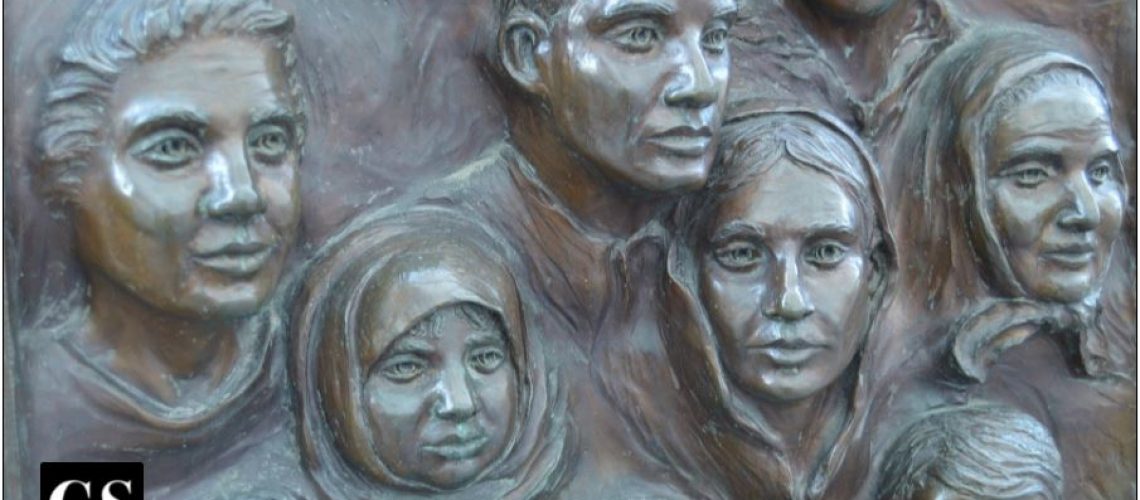
There are 30 different dialects of American English, but there are 34 different dialects in Italy. This is rather curious.
I began thinking about dialects recently, after being privileged to participate in a local parish pilgrimage to the church of San Francesco a Ripa in Rome.
Returning home, buoyed by a wonderful dinner (and the wine that accompanied it), the parishioners engaged in jovial conversation that went late into the night. It was this conversation that got me thinking about dialects.
Dialects
For the most part, while the parishioners were all Italian, the conversations were not in Italian. The parishioners, most of whom are older, spoke to each other in sezzese, the town’s local dialect.
The presence of many dialects is a fascinating feature of Italian life. Standard Italian derives from Tuscan, but before the country’s unification in 1861, very few could speak it properly. After unification, standard Italian naturally became the standard. However, local dialects remained the mainstay for daily communication.
In the Lazio region, for instance the dialects are often vulgar forms of Latin. A number of people use forms such as Isso è ido to say He has gone. In standard Italian one would say Lui è andato.
Dialects are very much localized. For instance, the abbey where I live lies within the limits of the town of Priverno, where the dialect is pipernese. (The city’s name used to be Piperno, the name of the secretary of Saint Thomas Aquinas). However, walking for just two minutes takes us to the town of Sonnino. Here the dialect is sonninese.
Given the close physical proximity, pipernese and sonninese are mutually comprehensible. So a person speaking pipernese can understand and communicate with someone speaking sonninese. Even so, there are still some different vocabulary words and expressions.
Unification
With the imposition of Italian throughout the nation, dialects slowly started to disappear. This vanishing was hastened by the introduction of radio, television, and movies, but more recently by university education.
As several young people have told me, there is a tendency now to look down on dialect speakers or those who have strong regional accents. The result is that the young people tend to perfect their Italian and cast aside their dialects.
The first large-scale movement to study at universities hastened the casting aside. Many graduates even refused to speak dialect when they returned home and started their own families. The result is that few young people speak dialect now. And the number of dialect speakers is rapidly diminishing.
But even though the use of dialects is decreasing, dialects continue to occupy an important role in culture. There are still poems, works of theater, and more in the different dialects. As such, the existence of a dialect gives a certain consistency to the city and the people.
Speaking with a diocesan priest about the various dialects in our vicariate, he mentioned that he finds one city rather odd: the city of Latina. It was founded in 1932 by people from all over Italy. (For the average Italian, a city founded in 1932 might as well have been founded yesterday. This is because many Italian cities pre-date even the Roman Empire.
As a consequence of the mixed population and the relatively recent founding, Latina has no dialect. This concerned the priest. He seemed convinced that a city without a dialect was a city without a culture or a history. To his way of thinking, such a city is lost in a country with firm foundations, even as those foundations themselves slowly slip away.
The Issue at Stake
Aside from my personal interest in the dialectics of dialects, there is a serious issue at stake here. What is at stake is the culture and identity of so many groups. This is true not only within Italian culture, but also throughout the world. In a sense, the loss of dialect mirrors the universalization of a certain sort of culture.
Take Pop Culture, for example. This global experience, mass-produced through Hollywood and recording studios, seems to fall short of the definition of culture. Etymologically, “culture” comes from the Latin colere, to tend and to cultivate. What does pop culture tend or cultivate? Often it seems that it only encourages uniformity, sin, and what is lowest.
Consider, too, what Pope Saint John Paul II said about culture. It seems that popular culture is not really culture at all. In 1998, during an apostolic visit to Croatia, the pope gave a message to the world of culture and learning, where he pointed out:
“There is no true progress without respect for the ethical dimension of culture. . . . It is also clear that the good of the person, which is the ultimate goal of every cultural and scholarly enterprise, can never be sundered from consideration of the common good. . . . Since culture has as its ultimate objective the service of the true good of the person, it is not surprising that, in seeking cultural progress, society finds the Church at its side. The Church too directs her pastoral care towards “the entire reality of the individual person, in the unity of body and soul, heart and conscience, intellect and will.” The service of the human person is the meeting-point between the Church and the world of learning and culture.”
Progress vs. Culture
No true progress can come from rejecting the moral values that are imbued in a culture. On the contrary, a true culture seeks the good of the human person. A culture seeks to be of service to its people, all of whom contribute to the common good of the whole of society.
Do globalized rap music and sexualized movies really cultivate, elevate, and serve the individual person and society at large? If not, then we cannot call them ‘culture’ in the truest sense of the word.
Some, however, will object to this way of thinking. They would say that eliminating local and regional differences leads to a truly global culture that anyone can participate in. Such a culture would be open and accepting of everyone. And there is an aspect of truth to this claim.
On the one hand, certain cultures do have elements that need purification. However, we cannot label commercialized, mass-produced culture “culture” in the proper sense. Any shortcomings are not really “culture” either, if they go against the dignity of the person and the common good.
On the other hand, it also would be impossible for a person to claim a “global culture” as their own.
Culture is Personal
Addressing the United Nations on June 2, 1980, the pontiff pointed out:
“Culture is specific way of man’s “existing” and “being.” Man always lives according to a culture which is specifically his, and which, in its turn, creates among men a tie which is also specifically theirs, determining the inter-human and social character of human existence. In the unity of culture as the specific way of human existence, there is rooted at the same time the plurality of cultures in the midst of which man lives. In this plurality, man develops without losing, however, the essential contact with the unity of culture as the fundamental and essential dimension of his existence and his being.”
So culture isn’t something that can be simply imposed. Rather, it arises from being born in a specific time and place. It is in a sense personal. But it is also shared with those closest to us in time and space. It is a sort of vast extended family.
As Pope Saint John Paul II said, culture is specific, but it is also “fundamental and essential.” Man can and must enter into contact with other cultures, embracing the good in them. At the same time a man’s culture is forever a part of him. To try to remove it or to replace it is to do violence to man’s very being and existence. If removal or replacement were to succeed, it would leave man without roots and foundation, and hence without a future and without hope.
Building a Culture
In his 1982 letter to Cardinal Casaroli, in which he established the Pontifical Council for Culture, John Paul II made clear the importance of his act:
“Culture allows us to live a fully human life. “Yes, the future of humanity depends on culture,” as I said in my speech to UNESCO on 2 June 1980, speaking to an audience which was so very different in its backgrounds and convictions. And I added, “We rediscover ourselves on the ground of culture, the fundamental reality which unites us. . . . We rediscover ourselves through that which is all around us and, in a certain sense, in us as humans.”
“The future of humanity depends on culture.” This is a profound insight and a challenge to us as Christians and Catholics. How do we build a culture that really strives to unite and encourages us to become fully human and fully alive?


[…] I. F. S. Abortions in Texas Drop 99% Following Roe Reversal – Katherine Hamilton at Breitbart Dialectics about Dialects & Culture – Fr. Nathanial Dreyer at Catholic […]
“Son of man, he said to me, feed your stomach and fill your belly with this scroll I am giving you. I ate it, and it was as sweet as honey in my mouth. Then he said to me, Son of man, go now to the house of Israel, and speak my words to them.
Not to a people with obscure speech and difficult language am I sending you, but to the house of Israel. Nor to many nations of obscure speech and difficult language whose words you cannot understand. For if I were to send you to these, they would listen to you.”
“Are not all these people who are speaking Galileans? Then how does each of us hear them in his own native language? We are Parthians, Medes, and Elamites…”
The language wasn’t unified, instead each person heard his own language. A culture was not being imposed.
“So the Lord God formed out of the ground all the wild animals and all the birds of the air, and he brought them to the man to see what he would call them; whatever the man called each living creature was then its name.”
Though Him [The Word] all things were made, yet not “imposed.”
Hi Victor,
Thank you for all of the Bible quotes! These are a great starting point for thinking about language and how our words need to resemble the Word Himself.
God bless!
Hi, and thanks for the comment! You know, that’s a very interesting point. On the one hand, we have Jesus praying to the Father, asking at the Last Supper for the unity of His followers (Jn 17:21). Clearly, it’s something He desires. Yet, we also have Him saying He came “to bring division” (Lk 12:51), dividing families. How are we supposed to reconcile these passages and, related to your question, how does that explain Babel and mankind’s attempts to overcome its consequences? The confusion at Babel was a response to mankind’s pride; they were all united, but for an evil, proud purpose. Hence, God divided them by means of language. Jesus does want unity among His children, but it needs to be a unity in what is good, not in what is evil. That’s why the Gospel message brings division: some will accept it, others will not. However, if everyone were to accept it, there would be peace and unity. In short, I think you’re absolutely right: in much the same way today, the world is trying to unite itself, like it did at Babel. It’s not a unity in good, but rather in evil. Thanks, and God bless!
On the other hand, when mankind is able to communicate without a language barrier, when we can speak to any common foreign national on a one-to-one basis without government speaking for us, the world will discover its universal common values, intrinsic to all humanity.
I think mankind has the goal of trying to undo the curse of Babel
which has plagued all of mankind.