

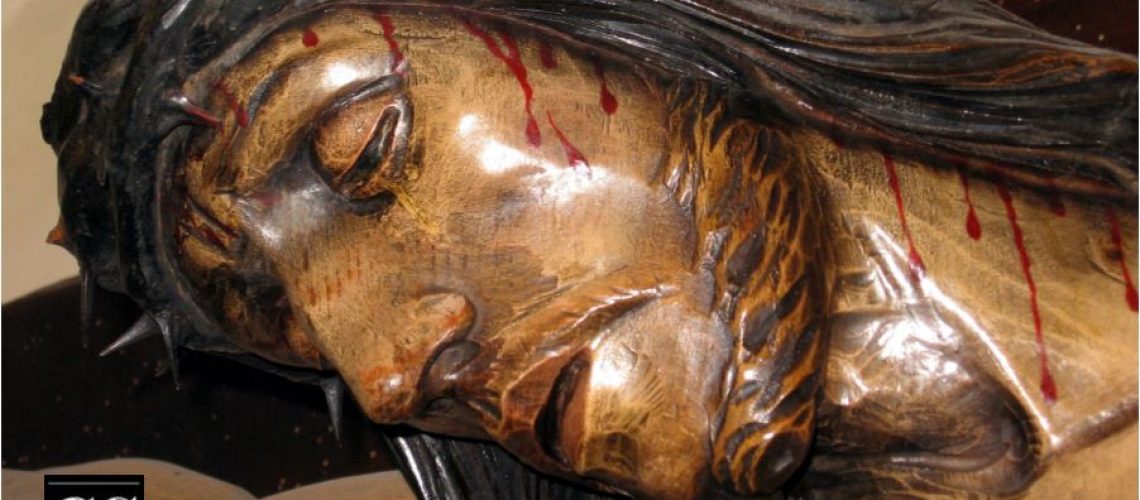
I’ve often wondered why it is that most sculptures and paintings of the crucified Christ inaccurately depict His physical appearance after He was scourged, carried His Cross (or a wooden beam), and was nailed to it. Of course, anyone can invoke artistic license, but if you look closely, Christ is commonly seen with unblemished skin, with no traces of the horrible whipping He suffered at the hands of His torturers, and the wounds and lacerations resulting from His bloody crucifixion.
Let’s start with His prayerful Agony in the Garden before He was taken into custody by the Roman guards. Medical experts say Christ had already undergone stress so severe that His tiny blood vessels were rupturing into His sweat glands. This was probably why St. Luke wrote that “…his sweat became like drops of blood falling to the ground” (Luke 22:44).
Horrific Scourging
A medical description of His scourging (condensed from The Crucifixion of Jesus Christ by C. Truman Davis) gives these horrific details (warning: this is not for the faint-hearted):
The prisoner is stripped of his clothing and his hands tied to a post above his head. The Roman legionnaire steps forward with the flagrum in his hand. This is a short whip consisting of several heavy, leather thongs with two small balls of lead attached to the ends of each. The heavy whip is brought down with full force again and again across Jesus’ shoulders, back and legs. At first the heavy thongs cut through the skin only. Then, as blows continue, they cut deeper in subcutaneous tissues, producing first an oozing of blood from the capillaries and veins of the skin, and finally spurting arterial bleeding from vessels in the underlying muscles. The small balls of lead first produce large, deep bruises which are broken open by subsequent blows. Finally, the skin of the back is hanging in long ribbons and the entire area is an unrecognizable mass of torn, bleeding tissue…the half-fainting Jesus is then untied and allowed to slump to the stone pavement, wet in his own blood…
Brutal Torture and Shock
Paul Taylor, writing for ChristianAnswers.net, cites an excerpt from a discussion of historians and archeologists about Christ’s physical torture:
The beatings were designed to be painful to the extreme…causing a fluid buildup around his lungs…a crown of thorns was forced into the scalp severely irritating major nerves in his head, causing excruciating pain…having had no nourishment for many hours, and having lost fluids through profuse sweating and much bleeding, Jesus would have been severely dehydrated.
This brutal torture would certainly be sending him into what doctors call “shock”, and shock kills. In addition, Jesus was forced to carry the wooden beam on which he would die. Imagine the effect of carrying a heavy weight if you were in that condition.
Taylor adds, “The heavy beam was tied across Christ’s shoulders and the rough wood rubbed against lacerated skin and muscles!”
A Symphony of Pain
Taylor says the pain and damage caused by crucifixion was so devilishly intense that one would continually long for death! Quoting Dr. Frederick Zugibe, an American expert in forensic medicine, Taylor says that the piercing of the median nerve of the hands with a nail can cause pain so incredible that not even morphine would help.
“It was severe, excruciating, burning pain, like lightning bolts traversing the arm into the spinal cord. Rupturing the foot’s plantar nerve with a nail would have a similarly horrible effect,” Zugibe says. “Furthermore, the position of the body on a cross is designed to make it extremely difficult to breathe.” One doctor has called it “‘a symphony of pain’ produced by every movement, with every breath; even a slight breeze on his skin could bring screaming pain.”
The movements of the one crucified included twisting and moving up and down to inhale and exhale. Some medical doctors believe that Jesus’ agony on the Cross resulted in “a compressed heart struggling to pump heavy, thick, sluggish blood into the tissues while the tortured lungs are making a frantic effort to gasp in small gulps of air.”
There have been other medical theories and controversies on the cause of Christ’s death. Zugibe says he believes Christ died from shock due to loss of blood and fluid, plus traumatic shock from his injuries, cardiogenic shock causing Christ’s Heart to fail. Some doctors and physiologists believe He died from “agony of mind” producing rupture of the Heart.
Taylor writes: “Their evidence comes from what happened when the Roman soldier pierced Christ’s left side. The spear released a sudden flow of blood and water (John 19:34). Not only does this prove that Jesus was already dead when pierced, but it is also evidence of cardiac rupture.”
Beyond Human Capacity
Just how Christ stayed conscious and how He was able to utter His seven last words (even promising the repentant thief the glory of heaven) throughout His agonizing hours of torture and on the Cross are beyond human comprehension.
A lay religious writer once said that Christ chose His moment of death and that it was induced not by pain, emotional stress, or heart attack but by His own will. Because of His unfathomable love for humanity, He voluntarily chose and accepted to die a most terrible, grueling death — pushed beyond any human being’s capacity to endure pain.
This Lent and throughout our earthly existence, we would all do well to think of Christ’s Passion and Crucifixion and meditate on the reality that our own river of sufferings cannot compare with His unimaginable suffering on the cross. And when we’re tempted to whine about our aches and pains, we can recall the words of St. John of the Cross: “Whenever anything disagreeable or displeasing happens to you, remember Christ crucified and be silent.”





4 thoughts on “Contemplating Christ’s Torture and Crucifixion”
Jesus, I trust in you
How can a crown of thorns be placed upon another’s head without harming one’s own hands? The solution seems to be to take the torn vine, remove some thorns from each end, then finally WRAP it around his head, tying the ends. Jesus endured this malice, for our sake, without sin, after 30 hours with no sleep.
Thank you Peter. It is more a reflection than something worth arguing about, and I truly regret if I offended anyone. We can likely thank Nicodemus and Joseph of Arimathea who most likely were privy to this information; however even John says, “they brought Jesus from Caiaphas to the praetorium. It was morning. And they themselves did not enter the praetorium, in order not to be defiled so that they could eat the Passover.” On top of that, Mark continues, “The soldiers led him away inside the palace, that is, the praetorium…”
In addition, I wonder why “They plucked out my beard” is ignored. Even pulling out one hair hurts.