

Piet (pronounced Peet) Hein was a Danish mathematician, inventor, and poet (among other things). He is perhaps most famous, however, for his “Grooks.”
Piet Hein (1905-1996) was president of an anti-Nazi organization when the Germans invaded Denmark in 1940. He promoted resistance to the occupation with his short poems called, in transliterated, English “Grooks.” They were accompanied by simple but charming line drawings he also created.
I first encountered his Grooks in the early 1960s. My adult stepsister gave the 13-year old me two collected volumes of them. Over the years I have snapped up every new volume I could find (a total of five by Hein, translated into English).
One of my favorites is titled “SIMPLY ASSISTING GOD” —
I am a humble artist
adding my labour to nature’s,
simply assisting God.
Not that my labour is needed,
yet somehow I understand,
my Maker has deemed it that I too should have
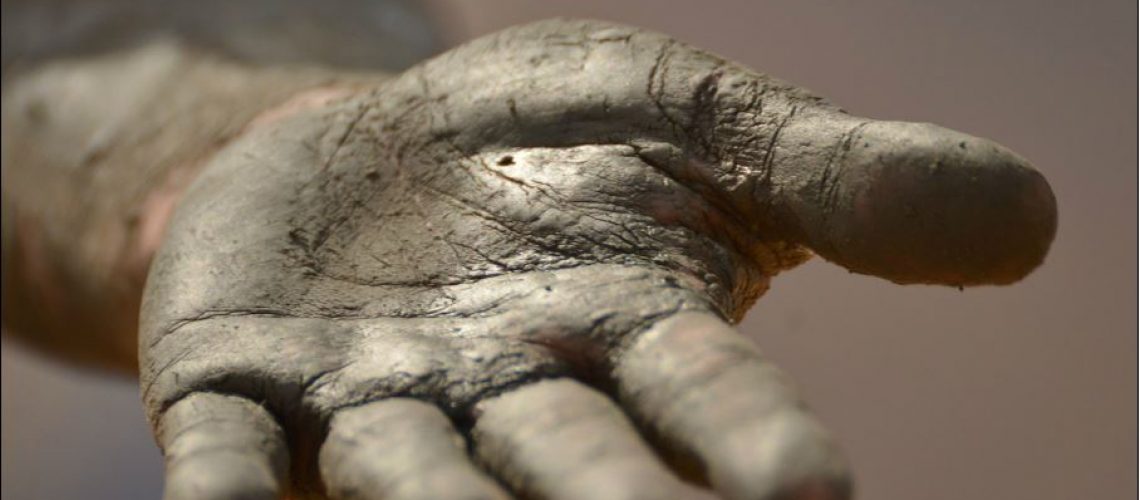
Unmoulded clay in my hand.
Similes and Metaphors
Much has been written and said about what the Book of Genesis means in saying that God created humans after his own image. One of the most common examples is the human propensity to be creative. The “be fruitful” part of the command “Be fruitful and multiply” is not just about reproduction. It includes using our minds and hearts to create works of art and works of understanding and illumination (from scientific treatises to novels and poems).
Of course any simile or metaphor can be overused and beaten to death until it finally passes out of vogue.
A number of years ago I once heard a priest who had always presented an especially gentle face to the world mutter something uncharacteristic. He said, “If I go to one more conference or retreat where someone hands me a lump of clay and says ‘Today we will be exploring Isaiah 64:7’ I am going to become a Protestant!” I had to inform him that there was no escape in that direction. Once a conference theme escapes into the wild there is no containing it, including with denominational walls.
Of course he knew that. He was just putting my vocation of “listen but don’t repeat (in an attributable way)” to use.
Serving God
One does not typically think about People going to God’s aid. And in the sense of “helping God out of a bind” that is perfectly proper. But every book in the Bible, and every biography of a Saint is an example of some human serving God. And what is service but not help in a concrete form?
The areas of service are innumerable. Every Parish, for instance, has more opportunities for volunteers than they have volunteers. And while there may be specific projects that do not need more people, there are always other efforts that could use extra hands. There are many opportunities for service that go unmet because there are so few volunteers to go around.
But this is not what Piet Hein is referring to in this short poem. Someone shapes beams that not only support a church roof, but also ‘create’ a sense of a soaring motion toward Heaven. Someone also ‘creates’ altar cloths and funeral palls and vestments of beauty. But sometimes they are somber and sometimes exultant.
Someone also ‘creates’ glorious colored glass that others work into dazzling windows. Such windows illustrate elements of the faith. They also literally illuminate it into displays that catch the imagination and entrance the eye.
Someone even ‘creates’ the molding decorating lecterns and pulpits and altar rails. And someone carves stone baptismals, while someone else needle-points kneelers and cushions for the altar rail.
Even the most sturdy, unadorned, utilitarian piece of church furniture or architecture is still the product of someone’s ability to ‘create.’ Sawing a tree into planks or shaping bricks or stone blocks for building is also creating.
Creating
Those contributions that may not seem as direct as molding clay echo our Creator’s work. God all the matter of the universe and then shaped it into elements like clay and more. Someone comes along and digs the clay the potter uses. Someone else removes sand, grit, and other impurities before it is made available to the potter or artist. Both of these things echo divine creativity in one way or another.
When I look at life in this light, I find that I am less impressed with the clay metaphor than I am by another one: the bonsai tree. Masters study and train for years to achieve the skills to shape these creations. They use real trees and bushes and other woody plants in plying their craft. Yet every book I have read on bonsai has emphasized that the tree gets a vote, as it were. It is not a passive medium, like clay. A bonsai tree is a living thing, and attempting to force it too far outside its natural limits will damage the plant. It may even kill it.
We may idealize our interactions with God, and hope to be as malleable as clay in His hands, but how often do we pray “Thy will be done” and mean it? More often, don’t we pray with a hope that God’s will mirrors our own? Don’t we tend toward a stubborn determination to hold out hope that God will somehow give up and agree with our vision of what is best for us?
Shaping Our Destinies
Hein’s poem talks about clay in his hand, not his own life. We must make choices that will shape our lives, true. But our primary job is not to shape our own destinies. Rather it is to work in the world around us to shape it to better serve our fellows.
This can mean farming for food or mining ore for metal or IC chips. Or it can mean writing computer code, working in healthcare, teaching, public service, or working as a merchant, a mechanic, or as a barber.
Whatever we do, though, most of us do it in hopes of benefiting society and humanity as a whole. Sometimes the connection between the job and that vision is clear and beautiful. Sometimes is it is indirect to the point of obscurity. Clearing a clogged sewer line is far less glamorous and appealing than clearing a clogged artery, but both are necessary in their own time and place.
The world around us is full of unmolded, or even partially molded clay. It has edifices in need of repair, and others that need maintenance.
We expelled ourselves from the earthly paradise of Eden. However, we have been given a broad and generous world to work with to make some echo – no matter how faint – of what we lost in the Fall.
That is the purpose of our individual lumps of clay: to make something for the world for the good of others. May God grant us the vision and skill to do this according to His will.
Prayer
Oh Lord, direct our hearts and minds to move our bodies in service to your will, in whatever way you have made us to do. Help us find our path to work in service to your will despite our sinful reluctance and the distractions and delusions of the Enemy. Grant us the grace to be met by you with the precious words, “Well done, thou good and faithful servant.” Amen.





2 thoughts on “Clay In Our Hands”
A cold war relic…. Glad that’s over!
My favorite grook:
Coexistence
Or no existence.