
The very first covenant in the Holy Bible is the sacred covenant of marriage between Adam and Eve. For sure, the devil is attacking that covenant today in the USA with his so-called “homosexual” marriage, an oxymoron if one ever existed. But Jesus fulfilled Adam’s role (Eve’s husband) with humanity by dying on the cross, when He said, “It is consummated” (“consummatum est” in Latin). His sacred body and blood crucified on the cross turned that wood (similar to the tree of death known as the tree of knowledge of good and evil in Genesis) into the New Testament tree of life for mankind. Since Jesus is the fruit of Mary’s womb, per St. Elizabeth in Luke 1:42, the fruit of the cross (stained with His precious blood and holding his holy flesh) is now called the Eucharist. This fruit gives us eternal life and salvation and thus overcomes the forbidden fruit that gave us death and damnation. This most perfect bookend finishes the whole Genesis 3 forbidden fruit episode. Jesus’ complete obedience to His Father thus overcomes Adam’s complete disobedience to God the Father of us all, which means that He abides in us, and we in Him (John 6:56). In marriage, the two become one flesh (Ephesians 5:31). We become one with Christ each and every time we consume Him as the Eucharist.
Jesus the Bridegroom in Scripture
Jesus Himself referenced in sacred scripture that he is the Bridegroom. So who is his bride? We are, the body of Christ known as His Church. Jesus said the following:
Mark 2:19-20: “Can the wedding guests fast while the bridegroom is with them? As long as they have the bridegroom with them, they cannot fast. The days will come, when the bridegroom is taken away from them, and then they will fast in that day.”
John 3:29: “He who has the bride is the bridegroom; the friend of the bridegroom, who stands and hears him, rejoices greatly at the bridegroom’s voice; therefore this joy of mine is now full.”
So it’s evident that Jesus is the bridegroom. Most scholars agree that the “friend of the bridegroom” mentioned above is St. John the Baptist, the best man at the wedding. So what was the wedding feast? And when was the wedding?
The Marriage Supper of the Lamb
Revelation 19:9: And the angel said to me, “Write this: Blessed are those who are invited to the marriage supper of the Lamb.” And he said to me, “These are true words of God.”
The marriage supper of the Lamb is the Eucharist, of course, and Paul says in 1 Corinthians 11:26 that whenever we eat the bread and drink the cup of the Eucharist, we proclaim the death of the Lord until He comes again. So the Last Supper was in reality the marriage supper of the Lamb, and the crucifixion of Christ was, in a way, the marriage ceremony.
The Crucifixion “Ceremony”
How? Well, when a bridegroom gets married, he gives his body to his bride on the wedding night, and he is unclothed. Christ gave His bride, the Church, His body on the cross, after he was stripped naked before His death. Jesus, from the cross, told Mary to “behold her son,” and the beloved disciple (all of us are beloved disciples) to “behold your mother,” words you might hear in the hospital when a child is introduced to his mother. The blood and water which flowed from the side of Christ after he was stabbed with a spear represents new birth, since blood and water are always present at the birth of a child. And the fact that blood and water flowed from His side is analogous to God creating Eve from the side of Adam. Now the new creation is not a woman but His bride the Church, which has as two of its sacraments the blood of Christ in the Eucharist and the waters of Baptism. We know that Jesus called His body a temple, in John 2:19. The temple building in Jerusalem had a small aqueduct inside of it to carry all of the bloody water from the slaughtered animals outside into a river, so the blood and water from the side of Jesus mirrors the fact that His body is the new temple of God.
Additionally, His body was laid in the tomb by his mother Mary, who has always represented the Church. Psalm 139:15 compares the womb to the “depths of the earth,” or a tomb. Christ was placed in the tomb, which like the womb of Mary, had never had anyone inside of it. The slab His body laid upon represented the altar. The tomb represented the Holy of Holies, where the Word of God, also known as the Ten Commandments, resided in the temple of Solomon. His dead body represented the earthly unleavened bread (called the bread of the presence in the Old Testament), and His risen body represented the heavenly Eucharist after the bread is blessed. The amount of imagery and typology going on here staggers the imagination!
Other Nuptial Connections
The aromatic nard with which the woman who anointed Jesus feet in John 12:3 is a nuptial spice from The Song of Songs 1:12 and is associated with the wedding night consummation. Jesus said to save it for His burial:
“While the king was on his couch, my nard gave forth its fragrance.”
The myrrh and aloes that were brought to the tomb and were used to anoint Jesus after his death are also nuptial spices from the Song of Songs 4:14:
“nard and saffron, calamus and cinnamon, with all trees of frankincense, myrrh and aloes, “with all chief spices”
The woman looking for her beloved from the Song of Songs chapter 5 also represents Mary Magdalene at the tomb looking for the risen Jesus:
“I opened to my beloved, but my beloved had turned and gone. My soul failed me when he spoke. I sought him, but found him not; I called him, but he gave no answer. The watchmen found me, as they went about in the city; they beat me, they wounded me, they took away my mantle, those watchmen of the walls. I adjure you, O daughters of Jerusalem, if you find my beloved, that you tell him I am sick with love.”
From Genesis 2:24 – “A man shall leave his mother and father and cleave to his wife.” This was allegedly said about Adam, who had no mother and father. Women usually leave their mother and father and cleave to their spouse. The answer, says St. Paul in Ephesians 5:32, is that this prophecy is in reality not Adam but a type of Christ, who did leave His Father in heaven and his mother on earth to cleave to his bride, the Church. And He becomes one flesh with us and cleaves to us when we consume the Eucharist, the bread of everlasting life.
Remember that Jesus did not drink the final cup of the Passover meal (called the cup of consummation) during the Last Supper. He said he would drink it in His Father’s kingdom. When he said, “I thirst” from the Cross and they gave him sour wine, he drank it and said, “IT IS CONSUMMATED.” These words of Christ not only tie the Last Supper to the Crucifixion as a one-time perpetual sacrifice (drinking the cup of consummation at the Passover Meal), but are also nuptial imagery that Christ the bridegroom has indeed married his bride, the Church.
The incident of the Woman at the Well in John Chapter 4 is also a prefigurement of Jesus’ marriage to His church. In the Old Testament, Jacob met his wife Rachel at a well, Isaac met his wife Rebekah at a well, and Moses met his wife Zipporah at a well. Jesus’ words to the Samaritan woman, “Give me a drink,” not only looked back into the Old Testament to Jacob, Isaac, and Moses and their brides but also looked forward to the cross, where Jesus said, “I thirst.” Jesus told the woman at the well that she has had five husbands, and the one she is with now (which could refer either to the man she is living with now or to Jesus) is not her husband (because Samaritans worship false gods). When Jesus told her that she should ask him for “living water,” he was referring to the Song of Songs 4:15 and its nuptial imagery:
“a garden fountain, a well of living water, and flowing streams from Lebanon.”
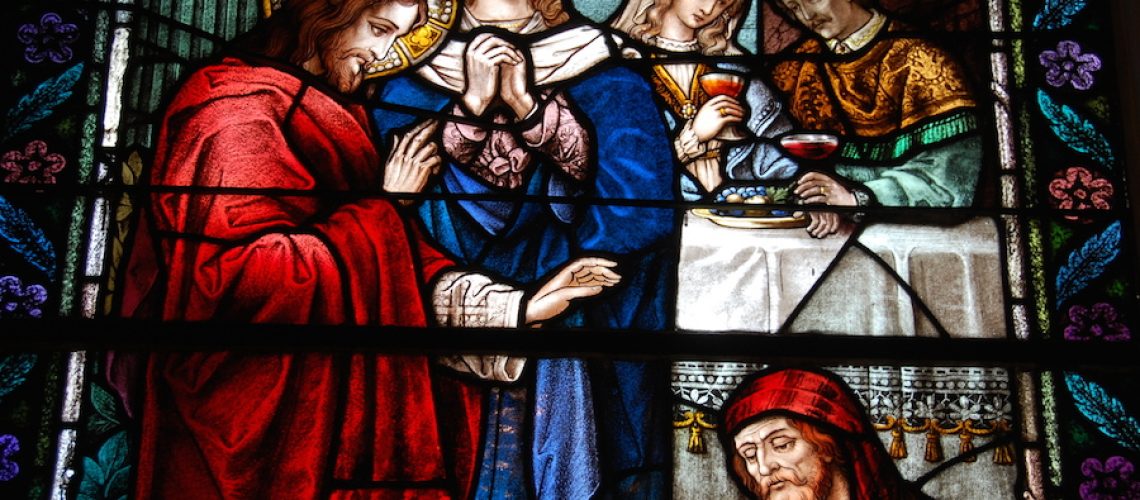
The wedding feast at Cana in John 2 is also prophetic when it comes to Jesus the Bridegroom. Notice that John did not mention the names of the bride and bridegroom at this wedding, but he did mention the names of Jesus and Mary. Mary told Jesus,“They have no wine.” Jesus replied that “what is that to you and me? My HOUR has not come.” This statement implies that he would be providing fine wine at a certain hour in the future, the hour of the Last Supper, which is the marriage feast of the lamb. Just as one substance was changed into another at Cana (water into wine), Jesus will change the wine at the Last Supper into his mystical and sacred blood, the finest wine of all, when His hour arrives. When we consume the Eucharist, we then have the blood of Christ flowing in our veins. Having His blood within us makes us all kin to Him, forever.
Summary
Jesus, according to John 15:9 loves us as much as His Father loves Him, which is infinite. It’s so hard to believe this truth when we are all weighted down by selfishness, ego, pride, lust, greed, gluttony, and so on. But it’s true! Jesus gave us the sacrament of marriage to show us that He wants to be one with us, as we are one with our spouses but in a much more meaningful and spiritual way. 1 Corinthians 6:17 says that “he who is united to the Lord becomes one spirit with Him,” which points to our marriage with Him, and life everlasting in Heaven. St. Peter says in 2 Peter 1:4 that we will be partakers in His divine nature! What could possibly be better than being one with God, forever?
John 6:56 – He who eats my flesh and drinks my blood abides in me, and I in Him.”
Whereas the devil lied and said that eating the forbidden fruit would lead to us being like God, Jesus says that consuming Him in the Eucharist means that God abides in us! The Lion of Judah (Jesus) thus overcomes the roaring lion (Satan) who wants to devour us (1 Peter 5:8), by allowing us to consume Him in the Eucharist! What a happy ending to the disobedience of Adam and Eve! Praise Jesus forever!


[…] Jesus, the Bridegroom of His Church – Ray Sullivan at Catholic Stand […]
All men are bridegrooms of all women in the Paradise, for which God created not only us as man and woman but caused the original sin.