

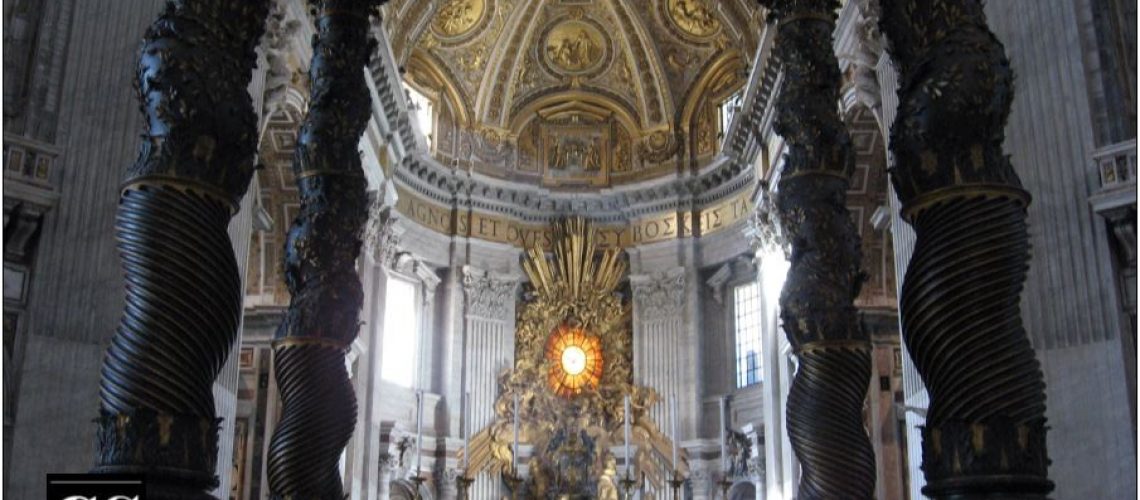
The Church is one in the integrity of the life of the Blessed Trinity, Whose life is shared with Man as sanctifying grace through baptism.
The Church is one because of her source: “the highest exemplar and source of this mystery is the unity, in the Trinity of Persons of one God, the Father and the Son in the Holy Spirit.” (Catechism of the Catholic Church 813)
The Human Experience of Life as a Unifying Principle
The human knowledge and experience of life are most notably that of material life. Of course, we do know the life of man in its immateriality, its spirituality. However, we know it through its extrinsic dependence upon matter. It is only through revelation that we know of our sharing in the life of the Trinity by way of baptism.
We are aware that a material thing is alive by observing its integrity as an entity despite the diversity of its parts. Life is the unifying principle of a living entity. Typically we know a living thing directly in its existence as a singular entity. In contrast, we typically do not know inanimate things in their singularity as entities. We typically know them as aggregations.
Water is ubiquitous and it exists often as an entity in itself. However, its singularity as an entity is not within the scope of sensual experience. Consequently, we know water only in an aggregation that lacks the integrity of an entity. We refer to water in our personal experience by quantity and location such as a cup of water, rainwater, humidity, and lake, but we cannot identify water in the singularity of its existence as an entity through immediate personal experience. With living things, most notably animals, it is by their integrity as an entity, that is, in their singularity, that we know them immediately and directly through personal experience.
Gradations of Integrity in Material Entities
A clear distinction among material entities is inanimate and animate. We might at first think that inanimate entities have greater integrity than living things by mistaking the monotony of uniformity for the unity of integrity. Water is water is water. In contrast, there is great diversity among animals even within species. Perhaps most familiar to us is the great diversity of canines, especially among domestic breeds of dogs. Yet, whether a dachshund or a collie, a dog, as a living entity, is of greater integrity than any molecule of water.
Among the animate are gradations of life and integrity, namely, vegetative, sentient, and intelligent. An animal dies when its body deteriorates to the point where its principle of life can no longer inform it as an entity. In death, however, the mammalian body does not immediately revert to inanimate matter. Its organs, e.g., enter a transient vegetative state. This permits the modern art of organ transplant, such that the life-principle of the recipient can inform the once isolated and vegetative organ, integrating the organ into the recipient’s own animal life.
Anyone who has experienced leg cramps due to dehydration knows directly the power of animal life to integrate what otherwise would appear to be the transient commandeering of another entity, namely water. Rehydration relieves the cramps by the integration of the water into the living tissues, into the life of the animal, oneself.
Of course, the highest form of material life is human life, the informing principle of which is the immaterial soul.
God and Creation
In every created entity, its existence is not its nature. The creature is an integral whole in its existence, but its existence, in a manner of speaking, is an add-on to its nature. In contrast, God’s nature and existence are identical, a perfect unity. The nature and existence of God are only logically distinct in human knowledge. Similarly, in human knowledge, the transcendentals (the existent, the true, and the good) are only logically distinct.
The Unity of the Transcendentals
Truth concerning human knowledge is the conformity of human judgment to reality. From this flows the realization that objectively (1) the true is the existent, is the good; (2) the good is the true, is the existent; and (3) the existent is the good, is the true. There are only logical distinctions among them. They are a unity, which is apprehended under three different human perspectives. We humans see them as logically distinct because our intellectual knowledge is analytical due to its extrinsic dependence upon sentient knowledge, which, as material, is particular and, consequently, always exclusively of one perspective at a time.
Sometimes the transcendentals are listed as the existent, the true, the beautiful. The good is logically distinct from the beautiful in that the good is the object of the will’s desire, while the beautiful is that which attracts the will.
The Unity of Divinity in Jesus, Who Is Our Destiny
Jesus alluded to his Divine Essence, the One Who Is (Exodus 3:14), when he referred to himself as “the Way, the Truth, and the Life” (John 14:6). The Way is to the One Fully Good. The Truth is the One Fully True. The Life is the One Fully Existent.
The Unity of the Trinity
God revealed himself, not as a solitary monad, but as a full complement of three persons, in the operations of divine life corresponding to the three transcendental functions. The Father is the Existent. The Son (the Logos) is the Known, the Truth. The Holy Spirit is their mutual Love of their Goodness.
The Unity of the One Church
The Church is the Mystical Body of Christ. The members of the body, by being integrated into the Divine Life of the Most Holy Trinity through baptism, are vivified in the most perfect unity possible for creatures. One of the visible marks of the Catholic Church is its unity in faith, morals, hierarchy, and worship. The Church also possesses a more perfect, but invisible integrity through the Divine Life of Grace in union with her head, our Lord.
Heaven, the Ultimate Life of Unity
In heaven, we will experience the immediate life of the Blessed Trinity, not of course by nature, but by the magnanimity of the grace of God. We will not be absorbed into the Unity of the Trinity but will have a share in its intimate life. It could not be expressed more beautifully than in the words of Pope Benedict XII, in 1336:
Since the passion and death of the Lord Jesus Christ, these souls have seen and see the divine essence with an intuitive vision and even face to face, without the mediation of any creature by way of object of vision; rather the divine essence immediately manifests itself to them, plainly, clearly and openly, and in this vision they enjoy the divine essence. Moreover, by this vision and enjoyment the souls of those who have already died are truly blessed and have eternal life and rest. Also the souls of those who will die in the future will see the same divine essence and will enjoy it before the general judgment.
Such a vision and enjoyment of the divine essence do away with the acts of faith and hope in these souls, inasmuch as faith and hope are properly theological virtues. And after such intuitive and face-to-face vision and enjoyment has or will have begun for these souls, the same vision and enjoyment has continued and will continue without any interruption and without end until the Last Judgment and from then on forever.




2 thoughts on “The Church is One in the Integrity of Life”
All nice “faith and reason” gobbledygook. For philosophers and folks who only focus on the ideals of the Church this is a great piece. But for those of us who live and serve in the real world “integrity of life” is a goal that few are working to reach in the Church. Is the treatment of Card. Pell by brother bishops.and the Vatican a sign of “integrity of life”? What about the priests and seminarians defiled by Theodore McCarrick? What about the cruelty inflicted on your own St Mary McKillip? The list could go on and on. Give us less academic papers and studies, more orthopraxis of what we already know is good, just and holy.
In the context of your criticism, I can think of only one excuse for having written the essay. Love follows knowledge. It is a lot easier to live in contradiction to reality, if one doesn’t understand it. Hopefully the evil manifested by corruption in the Church and in secular society is due to a lack of understanding by our weakened intellects and not a sincere dedication to chaos.