

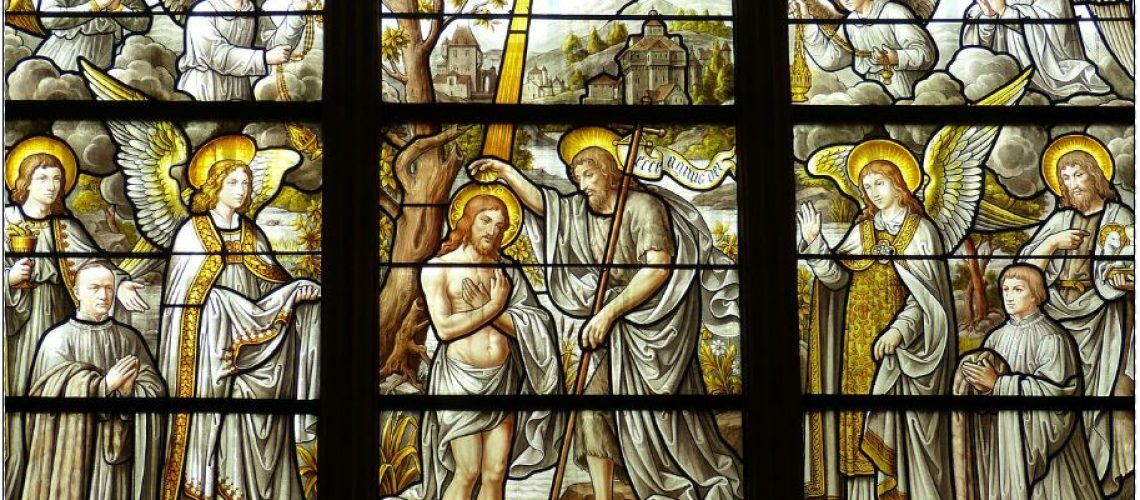
On June 24 the Church celebrates the feast of St. John the Baptist. Having just celebrated the birthday of the Church at Pentecost, St. John’s feast day jump-starts another year of reflection on the nature and wonders of our salvation, moving me to reflect on the role of prophets in our troubled times. Clearly, Jesus had troubled times in mind when he said,
Blessed are you when they insult you and persecute you and utter every kind of evil against you because of me. Rejoice and be glad, for your reward will be great in heaven. Thus they persecuted the prophets who were before you (Matthew 5:11-12).
Should we be surprised when faithful priests are persecuted by their own bishops? Were not the prophets—and the Messiah—persecuted and put to death by their fellow influential Israelites? By clerics?
Why were they persecuted? Largely, just for promoting the commandments and the law. It wasn’t because they were proposing some avant-garde theology or philosophy; it was because they were trying to prevent the secularization—the corruption—of the faith. Many things have changed through the years, but not human nature. The persecution continues and will until the end of time.
We have only to decide whether we are secularist or prophet, persecutor or persecuted—lost or saved—there’s nothing in between. Many try to sit on the fence. They say, “I believe such and such, but there are many other religions in the world; who am I to say that what I believe is better?”
Absolute certainty would not require faith, and that is why we never stop searching, but fitting comfortably into a socio-religious niche is not faith. Practicing and proffering a philosophy of religious indifference is the antithesis of faith; religious indifference has become an unassailable social absolute of our era.
Trying to sit on the fence is spiritually inadvisable because avoiding controversy is avoiding the truth. Jesus referred to himself as a sign of contradiction. God respects the searcher who is still on the wrong side of the fence and he longs for their search to bear fruit, but he has this to say about fence-sitters:
I know your works: you are neither cold nor hot. Would that you were either cold or hot! So, because you are lukewarm, and neither hot nor cold, I will spit you out of my mouth.
When we see news headlines about Christians being persecuted in other countries, we need to ask ourselves if their persecution is as great as it is because many of the rest of us are just going along to get along. While it is true that we need to pick our fights wisely, pick them we must, because fighting for the faith is only optional so long as saving souls, including our own, is optional.
I have, in the last few years, come in contact with more and more people, who are simply burnt out. They are news-weary to the point of withdrawing from the conversation, literally avoiding media of every sort. I get it. We all need balance. We all need an occasional break. In the realm of world events, it has become frustratingly difficult to discern truth from lie. This is generating a sort of withdrawal, what the individual might see as a sort of cloistering.
However, there is a common misconception about cloistering. The truly, religiously cloistered don’t withdraw from the battle, they withdraw from those things that distract from the battle. Most of them remain well aware of the world situation, an awareness necessary to be effective prayer warriors. Theirs is a simpler, more focused life, not an easier one. Theirs is a balanced life, though balanced in ways unique to their calling. St. John the Baptist was a desert hermit who was fighting on the front lines.
Benjamin Franklin famously said, “Love you enemies, for they tell you your faults.” This came to mind after a recent conversation with my wife. While discussing my last Crisis article, I expressed the opinion that writing had changed me in ways that I hadn’t really expected, and before I was able to complete my thought, she informed me that I was dealing with anger much better than I had before.
Now, I imagine the reader trying to tie this drivel into a cogent thought stream. Am I saying that my wife is my enemy? No. But my anger was her enemy. To paraphrase Franklin, “Love your wives, for they tell you your faults.” Our spouses are not our enemies, but our flaws are their enemies and the enemies of our relationships.
Christ assured us that, “No man is a prophet in his own land or among his own kin.” Our own know us, and the knowledge of our sinful nature throws a damper on our image of one another as prophets, especially if our concept of a prophet is that of a person of immense, palpable holiness.
“Familiarity breeds contempt” an old aphorism assures us. Why is that? What if the prophet in question is relatively flawless, or as in the case of Christ, entirely flawless? What is there to breed contempt? Well, it’s simply the reciprocal of what was stated above: just as my flaws are my wife’s enemy, a prophet’s relative purity can be the enemy of another’s flaws. A prophet’s relative transparency can be the enemy of another’s hard-fought obfuscation.
The reader is perhaps thinking, “So, you see yourself as a prophet? Isn’t that nicely self-aggrandizing!” Such an observation, of course, necessitates starting at the beginning, that is, by defining what a prophet is. Our common association is with that of a person who foretells of future events, but while that is certainly prophecy’s showy side, a prophet is simply anyone who attempts to extol the truth about the God of love—to be a witness.
However frail one’s attempt at answering God’s call to witness, it will not go unrewarded—or unpersecuted. Many prophets are unknown to us. They are living, or have lived and died, in obscurity, but are/were a witness to the God of love nonetheless. Every humble act of kindness done to exemplify the love of God is a witness, the work of prophecy.
Showy or not, prophecy is never fully clandestine; that is, it is always showing the light of Christ to someone, whether in action or words, and that communication often comes at great cost to the prophet.
A trap for all of us average, perhaps pathetic prophets is the tendency to believe that, because we are making people angry—that is, ruffling feathers, rocking the boat, shaking things up—we must be doing God’s will. Among my favorite recent reads is an article by Daniel Fitzpatrick titled, “Fear and Loathing in America” wherein he attacks the old adage that says “You don’t have to like everybody, you just have to love them.”
His point is that a dislike, which easily becomes a hostility toward the expressed personality and rudimentary flaws of any sinner, becomes difficult to extract from our overall view of the person; in other words, there is something likeable about everyone if we are able to see beyond their sins and see Christ crucified in them—that to love is also to like the possibilities that Christ sees dormant in every sinner.
In the 1977 television mini-series “Jesus of Nazareth”, Christopher Plummer brilliantly plays Herod Antipas, whose soul St. John wanted to save from sins of adultery and hedonism. The Herod that Plummer portrays is a likeable guy, not sadistic; a party animal who is sensitive, at some level of his soul, to truth and wisdom. St. John, no doubt, sees that flailing, drowning spiritual core of the man and wants to save it from the clutches of pride and addiction.
No true prophet finds satisfaction in making people angry—in pushing their buttons—or takes delight in an I-told-you-so or a gotcha, and if you’re not guilty of any of those things, you’re more the prophet than I. On the other hand, the prophet is not called to stoicism. No prophet should be expected to be comfortable with persecution. The call to prophecy is a call to sacrifice, not a call to be thick-skinned. Christ was never thick-skinned; the thick-skinned don’t sweat blood contemplating their own sacrificial witness to the love that is God.
We are called to “rejoice and be glad” when we are found worthy of the devil’s scorn, but we must never lose sight of the goal of our prophecy: the salvation of others. Their scorn is a burden, a sacrifice to be carried to the altar and offered up for their sins. Save your thick skin for the devil.
Proclaiming truth for any sake other than the salvation of others can, indeed, quickly become self-aggrandizement. So don’t lose your head, as I often have, venting righteous indignation; lose it witnessing to truth plainly for the sake of love, as did John the Baptist.
At its core, prophecy is martyrdom.





3 thoughts on “Blessed Are the Persecuted”
Pingback: Meet the Rich Kid Who Gave Up All His Wealth for Christ, and More Great Links! - JP2 Catholic Radio
Pingback: VVEDNESDAY EDITION – Big Pulpit
You are less angry – glad we could help.