
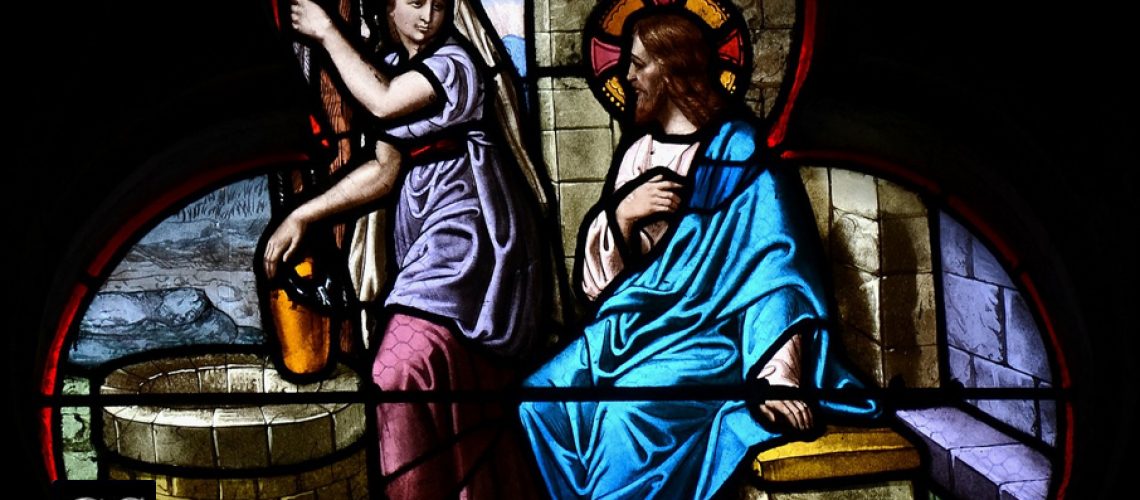
Can water become more than one of the classical elements, more than that which satisfies the thirst of animals and human beings? And can this water be life giving, not just in a bodily sense, but also in a spiritual sense?
In pondering these questions, the biblical account of the Samaritan woman at the well – assists in contemplating that which transcends a created element.
Now when Jesus learned that the Pharisees had heard that Jesus was making and baptizing more disciples than John (although Jesus himself was not baptizing, just his disciples), he left Judea and returned to Galilee. He had to pass through Samaria. So, he came to a town of Samaria called Sychar, near the plot of land that Jacob had given to his son Joseph. Jacob’s well was there. Jesus, tired from his journey, sat down there at the well. It was about noon.[1]
It was while Christ and His disciples were involved in making and baptizing more disciples than John in Judea, that He decided to return to Galilee.
Palestine is only 120 miles long from north to south. But within that 120 miles there were in the time of Jesus three definite divisions of territory. In the extreme north lay Galilee; in the extreme south lay Judaea; and in between lay Samaria. …There was a centuries-old feud between the Jews and the Samaritans, the cause of which we will shortly see. But the quickest way from Judaea to Galilee lay through Samaria. Using that route, the journey could be done in three days. The alternative route was to cross the Jordan, go up the eastern side of the river to avoid Samaria, recross the Jordan north of Samaria and then enter Galilee. This was a route which took twice as long. So, then Jesus had to pass through Samaria if he wished to take the shortest route to Galilee.[2]
Samaritans and Jews have a long history of conflict and hostility, dating back to the time of the Babylonian exile and the Persian restoration. Samaritans opposed the rebuilding of Jerusalem and the temple by the returning Jews, and tried to sabotage their efforts. Jews considered Samaritans to be impure and heretical, and avoided any contact with them. The hatred between Jews and Samaritans was so intense that Jesus used it as an example of how to love one’s enemies in the parable of the Good Samaritan (Luk. 10:25-37).[3]
Here one can see, it was the view of the devout Jew to avoid Samaritans at all costs – even traveling further around Samaria to accomplish this:
The name Samaritan became a byword of reproach. He was publicly cursed in the synagogue—cursed in the name of Jehovah, by the writing on the two tables of the law, by the curse of the upper and lower house of judgment. He was pronounced unworthy of eternal life—excommunicated alike from the Church on earth and the Church in heaven. The bitterest word of scorn the Jew could hurl at the Infinitely Pure One was this, “Thou art a Samaritan, and hast a devil.”[4]
Thus, it would have been unheard of for a Jew to willingly take this route through Samaria. And, it would have been unprecedented for a Jew to have contact with a Samaritan. Nonetheless, neither of these concerns hinder Christ in the fulfillment of what he has set out to accomplish.
The next point to be made, is that not only is Christ meeting up with a Samaritan, but with a woman alone in public:
The strict Rabbis forbade a Rabbi to greet a woman in public. A Rabbi might not even speak to his own wife or daughter or sister in public. There were even Pharisees who were called “the bruised and bleeding Pharisees” because they shut their eyes when they saw a woman on the street and so walked into walls and houses! For a Rabbi to be seen speaking to a woman in public was the end of his reputation—and yet Jesus spoke to this woman. Not only was she a woman; she was also a woman of notorious character. No decent man, let alone a Rabbi, would have been seen in her company, or even exchanging a word with her—and yet Jesus spoke to her.[5]
Christ meets this Samaritan woman at a well in Sychar, alone in public, as she arrives to draw water at noon – an hour not typical for women to draw water. Women ventured out to draw water with other women, early in the morning, or in the evening, to avoid the heat of the day:
This timing suggests she was avoiding the other women of the town, likely due to her ‘terrible reputation’ mentioned in (Joh. 4:18). Her multiple marriages and current living situation would have made her a social outcast, shunned by her community.[6]
It is to this woman that Christ speaks, and tired from His journey, requests a drink of water. Stunned, that He would make such a request, the woman replies: “‘How can you, a Jew, ask me, a Samaritan woman, for a drink?’”[7] To which Christ immediately answers: “If you knew the gift of God and who is saying to you, ‘Give me a drink,’ you would have asked him and he would have given you living water.”[8] Christ indeed requests a drink to quench His bodily thirst, but, He also longs with all of His heart for the Salvation of souls. Christ thirsts both physically, and spiritually, as He endures His Passion on the Cross: “Jesus’ physical thirst parallels His spiritual suffering as He bore the judgement for our sins. On the cross, He experienced both physical agony and spiritual abandonment.”[9]
Assuredly, Christ does not consider race, nationality, male, or female, what matters to Him is humility, faith, and true repentance for one’s sins, imploring Him for His mercy and forgiveness. Christ asserts that He will provide living water – and that if she had asked Him, (the gift of God) He would have given her living water.
St. Cyril of Jerusalem, Bishop and Doctor of the Church speaks of this living water in his writing: De Spirito Sancto:
The water I shall give him will become in him a fountain of living water, welling up into eternal life. This is a new kind of water, a living, leaping water, welling up for those who are worthy. But why did Christ call the grace of the Spirit water? Because all things are dependent on water; plants and animals have their origin in water. Water comes down from heaven as rain, and although it is always the same in itself, it produces many different effects, one in the palm tree, another in the vine, and so on throughout the whole of creation. It does not come down, now as one thing, now as another, but while remaining essentially the same, it adapts itself to the needs of every creature that receives it.
In the same way the Holy Spirit, whose nature is always the same, simple and indivisible, apportions grace to each man as he wills. Like a dry tree which puts forth shoots when watered, the soul bears the fruit of holiness when repentance has made it worthy of receiving the Holy Spirit. Although the Spirit never changes, the effects of his action, by the will of God and in the name of Christ, are both many and marvelous.[10]
Although the Holy Spirit apportions grace to each man as he wills:
[A]ll three Persons of the Blessed Trinity perform the work of sanctifying human souls, this work is especially attributed to the third Person, the Holy Ghost, because He is the Person who proceeds from the Father and the Son as the breathing of their love; and sanctification is a work of love.[11]
And though, all three persons of the Blessed Trinity perform the work of sanctifying human souls, it is Jesus Christ the Redeemer who merited all the graces since bestowed upon men:
Because no man has a strict right to share in the life of God Himself, grace is a free gift, distributed by God according to His good pleasure. Jesus Christ, the Redeemer promised by God to Adam and Eve after their fall, merited all the graces since bestowed upon men. The graces bestowed by God on those who lived before the time of Christ were granted through anticipation of the merits of Our Lord.
Man cannot attain eternal life by powers that are merely natural. He must be elevated to a supernatural plane through grace; and he constantly needs the impulse of God to merit eternal life.[12]
Thus, Christ established His Church and the Sacraments, that grace be imparted to all the faithful. The blood and water which flowed from the side of Christ on the Cross, are types of the Sacrament of Baptism and the Sacrament of the Eucharist:
But when they came to Jesus and saw that he was already dead, they did not break his legs, but one soldier thrust his lance into his side, and immediately blood and water flowed out.[13]
Water from the pierced side of Christ, a type of the Sacrament of Baptism is: “the basis of the whole Christian life, the gateway to life in the Spirit (vitae spiritualis ianua) (cf. Council of Florence: DS 1314: vitae spiritualis ianua), and the door which gives access to the other sacraments. Through Baptism we are freed from sin and reborn as sons of God; we become members of Christ, are incorporated into the Church and made sharers in her mission: ‘Baptism is the sacrament of regeneration through water and in the word’” (cf. Roman Catechism II, 2, 5; cf. Council of Florence: DS 1314; CIC, cann. 204 § 1; 849; CCEO, can. 675 § 1).[14]
And, blood from the pierced side of Christ, a type of the Sacrament of the Eucharist:
“[T]he source and summit of the Christian life”(cf. LG 11). “The other sacraments, and indeed all ecclesiastical ministries and works of the apostolate, are bound up with the Eucharist and are oriented toward it. For in the blessed Eucharist is contained the whole spiritual good of the Church, namely Christ himself, our Pasch’”(cf. PO 5).[15]
“Amen, amen, I say to you, no one can enter the kingdom of God without being born of water and Spirit.”[16] “Amen, amen, I say to you, unless you eat the flesh of the Son of Man and drink his blood, you do not have life within you.”[17]
[1] Confraternity of Christian Doctrine, Catholic Church, Saint Joseph Edition of the New American Bible (Washington, D.C. United States Conference of Catholic Bishops, and Totowa, NJ: Catholic Book Publishing Co. 2011)., Joh. 4:1-6., (Hereafter cited as NAB).
[2] Barclay, William, ed. 1975. The Gospel of John. Rev. ed. Philadelphia: Westminster Press., pg. 146-147., (Hereafter cited as Barclay).
[3] Azahari Hassim and Abrahamic Theology. The Relationship Between Samaritans and Jews: A Complex Historical and Religious Connection. P4. accessed March 21, 2026. https://abrahamic-theology.com/samaritansandjews
[4] Bible Hub. The Hatred of the Jews for the Samaritans. Canon Tristram. P1. accessed March 21, 2026. https://biblehub.com/sermons/auth/tristram/the_hatred_of_the_jews_for_the_samaritans.htm
[5] Barclay, pg. 151.
[6] Bible Reflection. Samaritan Woman: Why She Came Alone to Fetch Water at Noon? Social Isolation. accessed March 21, 2026. https://biblereflection.org/samaritan-woman-alone/
[7] NAB, Joh. 4:9.
[8] Ibid., Joh. 4:10.
[9] Truths to Die For. John 19:28: Why Did Jesus Say ‘I Thirst’? Theological Implications. P2. accessed March 21, 2026. https://truthstodiefor.com/john-1928-why-did-jesus-say-i-thirst/
[10] Cyril of Jerusalem, Catholic Church and Franciscans. 1975 1976. The Divine Office : The Liturgy of the Hours According to the Roman Rite : As Renewed by Decree of the Second Vatican Council and Promulgated by the Authority of Pope Paul. Volume III. New York: Catholic Book Pub., De Spirito Sancto., pg. 967.
[11] Douay Rheims Bible Online. Baltimore Catechism 3. The Holy Ghost and Grace. Important Truths About the Holy Ghost and Grace. P1. accessed March 21, 2026. https://www.drbo.org/cat/htm/02009.htm
[12] Douay Rheims Bible Online. Baltimore Catechism 3. The Holy Ghost and Grace. Q. 109. What is grace? accessed March 21, 2026. https://www.drbo.org/cat/htm/02009.htm
[13] NAB, Joh. 19:33-34.
[14] Catholic Church. Catechism of the Catholic Church : Revised in Accordance with the Official Latin Text Promulgated by Pope John Paul II. 2nd ed. Vatican City
Washington, DC: Libreria Editrice Vaticana ;
United States Catholic Conference, 1997., para. 1213.
[15] Ibid., para. 1324.
[16] NAB., Joh. 3:5.
[17] Ibid., Joh. 6:53.


[…] Orthodoxy – The American CatholicCan Catholics Go to a SSPX Mass? – David L. Gray, Th.M.Beyond Human Wisdom: Christ Provides Living Water – Fr. Kenneth M. Dos Santos, M.I.C., at CSMWhen Being a Jesuit Actually Meant Something: The […]