

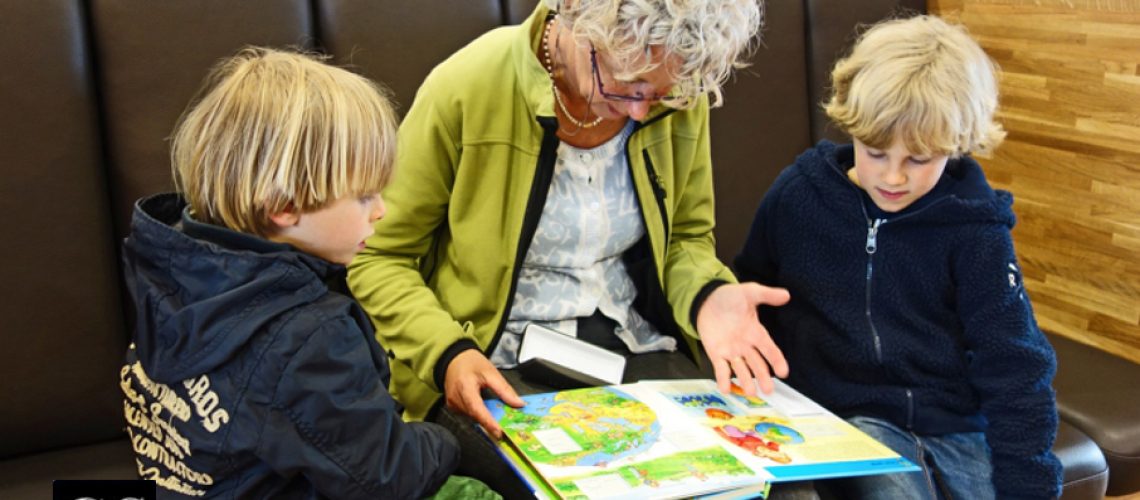
August is passing away quickly. I’ve a pile of new-to-me old schoolbooks on the table and an empty planner awaiting structure. Today, the kids are running wild in the hot sunshine – gathering leaves and acorns, chasing chickens, and catching frogs. Childhood at its finest. But in a week or two, we’ll be stepping back into our school year at home. I’m preparing with my books, papers, and planners; while they’re preparing in their own way.
“Parents have the first responsibility for the education of their children”(CCC 2223), as the Catechism reminds us. That responsibility includes in it a right and a responsibility to “chose a school for them which corresponds to their own convictions”(CCC 2229). For many families, such an ideal school can be found within the home itself. In the past few years, I’ve met an overwhelming number of parents who are turning homeward to find such a school. Ex-teachers and tattoo artists, Catholics and atheists, rebellious types and rule followers – after a while, we all unite in pursuit of an education that is “a mosaic of beauty” and truth for our children.
But choosing how to go about nurturing education in the home can be overwhelming – especially for those of us who grew up in the public school system. A quick search online isn’t much help either – unless you’re already aware of all the specialty terminology that has taken over the homeschooling world. But unless you’re especially interested, there’s no need to wallow in all the subcategories. Instead of wondering if a Classical education is better or worse than a Waldorf education, or if unschooling is better than structured schooling, take some time to examine your convictions. If you’re choosing to homeschool simply because home is the best option, then you really don’t need to worry about whether or not your homeschool follows an ideal method. Begin, and let life teach you from there.
“A Mosaic of Beauty”
That isn’t to say there aren’t ways to make starting a little easier. If you’re new to homeschooling, or if you’re just stepping into another year, looking at it from a specifically Catholic perspective is a great way to remind yourself of your convictions. In my little homeschool, we focus a lot on the beauty in art and nature, we spend a lot of time delving into the stories that make up our faith and history, and exploring the traditions that have carried our fellow Catholics through the centuries. On a day-to-day level, that looks like a few hours spent with subjects like art, math, catechism, grammar, literature, history, and languages; a lot of time outdoors; piles of good books; and little to no time around screens.
Textbooks?
Some homeschoolers don’t bother with textbooks, others use the same books you’ll see in your local public school. Good textbooks can be a great way to teach subjects that benefit from consistency and continuity – like math and history. I like using textbooks as a backup, or support system. They help keep me on track. But I also edit them freely as we work through them.
For example, we have a lovely, little American history book from 1941. I love the way the author covers early American history, but his chapters on the mid-19th century and beyond are brief and unhelpful. When we started studying these periods in American history, I brought in more extra materials, and expanded on our author’s limited information.
Expanding on textbooks is a good idea no matter how well-done they are. But when you see a text short-changing something essential or misrepresenting the faith, it’s essential. Remember that a good, Catholic education includes both justice and mercy. Glossing over the sins of historical figures – whether they’re popes or revolutionaries is as problematic as obsessing over those sins. Most textbooks err on one side or the other, and it’s important to balance them out.
The Great Outdoors
Outdoor time is essential at our house! Partially because we have a lot of yard and animal chores connected to our homestead, and partially because we live in a tiny house. But both of those reasons stem from the deeper longing to live life close to nature.
On especially beautiful days, I put all lessons aside and send the kids out to explore our little woodland. On cold winter mornings, we delay everything to sip coffee or hot cocoa and listen to the old pines snap and pop in the icy air. Some autumn afternoons the decaying logs offer a better education than I can; and lambing season is full of opportunities to grow in understanding. But even if you don’t live on a rural homestead, there are pockets of nature everywhere.
Growing up in the suburbs, I loved spending time in cemeteries. It’s a practice I try to continue with my own kids – especially around the feast of All Souls. Cemeteries are often beautiful, natural spaces. They’re perfect for picnics, devotions, and respectful games.
Even if cemeteries aren’t on your list of favorite places to greet nature – find a way for your kids to spend part of each day outdoors. Too often, kids are cooped up indoors with screens and snacks, losing their childhood to distractions and missing out on all the beauty the natural world has to offer.
Book-Piles
When I was a child, our house was always full of books. There were shelves of children’s books, shelves of grown-up books, and stacks of huge coffee-table books. When I was very small, I could spend hours flipping through the pictures in my own books, or the pictures in the big coffee-table books.
In the evenings, my dad would read his favorite children’s books to us, and in the morning, we could fill our time looking (and eventually reading) all the books within our reach.
Now with my own children, I imitate my parents’ abundance of books. If they wake up early, my kids can freely forage through shelves of books – settling down to read Black Ships Before Troy or “The Water of Life”; or just flipping through photos of the Cosmos. When children have access to an abundance of books, they grow up loving them. Whether you’re homeschooling or not, you can make your house into a bookish little nest – a place to nurture young readers – all you have to do is fill your home with good, beautiful books.
Screen-Free
It’s easy for me to talk about raising my kids without screens. We’re off-grid homesteaders without a television, Wi-Fi, smartphones, or even a working DVD player. The truth is, my kids don’t spend time on screens because screen time is something that takes a lot of effort to make happen. It’s generally limited to work tasks and putting in orders.
But life without screens isn’t just easy for us, it’s also a part of what’s made our family culture so cohesive. Screens – particularly social media – quickly become an invasive, parasitic part of family life. When parents and their children start absorbing instant information, expecting constant entertainment, and sharing each feeling as it crosses their minds, life itself becomes discordant. Too many things are going on alongside daily life, distracting from it.
I realize that I can’t convince every parent to quit their smartphone, just as I can’t convince every parent to quit Disney and whatever frenetic TV shows the world is selling their children. But reduction helps. Keep screens and the images on them to a minimum. Fill their lives with nature, beauty, truth, and goodness instead.
A School of Conviction
These tenets have kept our little family school happily learning through the challenging seasons of the past few years. They’re simple, solid ways for our family to embrace a consistent approach to life and learning without worrying about all the subgroups in the homeschooling world. What would you recommend?




3 thoughts on “Beautiful Schooling”
Thank you for this beautiful article…a good prequel to my own homeschooling preparations! I have eleven children. We have experience with mainstream Catholic schools, private Catholic schools, and homeschooling. Currently, I am educating my last two children (12 & 15) at home. They previously attended a small,.private Catholic school, and I taught there. I brought them home, because I knew more about my students than I did my own boys. It was one of the best decisions I’ve ever made…and homeschooling post-toddler era is a whole new experience! 🙂
Thank you for the encouragement to go screen-free. That is something that waxes and wanes in our family, and definitely impacts family life. I needed your words of encouragement in planning that break for our upcoming year!
I wish you and your family a richly blessed school year! 💕
As a retired Montessori teacher, I look back on the gift of my vocation. I was called to do that particular work and it is such a beautiful methodology works with all children, all ages, all learning modalities (visual, auditory and kinesthetic). Montessori knew all children learned differently and developed understanding at different rates. The results were amazing. However, like the traditional classroom it is being taken over the WOKE ideologies. Yet, it is perfect for homeschooling.
We educated four grown children in Catholic schools from pre K through college. Some of the greatest detractors of our Catholic schools were homeschoolers. They should all wish Catholic schools to be successful. If the many enemies of Catholic schools are ever successful in killing them off, the homeschool movement will be gone in six months.