

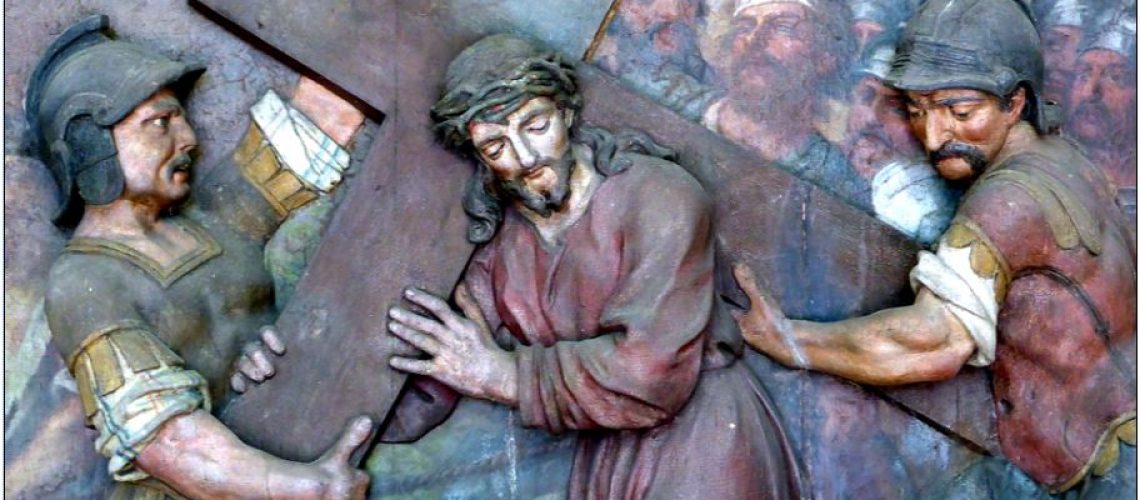
Much to everyone’s surprise – and my own as well – when it came time to pick a patron for my reception into the Roman Catholic Church, I chose Simon of Cyrene. Right up to that point I was going to pick of St. Augustine of Hippo.
Why did I choose Simon of Cyrene? The works of St. Augustine were a major influence on my decision to become a Catholic. It would seem choosing him as my reception patron would be a slam dunk. But when it came time to write down our selections, it was Simon of Cyrene who suddenly came so strongly to mind. I could not deny the impulse as being some kind of inspiration or leading.
Over the next several days it gradually became clearer why I might make this choice.
Simon of Cyrene
Every Christian should know the name Simon of Cyrene. He is mentioned in the Synoptic Gospels (Mathew, Mark, and Luke). Simon is picked out from the crowd during Jesus’s trek to Golgotha and forced to carry the cross for a time. Jesus had fallen three times already – unsurprising given the torment his body had gone through even before the walk to the place of execution.
Simon is not mentioned in the Gospel of John. In John, Christ carries the cross on his own the entire way. Regardless, the cross being handed to Simon is the Fifth Station in the traditional Stations of the Cross.
And it turns out Simon of Cyrene is not actually a Saint of the Church, though he is listed as Patron of the passers-by. Mark 15:21 says that Simon was the father of Alexander and Rufus who are traditionally believed to have become missionaries. Apart from this scanty information we do not know much about Simon.
Over time various visionaries have added a few bits about Simon. Novelists and scriptwriters have contributed their imaginations as well. But actual facts are scarce on the ground.
So, Why Simon?
Everyone in life bears burdens. Some spend time and energy avoiding the burdens that should be theirs. Others take on burdens that do not or should not belong to them, just like Simon of Cyrene. Still others bear neurotic burdens created from trauma or family habits. But some people avoid burdens that are rightly theirs.
My tendency over the years has been to take on more than I should. I took my patron inspiration as a call to get better about what burdens to take on.
What Are The Right Burdens?
Some burdens are obviously ours – the expense and labor of bringing our children from birth to functioning adulthood, caring for aging parents, supporting the Church materially as well as spiritually. It’s easy to discern these and other burdens.
Others are not so clear. For example, one can argue that people have a burden to research and use their votes responsibly. But some people find voting a straight ticket, or not voting at all, just fine.
It’s also not hard to find someone willing to argue against giving to charity, participating in community events, or stopping to help someone change a tire. One of the earliest sins in The Book – literally – is casting doubt on whether or not we are our brother’s keeper.
In the end, discernment is as crucial here as it is in any of our endeavors. We must exercise discernment to know what burdens are ours and what burdens are not. This means prayer, contemplation, and meditation. It also means seeking out good counsel and receiving unsolicited counsel well.
My parish priest is fond of citing a “rule of three.” By this he means that if three people – unsolicited – advise him as to a course of action, a problem needing attention, or some other kind of issue, it needs to be taken seriously. Very often this is how God works. He sends multiple messages so we do not mistake His will for our own, or our own will for His.
How Do We Bear Our Burdens?
In some ways the simplest burdens to bear are those clearly requiring some direct but finite concrete action. The action may be difficult, or for some reason personally distasteful. But the call is unmistakable and the response clear and clean cut.
Maybe it requires time and effort, or a sacrifice of money or resources. But the need is clear, and the action necessary is comprehensible. And when it is done, it is done.
At the other end of the spectrum of bearing burdens are the long-term responsibilities of giving care, or continuing material support. And sometimes we must provide emotional, spiritual, or intellectual support to a long-term endeavor in which we can provide no support by direct action. This can be a very difficult burden.
I once knew a priest who inquired of his replacement in a previous congregation how a troubled parishioner was getting along. “Oh, about an hour a week on average,” his replacement replied. This is the sort of wry humor shared inside professional associations. But it also illustrates the nature of some continuing burdens.
Some burdens may not be what we would choose for ourselves. They become ours, however, by virtue of our position or profession or talents. We may bear them with different levels of grace and goodwill at different times in our lives. Nonetheless, they are ours to bear, and we neglect them to the peril of our souls.
Why Must We Bear Our Burdens?
Twice in Matthew (Mt 10:38; Mt 16:24) once in Mark (Mk 8:34) and once in Luke (Lk 9:23) Jesus tells us to take up his cross and follow him. A direct instruction repeated five times in the four Gospels is not something to be ignored. Some burdens are simply ours to bear, and we cannot deny them because they are inconvenient or difficult.
We bear our burdens because we are called to follow the example of Jesus with our entire lives, not just in the areas that suit us or are convenient for us. We bear them because burdens are meant to be borne.
If we neglect our burdens they will surely fall to others (some already overburdened) to carry in our stead. We bear them out of duty, for our own self-respect and out of love for others. But, above all, we bear them out of love for our Lord who bore all His for us even unto the cross and the grave.
“No one has greater love than this, to lay down one’s life for one’s friends,” Jesus tells us (John 15:13). But we need not die to lay down our lives; more often we must lay down our desires in life to live as we ought.
Let Us Do From Love What Simon Was Compelled To Do
Some say that because of his experience Simon became a missionary like his sons Alexander and Rufus. We can imagine but cannot know; such speculation is beyond the reach of the scriptural canon. Simon was compelled to take up the cross. We have the great gift of being allowed to shoulder our crosses of our own free will, in whatever form it takes in our lives.
St. Theresa of Avila is said to have asked for more crosses rather than more consolations. I have never felt that much courage myself; I ask for strength and courage to bear those crosses that come my way without asking. But when I face a burden, I try to take it up as joyfully as I am able. Failing in joy, I try to take it up with at least some love along with some gratitude.
Our burdens – our crosses – give us a chance to follow in some small way in the footprints of our Lord and of the many saints who have walked His path in the fullness of Glory.
Prayer
Lord give us the wisdom and discernment to see the burdens we are given as a Grace coming from you to allow us some small part in the continuing work of your Kingdom to come. Create in us a cheerful heart to manage our challenges, and a spirit of witness for others to discern your work in this world through all your servants. Grant us strength, persistence, and courage to finish what is given for us to do, and to earn that greatest of all final blessing: “Well done, thou good and faithful servant.”
Amen





6 thoughts on “Bearing Our Burdens”
Pingback: Taming the Three Heads of Desire, Changing Words Doesn’t Change Things, The Miraculous Story Behind the True Cross, and More Great Links!| National Catholic Register - News Trends
Pingback: Taming the Three Heads of Desire, Changing Words Doesn’t Change Things, The Miraculous Story Behind the True Cross, and More Great Links! - JP2 Catholic Radio
Pingback: TVESDAY AFTERNOON EDITION – BigPulpit.com
Pingback: MONDAY AFTERNOON EDITION – BigPulpit.com
A well thought-out and clearly communicated piece, as usual. Timely for me. Many thanks!
Thank you!