
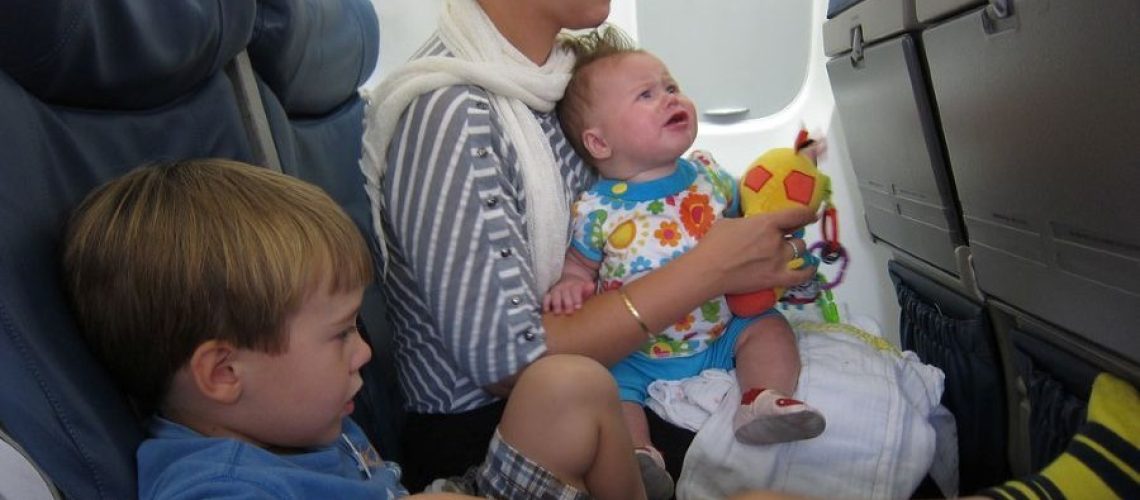
On a February day, 48-year-old Courtney Seard boarded the jet and settled in for the four-hour flight from London to Istanbul. To her dismay, a little boy in the row behind her began kicking the back of her airplane seat. In a March 2 article on Today.com, A Child Wouldn’t Stop Kicking Her Airplane Seat. Her No-Drama Response Is Going Viral, Seard described the way that she responded to the unwelcome jolting. “I don’t believe in addressing the child,” she said, ”I find that passive aggressive and rude.” Therefore, after waiting a few minutes for parental intervention, she appealed to the parents of the seat-kicker. Later, in a post on Threads, Ms. Seard recalled how the incident unfolded:
I calmly turned around looked at his parents and said one of you need to switch seats because I’m not going to tolerate 4 hours of your child kicking my seat and you NOT paying attention and properly parenting, BOOM the shock. The Dad said sorry and moved his child to the middle seat. Well played Pops. And yes, I realize I’m childfree in a childfilled world, but what I’m NOT gonna do is be inconvenienced by a lack of parenting (Threads, @courtneyseard).
The account of Courtney Seard’s “measured” reaction promptly went viral, drawing praise across the Internet as a model of skillful conflict resolution. One father with two small “frequent fliers” was quick to range himself on the side of the disrupted traveler, writing, “Kids existing in the world does not entitle them to not be parented or mean they can do whatever they want without consequence.” Numerous commentators shared their tales of being subjected to in-flight harassment by pint-sized monsters. Other respondents aired their disgust with parents’ failure to control their “crotch goblins” and “sex trophies.”
Ms. Seard, who offered her cookies to the little boy later in the flight, treated the child’s infraction lightly in a subsequent post: “It’s wasn’t his fault kids kick seats. I used to kick them too. I got popped in the legs as my consequence.” She emerges as the heroine in this story, a woman who knows her own needs and how to articulate them properly, who admits that she may not be “nice” but chooses to be “kind.” But does Ms. Seard, a performance trainer and motivational speaker who has worked with Fortune 500 company executives, really deserve such accolades for putting a distracted dad in his place?
In her 2020 TEDx talk, “Mindset Matters: The Art of Playing the Game to Win,” Ms. Seard disclosed that after a difficult childhood including abandonment by her mother, and a young adulthood marred by a catastrophic bicycle accident, she found transformation through embracing a positive mindset:
The world works in two ways—either you’re at cause for the things that happen to you in your life, or you’re at effect. And if your mind doesn’t know the difference between what’s real, remembered, or imagined, play the game that you are at cause, that you’re Player 1, and watch how things change. Because when you’re at effect, things are always happening to you. They’re always coming at you. But when you’re at cause, you’re the creator. And it’s just a game.
It is hard to deny that the pressing need to enforce some control over her traumatic past has profoundly shaped Courtney Seard’s philosophy of life and her reactions to the outward factors that she encounters in her day-to-day life. She is not alone in her views. As I delved deeper into popular reactions to the seat-kicking story, I became intrigued by commonalities that Seard appears to share with others who have embraced a child-free lifestyle—an intense focus on self-actualization and a difficult personal history. In the Reddit thread “No one has ever thought more about having children than childfree people,” one commentator opines that parenting “is nothing but sacrifice unless you work twice as hard to still be fulfilled as a person.” Another writer suggests that many “child-free” people may have made their decision to forego offspring in response to personal trauma stemming from child abuse, poverty, and related issues.
The same commentator further states,
I think a lot of us here understand the distinction between wanting children, which puts the emphasis on how the parent stands to gain from having children, and wanting to be a parent, which puts the emphasis on how the parents can benefit the children and give them the best possible upbringing.
Before the little ones have even been conceived, it seems, prospective parents need to have the game plan in place to assure their children the maximum amount of comfort with the minimum amount of suffering.
In another thread, “Are these valid reasons to have children?” one poster makes the comically circular assertion that “every kid deserves parents who are educated in child and adolescent development, have extensive parenthood experience and training.” The poster does nothing to explain how new parents can possibly be expected to have acquired the abovementioned “extensive parenting experience.” In addition, said parents must be “100000% capable of raising them to be healthy, happy, well-adjusted, sane, non-traumatized and fully educated adults who are fully capable of contributing positively to the global community.” The implication is that if a potential parent does not possess perfect certainty that these conditions will be met, parenthood is an irresponsible and selfish pursuit.
Whatever their views on children who may or may not be coming into the world, self-proclaimed child-free adults are put in the peculiar position of formulating a response to the children who are already here. Courtney Seard addressed the seat-kicking situation in a forceful manner that brings to mind Hillary Clinton’s controversial use of the adage “It takes a village to raise a child.” Could Ms. Seard’s in-flight chastisement be characterized as an honorable attempt to recall a disengaged dad to his self-appointed duties?
Ms. Seard’s statement on the plane is particularly notable in the light of her views about language, which she explains in one segment of her Tedx talk:
Say it the way you want it. Because your body is a robot, designed to do what your language—the computer code—wants you to do, be very precise with your words.
From an articulate and distinguished communicator with a painstakingly cultivated public image, Ms. Seard’s criticism of the father seems excessive. To ask that he stop his child from kicking is perfectly appropriate; to accuse him of “NOT paying attention and not properly parenting” is combative, regardless of the tone in which it is communicated, and Ms. Seard herself noted the stunned reaction of the parents. If her manner was, as she asserts, calm, it must have been the words themselves that produced the shock.
We do not know whether this mom and dad are attentive and loving caregivers who let their guard down out of travel fatigue, or whether they are neglectful parents who chronically leave their little boy to his own devices while they scroll mindlessly on their phones. However, we do know that Courtney Seard suffered childhood abandonment, because Seard has said so. We know that she was not properly and attentively parented, and it would be no surprise to discover that she still carries some unresolved childhood wounds, as most of us do. In this respect she deserves great compassion, and though it is impossible to say for certain, I prefer to believe that this grace was flowing through the tiny altercation in the airplane.
The fact that the father in question humbly and quietly acceded to his fellow flyer’s demand says more about his character than it does about the effectiveness of Courtney Seard’s interpersonal strategies. Was his child behaving inconsiderately? Of course. Should the dad have intervened sooner? Quite possibly. Nevertheless, to endure a direct attack on one’s character without one word or gesture of protest is extremely difficult, and he “opened not his mouth.” He simply got up and relocated his little boy. End of story, right? Not so much.
A truly appreciative response to this man would have been to brush off the event as one of the many little incidents, some to be relished and others to be endured, that crowd one’s days. This momentary blip, this tiny pebble in the shoe of a high-powered professional, did not have to get posted on Threads, where the father in question figures unflatteringly as “Pops,” a bumbling but ultimately tolerated figure in the personal drama of Courtney Seard (Player 1).
I cannot help imagining the humiliation of the young traveling couple whose unruly son’s behavior is plastered across the Internet on Newsweek and Today.com. It is to be hoped that they are not as touchy as I am; perhaps they have shaken their heads and embraced their mercurial burst of fame as a scrapbook memory to be savored for laughs; I envision Mom and Dad, a few decades down the line, regaling their son’s future bride with the awkward recapitulation of tension in the air between London and Istanbul. In any case, the potential embarrassment of the parents pales next to the deep societal wounds that have resurfaced in the wake of the story. Though it was doubtless not her intention, Ms. Seard’s post has elicited vitriolic displays of hatred from the online community against poorly-managed children and their presumably negligent parents, rising at its most hateful level to utter contempt for the institution of the family itself.
“When you start to create health, and happiness, and wealth as the things that you’re consistently focused on, they will come into your life,” Courtney Seard told the audience at her Tedx talk, “I have dramatically and drastically changed my life using these tools, and many people do consistently as well.” Her vision for self-actualization may inspire many in the corporate jungle to self-improvement, but it provides few occasions for child-free proponents like her to develop the patience and flexibility that are so richly offered by teething babies, sticky floors, and crayon scrawling on the wall. Quite possibly, the seat-kicking little boy on the plane presented a rare opportunity for character development greater than any that she had experienced in a long time. These days, a squirrely kid is hard to find.
Sadly, Ms. Seard has only to look around to see that her impression of being “childfree in a childfilled world” is in grave error. The tendency to relegate little ones to those spheres in which they are not likely to break or spill things, and in which they are given scant responsibility, is sadly rampant; as a result, they attain maturity much more slowly than previous generations, if at all. This dire situation is the fruit of today’s culture of self-fulfillment at all costs, which is adamantly “not gonna be inconvenienced by a lack of parenting” or any of the other potential pitfalls of imperfect children raised by imperfect parents in an imperfect world.
We are all too apt to like things our own way, but it shrinks us. When I preemptively arm myself against the risk of others violating my boundaries, intentionally or otherwise, this covert hostility bleeds into my best attempts to handle adverse situations with grace and restraint, transforming shared spaces into war zones. The greatest saints, on the other hand, learn to live peacefully in the mess.
On my refrigerator hangs a faded article torn from a parish bulletin, written by the late Msgr. Dan Arnold, director of the diocesan Cursillo movement, who died in March 2020. Discussing “the pearl of great price,” he declares, “Renunciation that helps us grow up makes our lives real in a way that daydreams don’t.” Fr. Dan, vocationally speaking, was “child free,” but in addition to the innumerable children of the spirit that he so gently shepherded, he was the proud uncle of fourth-grader JamieLynn, a nature lover who lost her life in 2017 after being struck by a tree branch in her backyard.
Those who have suffered the death of a child comprehend better than most of us the limits of our control and the price of love. Whether we are parents or not, catastrophe can strike without warning, and no armor of our forging can shield us from that possibility. We can practice for the big disasters, though, by extending grace in the little ones—whether we are shepherding flour-dusted grandkids in the kitchen, changing lanes on the expressway, or riding squeezed into a tin can hurtling through the stratosphere.


[…] Christianity & Islam Have a Long & Very Bitter History – The American SpectatorAn Inconvenient Child at 30,000 Feet – Dorothy Osanna at Catholic Stand MagazineTrump Cancels Miami Catholic Charities Migrant […]
This piece about an unexpected moment with a child is honest and touching. It feels real and memorable.