

Many protestants will criticize the images and statues in Catholic Churches. They accuse Catholics of violating the first commandment. A second argument specifically against the Crucifix is that it belittles the resurrection, and a cross should be empty. These arguments do not holdup.
You shall not have other gods beside me. You shall not make for yourself an idol or a likeness of anything in the heavens above or on the earth below or in the waters beneath the earth; you shall not bow down before them or serve them (Exodus 20:3-5).
John Calvin demanded clean white walled Churches with no art in order to make a clean break from the Catholic Church. Calvin wanted to avoid any possibility of breaking the first commandment regarding what some translations call “graven images,” but most translations now say “idols.” Regardless, neither translation implies not to make any images. An idol is not just any statue or picture. According to the Catholic.com Encyclopedia,
Idolatry etymologically denotes Divine worship given to an image, but its signification has been extended to all Divine worship given to anyone or anything but the true God.
This commandment is clearly talking about worshiping other Gods. One does not worship an image or statue unless one considers it a god. This commandment is not forbidding the creation of images, but rather the worship of them. The creation of any image is not forbidden. To the contrary, scripture actually commands the creation of images. In Exodus 25:18, God commands Moses to make the Ark with two large angels out of gold. Next, God commands Moses to make the Serpent. Later in First Kings, God commands statues of angels to be created in the temple. Also, early Christians were decorating tombs with sacred art. The Catacombs are full of these ancient images. In
783, the Second Council of Nicaea, the seventh ecumenical council, condemned idolatry, but emphatically upheld the use of and veneration of sacred images according to the New Advent Catholic Encyclopedia.
Therefore, we see the ancient Israelites making holy art, often at God’s command. Then, the early Christians continue the tradition of making holy images. Stained Glass windows and other art were created to share the Gospel to the illiterate. The Catholic Church has a long history of sacred art. The Orthodox take it a step farther with elaborate holy icons. Even most protestants today embrace religious art in and around their churches. There are many with images of the risen Christ and plenty with statues of a resurrected Jesus. Every Christmas season, most will also include the infant Jesus in some sort of Nativity scene. While there are still holdouts in the reformed tradition, most protestants today do not contend that any representation of Jesus, Father, or Holy Spirit constitutes idolatry. We can save discussion of images and statues of saints for another day, but the above applies to them as well.
The Crucifix
While many protestants accept some representation of Jesus, they still criticize the Crucifix. The aversion to the Crucifix is historically based on this anti-Catholic effort of Calvin and the Reformed tradition against all religious art. However, modern protestants are generally ignorant of this history and cling to the criticism that Catholics keep Jesus on the Cross. You might hear one say, “My Jesus is risen, not still on the cross.” This doesn’t explain why the same person will put a baby Jesus in a Nativity Scene. That said, it is a very biblical approach to venerate the crucifixion of Christ, meditate on it, pray about it, and preach the value of Christ’s sacrifice. St. Paul writes in 1 Corinthians 1:22-24,
Jews demand signs and Greeks look for wisdom, but we proclaim Christ crucified, a stumbling block to Jews and foolishness to Gentiles, but to those who are called, Jews and Greeks alike, Christ the power of God and the wisdom of God.
Later in chapter 2:1-2, Paul writes,
When I came to you, brothers, proclaiming the mystery of God, I did not come with sublimity of words or of wisdom. For I resolved to know nothing while I was with you except Jesus Christ, and him crucified.
The Images of Jesus
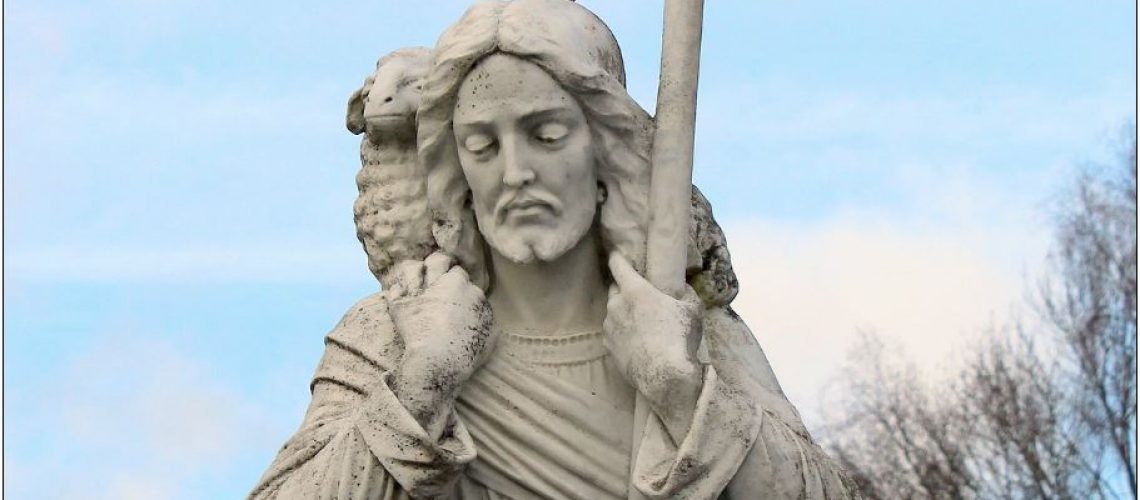
A visit to any Catholic Church will reveal multiple and very different representations of Jesus. Of course, every Catholic Church must have at least one Crucifix on or near the altar (GIRM, #308). Most will also have an infant Jesus, often in the arms of Mary, and sometimes the little Infant of Prague. Many will have an image of the resurrected Jesus that could be a painting, statue, or stained-glass window. Many also have the Divine Mercy Image, the Sacred Heart image, and or Jesus as the Good Shepherd holding a lamb. Some Churches will have the second coming with Jesus in the clouds. Some will also have Jesus depicted as lamb. And of course, most churches will have the stations of the cross depicting Jesus at different stages of His Passion.
Many find these visual aids valuable in steering their focus to God in a particular way. One might gaze at the crucifix during the Eucharistic prayer. There are times like after Communion where I find meditating on the Divine Mercy Image of Jesus helpful. When you feel bad about a mistake, the stations of the cross numbers three, seven, and nine with the images of Jesus falling can bring comfort. Not only can these images in the Church help us focus our prayer, but they can also assist in keeping distractions from hindering it. The benefit to such a variety of images, statues, and Holy art is there is something for everyone and their particular need. One can also simply close their eyes at times.
In his 1999 Letter to Artists, Pope Saint John Paull II wrote,
God became man in Jesus Christ… This prime epiphany of “God who is Mystery” is both an encouragement and a challenge to Christians, also at the level of artistic creativity. From it has come a flowering of beauty which has drawn its sap precisely from the mystery of the Incarnation.
It was God himself who presented humanity with an image in the flesh of the Second Person. From that day forward, human creativity and art would rightly portray our Lord for inspiration, prayer, encouragement, and beauty.





7 thoughts on “An Image of Jesus for Everyone”
Thanks for tackling these common Protestant criticisms! The points about images violating the first commandment and the Crucifix belittling the resurrection are often raised. I’m really interested in your perspective on why these arguments don’t hold up. Great topic!
Thanks for reading!
It’s great to see a clear take on the common criticisms regarding images and statues in Catholic churches. I found the discussion about the crucifix not belittling the resurrection, and why those arguments don’t hold up, particularly valuable.
Absolutely agree with every point made here. Too often, we get caught up in specific interpretations, but the core truth is that Jesus offers something vital for every human soul. It’s about personal connection, not just dogma. Well said!
Pingback: VVEDNESDAY LATE MORNING EDITION | BIG PULPIT
Thanks for reading. It’s funny, the protestants tend to use St. Paul to support their disagreements with the Catholic Church. I stand by Paul’s writing that he “preaches Christ Crucified.” Yes, it is shocking and bizarre to use the image of our tortured and crucified Lord in our prayer and worship. That’s exactly the point. Christianity is very different from every other religion and belief system. We worship a God who humbled himself rather than hefted his power upon us. Proper and fitting it is to use such an image, especially in the Mass. However, if the crucifix does not work for you, as I wrote, there are many other portrayals of Christ to use in personal devotion.
Pingback: An Image of Jesus for Everyone MEK Enterprises Blog - Breaking News, SEO, Information, and Making Money Online!The Number 1 Online Blog Worldwide!