
The meaning of the Sunday Mass Readings for August 2026 is made clearest by Catholic doctrine. “It is clear therefore that in the supremely wise arrangement of God, Sacred Tradition, Sacred Scripture and the Magisterium of the Church are so connected and associated that one of them cannot stand without the others” (CCC 95[1]). The Magisterium gives authoritative and unchanging clarification of Sacred Tradition and Scared Scripture in doctrine. Doctrine must be accepted as objectively true in order to be Catholic. Let’s see what doctrines – what unchanging truth – in the Catechism of the Catholic Church are takeaways from August’s Readings[2].
August 2, Eighteenth Sunday in Ordinary Time
In today’s First Reading, God announces that the benefits assured to King David will be fulfilled in an eternal covenant. “Christ instituted this New Covenant” (CCC 762). To fulfill this new, eternal covenant, “Christ ushered in the Kingdom of heaven on earth. The Church is the Reign of Christ already present in mystery” (CCC 763). Understanding the connection between God’s Covenants, the Kingdom of God, and the Catholic Church is essential to understanding the Catholic Faith.
“The miracles of the multiplication of loaves [as in today’s Gospel] . . . prefigure the superabundance” of the Eucharist (CCC 1335). The Eucharist is the “source and the summit” (CCC 1324) of the Church’s life.
- From the First Reading[3] (Isaiah 55:1-3): Is 55:1 is cited in CCC 694 and 2121; and Is 55:3 in CCC 762.
- From the Responsorial Psalm (Psalms 145:8-9, 15-16, 17-18): Ps 145:9 is cited in CCC 295 and 342.
- From the Alleluia (Matthew 4:4b): Mt 4:4 is cited in CCC 2835.
- From the Gospel (Matthew 14:13-21): Mt 14:13-21 is cited in CCC 1335; and Mt 14:19 in CCC 1329.
August 9, Nineteenth Sunday in Ordinary Time
“Kindness and truth shall meet,” the Responsorial Psalm proclaims. The Catechism cites this verse to affirm that love needs truth, and truth needs love. They supremely meet in God. “In all his works God displays not only his kindness, goodness, grace, and steadfast love, but also his trustworthiness, constancy, faithfulness, and truth” (CCC 214). There is more on real love in my coverage of the Twelfth Sunday in Ordinary Time.
The Catechism explains why people addressed Jesus as “Lord,” as Peter did in today’s Gospel. “At the prompting of the Holy Spirit, ‘Lord’ expresses the recognition of the [divinity] of Jesus” (CCC 448).
- From the First Reading (1 Kings 19:9a, 11-13a): 1 Kgs 19:1-14 is cited in CCC 2583.
- From the Responsorial Psalm (Psalms 85:9, 10, 11-12, 13-14): Ps 85:11 is cited in CCC 214; and Ps 85:12 in CCC 2795.
- From the Second Reading (Romans 9:1-5): Rom 9:4-5 is cited in CCC 839; and Rom 9:5 in CCC 449.
- From the Gospel (Matthew 14:22-33): Mt 14:30 is cited in CCC 448.
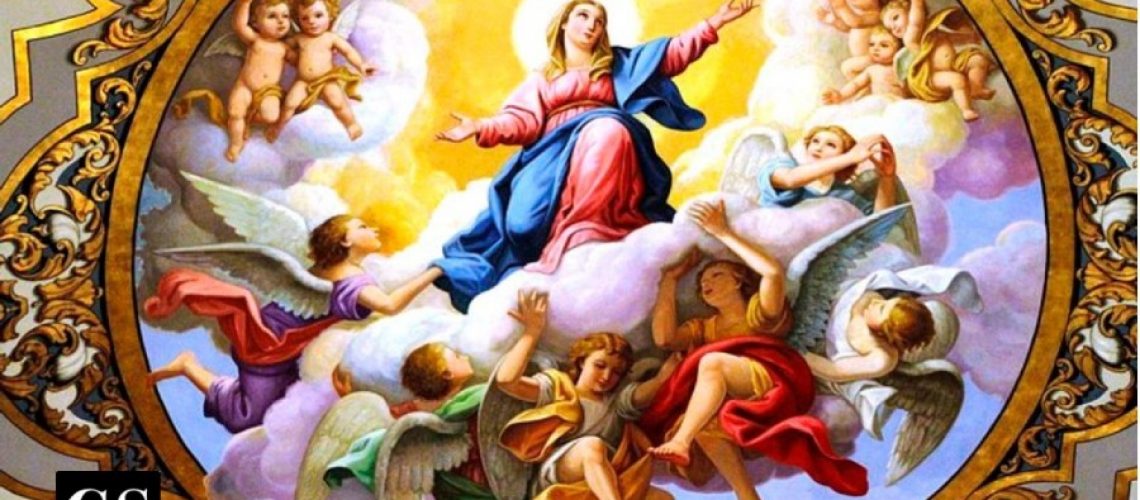
August 15, Assumption of the Blessed Virgin Mary at the Vigil Mass
None of the Readings for either the Vigil or the Mass of the Day is used by the Catechism to support the dogma of the Assumption: “when the course of her earthly life was finished, [Mary] was taken up body and soul into heavenly glory . . . so that she might be the more fully conformed to her Son, the Lord of lords and conqueror of sin and death” (CCC 966). (Dogma is infallible and unreformable doctrine.) So, Mary has the same kind of existence as Jesus has had since His Resurrection – supernatural existence which includes her body as well as her soul and which transcends death and earthly limitation (CCC 645).
The Second Reading reminds us why we need resurrection: “Man’s sins, following on original sin, are punishable by death” (CCC 602). God always has wanted and always will want human beings to be free of suffering and death (CCC 54-55). My coverage of the Twelfth Sunday in Ordinary Time also has more on original sin.
- From the Second Reading (1 Corinthians 15:54b-57): 1 Cor 15:56 is cited in CCC 602.
August 15, Assumption of the Blessed Virgin Mary Mass during the Day
The woman described in the First Reading is Mary (CCC 1138).
The Second Reading essentially means that “Christ’s Resurrection – and the risen Christ himself – is the principle and source of our future resurrection” (CCC 655). Christ is the principle of our resurrection because on the Last Day we will be transformed like He was at His Resurrection – to have supernatural bodies as well as souls. Christ is the source of our resurrection because we will only experience resurrected bodies thanks to Christ’s Resurrection.
Christ is the principle and source of Mary’s Assumption, which is her resurrection. “The Assumption of the Blessed Virgin is a singular participation in her Son’s Resurrection and an anticipation of the resurrection of other Christians” (CCC 966). Eternal salvation is being resurrected like Jesus and Mary.
- From the First Reading (Revelation 11:19a; 12:1-6a, 10ab): Rv 12 is cited in CCC 1138.
- From the Second Reading (1 Corinthians 15:20-27): 1 Cor 15:20-22 is cited in CCC 655; 1 Cor 15:20 in CCC 632; 1 Cor 15:21-22 in CCC 411; 1 Cor 15:24-28 in CCC 2855; 1 Cor 15:24 in CCC 668; 1 Cor 15:26 in CCC 1008; and 1 Cor 15:27-28 in CCC 668.
- From the Gospel (Luke 1:39-56): Lk 1:41 is cited in CCC 523, 717, and 2676; Lk 1:43 in CCC 448, 495, and 2677; Lk 1:45 in CCC 148 and 2676; Lk 1:46-55 in CCC 722, 2619, and 2675; Lk 1:46-49 in CCC 2097; Lk 1:48 in CCC 148, 971, and 2676; Lk 1:49 in CCC 273, 2599, 2807, and 2827; Lk 1:50 in CCC 2465; Lk 1:54-55 in CCC 706; and Lk 1:55 in CCC 422.
August 16, Twentieth Sunday in Ordinary Time
A takeaway from today’s Second Reading is that Catholics should respect the uniqueness of the Jewish faith among non-Christian religions: “The Jewish faith, unlike other non-Christian religions, is already a response to God’s revelation in the Old Covenant” (CCC 839). For example, Jewish faith believes in God sending a Messiah.
Yet, Jewish waiting for the Messiah “is accompanied by the drama of not knowing or of misunderstanding Christ Jesus” (CCC 340). Catholic doctrine calls for respecting the human dignity of every person and the universal right to freedom of religion, but “the Father willed to call the whole of humanity together into his Son’s Church. The Church is the place where humanity must rediscover its unity and salvation” (CCC 845). Evangelization which does not explicitly proclaim the importance of initiation into the Catholic Church is incomplete evangelization.
- From the Second Reading (Romans 11:13-15, 29-32): Rom 11:15 is cited in CCC 674; Rom 11:29 in CCC 839; Rom 11:31 in CCC 674; and Rom 11:32 in CCC 1870.
- From the Gospel (Matthew 15:21-28): Mt 15:22 is cited in CCC 439 and 448; and Mt 15:28 in CCC 2610.
August 23, Twenty-first Sunday in Ordinary Time
In today’s Gospel, Jesus tells Peter that he is the rock on which He will build His Church. Jesus made Peter the leader of the Twelve Apostles and of all His disciples (CCC 552).
This leadership of Peter, the first Bishop of Rome, passed on to succeeding Bishops of Rome. “The Pope, Bishop of Rome and Peter’s successor, . . . has full, supreme, and universal power over the whole Church, a power which he can always exercise unhindered” (CCC 882). The doctrine of the pope’s singular authority is called Papal Primacy.
This leadership of Peter and the bishops of Rome was unquestioned by those who personally knew Jesus and by those who personally knew those who knew Jesus. The first Christians were Catholics because they did what only Catholics do – accept the primacy of Peter and his successors. Why be Catholic? Catholics alone accept that Christ made Peter “shepherd of the whole flock” and that “[t]his pastoral office of Peter . . . belongs to the Church’s very foundation” (CCC 881). The pope’s pastoral office, or authority, is “to absolve sins, to pronounce doctrinal judgments, and to make disciplinary decisions in the Church” (CCC 553). “Discipline” in this sense means rules for discipleship in the Church, such as Canon Law and liturgical rubrics.
Papal Primacy does NOT mean that every pope is infallible whenever he teaches. Not all doctrine is infallible. No discipline is infallible. We are free to disagree with popes when they are not presenting doctrine and discipline, such as when they offer prudential judgments about social issues. Papal Primacy does not mean that a pope can change doctrine by contradicting doctrine. A pope may change discipline, but any change should be in harmony with doctrine. For more on the authority of the pope, see CCC 74-90, 888-896, 1555-1561, and 2032-2040.
- From the Responsorial Psalm (Psalms 138:1-2, 2-3, 6, 8): Ps 138:2 is cited in CCC 214.
- From the Alleluia (Matthew 16:18): see below.
- From the Gospel (Matthew 16:13-20): Mt 16:16-23 is cited in CCC 440; Mt 16:16 in CCC 424 and 442; Mt 16:17 in CCC 153 and 442; Mt 16:18-19 in CCC 881; Mt 16:18 in CCC 424, 442, 552, 586, and 869; and Mt 16:19 in CCC 553 and 1444.
August 30, Twenty-second Sunday in Ordinary Time
An important takeaway is from today’s Alleluia is: True faith opens a person to “the totality of God’s plan and the mysteries of faith, of their connection with each other and with Christ, the center of the revealed mystery . . . it is intrinsic to faith that a believer desires to know better the One in whom he has put his faith” which will “call forth a greater faith, increasingly set afire by love” (CCC 158).
As the Second Reading tells us, we should offer our bodies as “a living sacrifice” and as “spiritual worship.” “As does the whole of the Christian life, the moral life finds its source and summit in the Eucharistic sacrifice” (CCC 2031). As the very structure of the Catechism makes clear, to fully offer our lives to God is to believe, worship, act, and pray in harmony with Catholic doctrine (see CCC 1-3, 11-18).
Christ’s words in today’s Gospel means for most Catholics (those not called to poverty) that we should use something “insofar as it brings us closer to him, and to detach ourselves from it insofar as it turns us away from him” (CCC 226). We are spending our time and money well if our choices make us better able to believe, worship, act, and pray in harmony with Catholic doctrine. “God created everything for man, but man in turn was created to serve and love God and to offer all creation back to him” (CCC 358).
- From the First Reading (Jeremiah 20:7-9): Jer 20:7-18 is cited in CCC 2584.
- From the Second Reading (Romans 12:1-2): Rom 12:1 is cited in CCC 2031; and Rom 12:2 in CCC 2520 and 2826.
- From the Alleluia (Ephesians 1:17-18): Eph 1:18 is cited in CCC 158.
- From the Gospel (Matthew 16:21-27): Mt 16:21-23 is cited in CCC 540 and 607; Mt 16:21 in CCC 554; Mt 16:22-23 in CCC 554; Mt 16:24-26 in CCC 736; Mt 16:24 in CCC 226, 618, and 2029; Mt 16:25-26 in CCC 363; Mt 16:25 in CCC 2232; and Mt 16:26 in CCC 1021.
[1] CCC abbreviates Catechism of the Catholic Church. Any number after it is the number of a paragraph in the Catechism. For example, “CCC 95” means paragraph 95 of the Catechism.
[2] There are too many citations, or references, in the Catechism to the verses in a month of Sunday Mass readings to identify all the pertinent doctrines, so I will use my best judgment to select which verses and doctrines to cover in a column which may not exceed 2,000 words. The bullet points allow for further exploration of the Biblical basis of Catholic doctrine.
[3] If a Reading is not listed, then none of its verses is cited by the CCC.


[…] Gratis Asseritur, Gratis Negatur: Banning the T.L.M. with No Reason. . . – Fr. Z’s BlogThe Sunday Readings & Catholic Doctrine for August 2026 – Marty Dybicz at Catholic Stand MagPope Leo will Not Restore Latin Mass Permissions, […]