
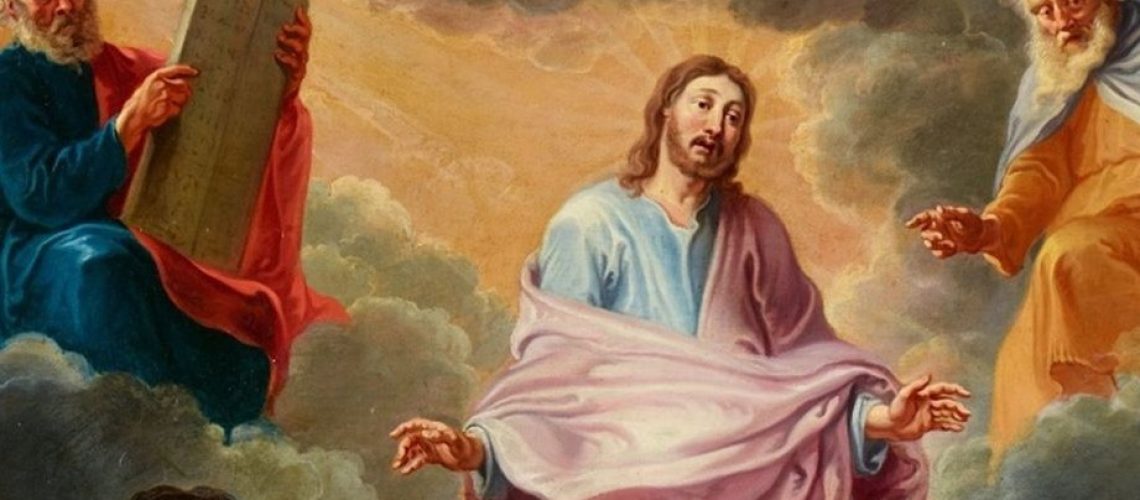
St. Matthew, more than any other Gospel writer, presents the Lord Jesus as the New Moses – the supreme Lawgiver who ascends the mountain, proclaims the Beatitudes, and reveals the Father’s glory. It is therefore fitting that in Liturgical Year A the Church places St. Matthew’s account of the Transfiguration (Matthew 17:1-9) before us.
His meticulous chronology begins with a theological time-bomb, “Six days later”, which recalls Exodus 24:16, where the glory of the Lord settled on Mount Sinai, and the cloud covered it for six days. St. Matthew signals that this is not merely a miracle; it inaugurates a New Covenant that supersedes the Old. The Lord Jesus is not merely a prophet; He is the very Word of the Father.
As we meditate on this great mystery, whether in the Luminous Mysteries of the Rosary or on the Second Sunday of Lent, we are invited to ascend that mountain ourselves. The three pillars of our reflection – “With Him on the Mountain,” “Listen to Jesus,” and “Ears that Hear” – form a spiritual ladder. They guide us from the radiant glory of Christ to the Father’s commanding voice, and finally to the interior disposition required to carry that glory down into the valley of daily discipleship.
With Him on the Mountain: The Ascent of the New Moses
To read St. Matthew correctly, hold the Old Testament in one hand and the New in the other, for Matthew draws parallels. When he writes that Jesus “led them up a high mountain, by themselves,” he evokes Moses ascending Sinai with Aaron, Nadab, and Abihu (Exodus 24:1 and 24:9). The crucial difference is that Moses ascended to receive the Law, whereas Jesus ascends as the Living Law. Moses went up to meet God, whereas Jesus goes up as God. The Transfiguration is the moment when the veil is drawn back, and the Apostles are given a glimpse of the divine hypostasis – the very nature of Christ concealed beneath His humble Galilean flesh.
The Shekinah Glory
St. Matthew tells us that Jesus was transfigured before them, and his face shone like the sun, and his clothes became white as light (Matthew 17:2). This is not reflected light; it is emitted light. In the Old Testament, Moses’ face shone because he had reflected the glory of God after speaking with Him (Exodus 34:29). But Jesus’ face shines from within. His clothes become dazzling white – the uncreated light of the Godhead, the same light that will fill the New Jerusalem, where the Lamb is the lamp (Revelation 21:23).
The call to be “with Him on the mountain” is the call to the interior life: Eucharistic Adoration, silent mental prayer, and a retreat from the world’s noise. The Lord Jesus leads them “by themselves.” While Christ died for all, the intimacy of contemplative prayer is a gift offered to those willing to leave the crowds behind.
The Vision of the Law and the Prophets
Moses (the Torah) and Elijah (the Nevi’im) appear with Jesus (Matthew 17:3). Together, they constitute the entire Hebrew Scriptures. They are not rivals but witnesses to Jesus’ identity. St. John Chrysostom notes that their presence proves that Jesus has power over both the living and the dead. Moses died and was buried (Deuteronomy 34:5-6), yet here he is, alive and conversing with the Lord. Elijah was taken up in a chariot of fire (2 Kings 2:11), and here he stands before the One who is the Fire of Love.
In Year A, we must focus on the Mosaic dimension. Jesus is the new and eternal High Priest who fulfils the old priesthood. He is the supreme Lawgiver who perfects the Decalogue through the Beatitudes. The Law was given amid thunder and lightning, terrifying phenomena that made Israel tremble. Yet on the Mount of Transfiguration, the Law (Moses) and the Prophets (Elijah) bow before the gentle majesty of the Son.
Our Ascent
To be “with Him on the mountain” means recognising that we, too, are called to radiate Christ’s love. The Catechism teaches that the Transfiguration strengthened the disciples’ faith in anticipation of the Cross, offering a foretaste of the glorious Resurrection and a pledge of our own resurrection (CCC 556).
When we spend time with Him in silence, our faces take on a radiance of peace and joy. We become living Gospels, written not in ink but in the light of the Spirit. The mountain, then, is not a geographical location but the state of grace we enter through the sacraments, particularly the Eucharist.
Listen to Jesus: The Primacy of the Beloved Son
Overwhelmed by the vision, Peter blurts out, “Lord, it is good for us to be here; if you wish, I will make three dwellings here, one for you, one for Moses, and one for Elijah” (Matthew 17:4). Though sincere, Peter is spiritually disoriented. He seeks to equate Jesus with Moses and Elijah and to build tents (sukkot) to prolong the celebration indefinitely. But “while he was still speaking, suddenly a bright cloud overshadowed them.” This is the Shekinah presence of Yahweh, the same cloud that filled the Tabernacle in the wilderness and the Temple of Solomon. From this cloud, the Father thunders, “This is my Son, the Beloved; with him I am well pleased; listen to him!” (Matthew 17:5).
The Father’s Command
This is the second time the Father has spoken from heaven. The first was at Jesus’ baptism, “This is my Son, the Beloved, with whom I am well pleased” (Matthew 3:17). Now, on Tabor, He repeats this exact phrase but adds: “Listen to him!” Because we (the disciples) desperately need to hear it. We love the glorious Jesus, the healer, the miracle-worker; but we do not want to listen to Jesus who speaks of betrayal, scourging, and crucifixion. Immediately preceding the Transfiguration, Peter rebukes Jesus for predicting His Passion, and earns the harshest rebuke: “Get behind me, Satan! You are a stumbling block to me; for you are setting your mind not on divine things but on human things” (Matthew 16:22-23). Now, on the mountain, the Father directly counteracts Peter’s erroneous thinking: “You wanted to silence Him when He spoke of the Cross? Now, listen to Him – even when what He says terrifies you.”
Obedience as Sacred Listening
To obey Jesus is ob-audire – to listen thoroughly. It is to so completely attune our ears to His voice that His will becomes our will. We drown in noise from podcasts, news alerts, social media, and endless chatter that fills every spare moment; yet we have forgotten how to listen. The Father’s command cuts through the static: “Listen to Him!” – not to the pundits, the zeitgeist, or your own ego, but to my Son.
This is ecclesial listening where Jesus speaks through His Body, the Church. We listen to Him in humble submission to the Magisterium, in attentive hearing of the readings at Holy Mass, and in the counsel of a wise spiritual director. The disciples fell to the ground in fear (Matthew 17:6), but Jesus immediately touched them, saying, “Get up and do not be afraid” (Matthew 17:6–7). This is the essence of our faith: a God who is so transcendent that He terrifies us, yet so merciful that He stoops to lift us up.
Ears that Hear: The Disposition of the Heart
It is not enough that the Word is spoken; we must have the spiritual capacity to receive it. In the Parable of the Sower (Matthew 13), the seed falls on rocky ground or among thorns. The problem is not the seed but the soil of the heart. Some people have ears yet do not truly hear (Matthew 13:13). The Transfiguration is a divine cure for spiritual deafness. The Apostles saw the glory and heard the voice, but did they retain what they heard?
The Prophetic Tradition of Listening
The Prophet Isaiah spoke of the Servant of the Lord who would possess an opened ear (Isaiah 50:4). Jesus perfectly embodies this. His humanity is entirely receptive to the Father’s will (Matthew 26:39). St. Matthew emphasises that the disciples were “overcome by fear” and fell prostrate. But Jesus touches them and commands them to rise from spiritual death (egeiro) (Matthew 17:7). To have ears that hear is to be raised from the paralysis of sin and fear.
The Touch of the Sacraments
Ears that hear God’s voice are a gift of the Holy Spirit, mediated through the Sacraments. In the Rite of Baptism, the priest or deacon touches the child’s ears and mouth, praying: “The Lord Jesus made the deaf hear and the mute speak. May He soon touch your ears to receive His word, and your mouth to proclaim His faith.” This ancient ritual acknowledges that we are all born spiritually deaf to God’s voice. We hear the world’s seductions of power, the allure of wealth, and the noise of vanity. But the still, small voice of the Lord (1 Kings 19:12) requires a supernatural hearing aid: the Holy Spirit working through the Sacraments. The Eucharist strengthens our capacity to listen; Reconciliation clears the static of sin. Venial sins dull our sensitivity, while mortal sin completely severs the connection. A good confession restores clarity to the line.
Mary, the Model of Listening
The ultimate model of “ears that hear” is the Blessed Virgin Mary, the theological backdrop to the entire Gospel. At the Annunciation, Mary says, “Here am I, the servant of the Lord; let it be with me according to your word” (Luke 1:38). She does not fully grasp the mystery nor the depth of the sorrow she will endure, yet she trusts. She listens (Luke 2:19). We do not listen to God merely to gather information; we listen to treasure His words, storing them in the inner sanctuary of the soul, so that when the valley of the shadow of death descends, we have the light of the Word to guide us.
Descending with the New Moses
When the disciples looked up after the voice, they saw no one except Jesus Himself alone (Matthew 17:8), just as He always looked – the humble carpenter from Nazareth. The vision faded. Moses and Elijah were gone. The light receded. The vision was over. But the Apostles had changed. They had seen beneath the veil. They had heard the Father’s voice. They had been touched and told, “Do not be afraid.” They were ready to descend; but they descended into the chaos of the demon-possessed boy (Matthew 17:14-21).
Often, it is in the valley of suffering (when we are stripped of consolations) that our ears are finally opened. In silence and pain, we cry out, “Lord, have mercy!” and we finally hear His response. St. Matthew’s account concludes with a command, “Tell no one about the vision until after the Son of Man has been raised from the dead” (Matthew 17:9). This paradoxical silence is necessary because the glory of the Resurrection is the hermeneutical key to the Gospel. Without the Cross, the Transfiguration is merely a dazzling light show; with the Cross, it becomes the promise of our own deification.
Take-Home Message
This is the rhythm of the Christian life in Liturgical Year A. We ascend the mountain to be transfigured; we descend to be transformed. We go to Mass to gaze upon the Eucharist (the Body of Christ, shining with Tabor’s glory) and we leave to bring that hidden glory to a world shrouded in darkness.
The Transfiguration is not an escape from reality but a lens through which we must view it. When we cultivate ears to hear the Father’s voice, we are granted the grace to see the crucified Christ in every suffering neighbour, to find the risen Christ in the Eucharist, and to carry the hope of Tabor into the heart of Golgotha.
Let us pray for the grace to accept His invitation, to heed the Father’s command, and to cry out with St. Peter: “Lord, it is good that we are here!”—not to camp out, but to be fortified for the journey. For if we have ears to hear, even the Cross becomes a throne, and every valley becomes a road leading home to the eternal mountain of Heaven.
A glance upwards, and we see Him. Jesus alone. And that is enough.
Amen.
*NB: Unless specifically stated, all Bible quotations are from the NRSVCE.


[…] Original Liturgy Wars: Raling Against Liturgical Abuses in the New Mass – Fr. A.J. McDonaldA Matthean Reflection on the Transfiguration – Dr. Pamela Mandela at Catholic Stand MagazineHow Did I Go from Writing Theology to Fiction? […]