The meaning of the Sunday Mass Readings for November 2026 is made clearest by Catholic doctrine. “It is clear therefore that in the supremely wise arrangement of God, Sacred Tradition, Sacred Scripture and the Magisterium of the Church are so connected and associated that one of them cannot stand without the others” (CCC 95[1]). Sacred Scripture at Mass cannot stand fully without the Magisterium (the pope and bishops). The Magisterium’s role is to give doctrine, which is the authoritative and unchanging clarification of Sacred Tradition and Sacred Scripture that must be accepted as objectively true in order to be Catholic. Let’s connect doctrines in the Catechism of the Catholic Church with November’s Readings[2].
November 1, Solemnity of All Saints
Today we celebrate and honor “those who dwell in heaven” (CCC 956). Heaven is being in the direct presence of God. For humans, this is with souls separated from dead bodies. Those humans who dwell in Heaven are the saints, canonized or not. They include “the servants of the Old and New Covenants (the twenty-four elders), the new People of God (the one hundred and forty-four thousand), especially the martyrs . . . the all-holy Mother of God . . . and finally a great multitude which no one could number (CCC 1138).” For more on Heaven, see CCC 1023-1029.
Of all in today’s Gospel, let’s focus on “Blessed are the clean of heart,” given the nature of this column. It “refers to those who have attuned their intellects and wills to the demands of God’s holiness, chiefly in three areas: charity; chastity or sexual rectitude; love of truth and orthodoxy of faith. There is a connection between purity of heart, of body, and of faith” (CCC 2518).
- From the First Reading[3] (Revelation 7:2-4, 9-14): Rev 7:2-3 is cited in CCC 1296; Rev 7:9 in CCC 775 and 1138; and Rev 7:10-12 in CCC 2642.
- From the Responsorial Psalm (Psalms 24:1bc-2, 3-4ab, 5-6): Ps 24:6 is cited in CCC 2582.
- From the Second Reading (1 John 3:1-3): 1 Jn 3:1 is cited in CCC 1692; 1 Jn 3:2 is cited in CCC 163, 1023, 1161, 1720, 2519, and 2772; 1 Jn 3:3 is cited in CCC 2345.
- From the Alleluia (Matthew 11:28): Mt 11:28 is cited in CCC 1658.
- From the Gospel (Matthew 5:1-12a): Mt 5:1 is cited in CCC 581; Mt 5:3-12 in CCC 1716; Mt 5:3 in CCC 544 and 2546; Mt 5:8 in CCC 1720 and 2518; Mt 5:9 in CCC 2305 and 2330; and Mt 5:11-12 in CCC 520.
November 8, Thirty-second Sunday in Ordinary Time
Readings from this week and next week prepare us to better celebrate the Solemnity of Christ the King in two weeks.
Today’s Second Reading describes what will happen to the living and the dead when Christ returns to earth (CCC 1001). As Christ rose from the dead into an eternal existence with not only a soul, but also a glorified body immune to suffering and death, so will the righteous be raised (CCC 988-1004). Those who are living when Christ returns will likewise be transformed to have eternal bodies and souls (CCC 1060).
“This eschatological [end-time] coming could be accomplished at any moment” (CCC 673), as in today’s Alleluia.
The time between the Resurrection of Christ and the resurrection of the dead is “a time of watching and waiting,” as in today’s Gospel parable – “a time of the Spirit and of witness, but also a time marked by distress and the trial of evil which does not spare the Church and ushers in the struggles of the last days” (CCC 672).
- From the Second Reading (1 Thessalonians 4:13-18 or 1 Thessalonians 4:13-14): 1 Thes 4:13-14 is cited in CCC 1012; 1 Thes 4:14 in CCC 649 and 989; 1 Thes 4:16 in CCC 1001; 1 Thes 4:17 in CCC 1025; and 1 Thes 4:18 in CCC 1687.
- From the Alleluia (Matthew 24: 42a, 44): Mt 24:44 is cited in CCC 673.
- From the Gospel (Matthew 25:1-13): Mt 25:1-13 is cited in CCC 672 and 796; Mt 25:1 in CCC 672; Mt 25:6 in CCC 1618; and Mt 25:13 in CCC 672.
November 15, Thirty-third Sunday in Ordinary Time
Awaiting the return of Christ, as today’s Second Reading and Gospel exhort us, includes this awareness:
Before Christ’s second coming the Church must pass through a final trial that will shake the faith of many believers. The persecution that accompanies her pilgrimage on earth will unveil the “mystery of iniquity” in the form of a religious deception offering men an apparent solution to their problems at the price of apostasy from the truth. The supreme religious deception is that of the Antichrist, a pseudo-messianism by which man glorifies himself in place of God and of his Messiah. (CCC 675)
Apostasy is “total repudiation of the Christian faith” (CCC 2089).
- From the Second Reading (1 Thessalonians 5:1-6): 1 Thes 5:2-3 is cited in CCC 675; 1 Thes 5:2 in CCC 673; 1 Thes 5:5 in CCC 1216; and 1 Thes 5:6 in CCC 2849.
- From the Alleluia (John 15: 4a, 5b): Jn 15:4-5 is cited in CCC 787; and Jn 15:5 in CCC 308, 737, 859, 864, 1694, 2074, and 2732.
- From the Gospel (Matthew 25:14-30): Mt 25:14-30 is cited in CCC 546 and 1936; Mt 25:21 in CCC 1029, 1720, and 2683; and Mt 25:23 in CCC 1029 and 1720.
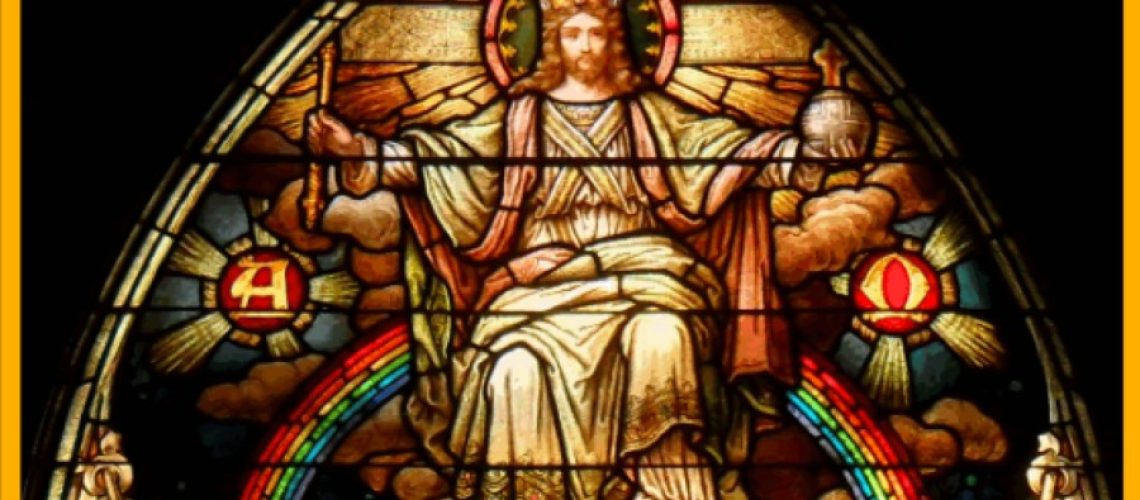
November 22, The Solemnity of Our Lord Jesus Christ, King of the Universe
When we celebrate Christ’s Kingship of the universe, we celebrate the Kingdom He establishes. What is this Kingdom?
The Kingdom is not Heaven, which, as we saw on the Solemnity of All Saints, is being in the direct presence of God but only with souls separated from dead bodies. Existence in the eternal Kingdom of God will include transformed bodies as well as souls, as we saw two weeks ago and as in today’s Second Reading (CCC 997).
Jesus’ mission was to establish the Kingdom on earth (CCC 541-542). The Kingdom is the fulfillment of the Old Testament—as we proclaim in today’s Alleluia. It is the restoration of Eden before Original Sin (CCC 374-379): perfect human existence because of perfect relationship with God, with each other, and with all God has created (CCC 1042-1050). The Kingdom transcends Eden because the Kingdom is freedom even from the possibility of sinning (CCC 1045). And, so, the Kingdom is perfect human happiness (CCC 1720).
The Kingdom was the theme of Jesus’ preaching (CCC 543-546): what He Himself preached (Mark 1:15), what He said to seek before seeking anything else (Matthew 6:33), what He taught to pray for in the Our Father, and the subject of many of His parables. It was what He instructed His disciples to preach (Matthew 10:7; Luke 9:2, 10:9) and what He and the Apostles discussed between the Resurrection and the Ascension (Acts 1:3-8).
The Kingdom was the theme of Jesus’ miracles. Each of His miracles reveals something about human existence freed from evil (CCC 547-550, 554-556). Jesus died for our sins to allow us entry into the Kingdom (CCC 613-617). His Resurrection reveals most clearly what existence in the Kingdom will be like for us, as we see in today’s Second Reading (CCC 645-646, 651-655).
Jesus has begun the Kingdom on earth by founding the Catholic Church (CCC 763), for example, by giving the keys of the Kingdom to Peter and his successors (CCC 551-553). The Kingdom is the goal of Catholic liturgy (CCC 1130), Catholic morality (CCC 1724), and Catholic prayer (CCC 2565).
Jesus will complete the Kingdom on earth when He returns to earth in glory on the Last Day to judge the living and the dead, as we see in today’s Second Reading and Gospel. Jesus will not take away from the earth those who are saved but, with His Father and Their Spirit, will come to be among them in a transformed universe (CCC 671-679).
As we repeat Gabriel’s announcement to Mary in the Creed, Jesus’ Kingdom will have no end. The Kingdom is the fullness of eternity since it includes body and soul, a new Heaven and a new earth, spiritual reality and physical reality combined in a way that transforms physical reality beyond space and time while not eliminating its physicality, with complete and eternal freedom from death as well as from all other pain and evil (CCC 1042-1050). The final establishment of the Kingdom does not mean the end of Hell (CCC 1033-1037), as we see in today’s Gospel. When we think salvation, we should think the Kingdom of God.
One requirement to enter the Kingdom is to “do for the least of [Christ’s] brothers,” as today’s Gospel enjoins us. Catholic social doctrine is covered in CCC 2234-2246, 2258-2317, 2351-2359, 2401-2463, and 2488-2499. Note that the Church rejects both socialism and unbridled capitalism. “Regulating the economy solely by centralized planning [which is socialism] perverts the basis of social bonds; regulating it solely by the law of the marketplace fails social justice, for there are many human needs which cannot be satisfied by the market (CCC 2425).
We celebrate the end of the Liturgical Year by celebrating the end of salvation history and the fullness of eternal salvation. Thy Kingdom come!
- From the First Reading (Ezekiel 34:11-12, 15-17): Ez 34:11-31 is cited in CCC 754.
- From the Responsorial Psalm (Psalms 231:1-2, 2-3, 5-6): Ps 23:5 is cited in CCC 1293.
- From the Second Reading (1 Corinthians 15:20-26, 28): 1 Cor 15:20-22 is cited in CCC 655; 1 Cor 15:20 in CCC 632 and 991; 1 Cor 15:21-22 in CCC 411; 1 Cor 15:24-28 in CCC 2855; 1 Cor 15:24 in CCC 668; 1 Cor 15:26 in CCC 1008; and 1 Cor 15:28 in CCC 130, 294, 671, 674, 1050, 1060, 1130, 1326, 2550, and 2804.
- From the Gospel (Matthew 25:31-46): Mt 25: 31-46 is cited in CCC 544, 1033, 1373, 2447, and 2831; Mt 25:31-36 in CCC 2443; Mt 25:31 in CCC 331, 671, 679, and 1038; Mt 25:32 in CCC 1038; Mt 25:36 in CCC 1503; Mt 25:40 in CCC 678, 1397, 1825, 1932, and 2449; Mt 25:41 in CCC 1034; Mt 25:45 in CCC 598, 1825, and 2463; and Mt 25:46 in CCC 1038.
November 29, First Sunday of Advent
Happy New Liturgical Year!
The Readings in Advent have the theme of coming. The word Advent means “coming.” Two comings of Christ are celebrated during Advent: the First Coming of God the Son when He was born of Mary and His Second Coming at the end of time. Advent’s Readings are cited in the Catechism to support doctrines about both the First Coming and the Second Coming.
An important meaning of Jesus’ warning to us to stay watchful until He comes again, in today’s Gospel, is that “[w]e are engaged in a spiritual battle” (CCC 2846), a battle over whether to give in to temptation. “[V]ictory becomes possible only through prayer” (CCC 2849), which is why prayer is one of the four pillars of the Catholic Faith – along with creed, worship, and morality (CCC 13). While prayer should be very personal, it should never contradict Catholic doctrine (CCC 2558).
- From the Gospel (Mark 13:33-37): Mk 13:33-37 is cited in CCC 672 and 2849.
[1] CCC abbreviates Catechism of the Catholic Church. Any number after it is the number of a paragraph in the Catechism. For example, “CCC 95” means paragraph 95 of the Catechism.
[2] There are too many references in the Catechism to the verses in a month of Sunday Mass Readings to cover all the connected doctrines, so I have used my best judgment to select which verses and doctrines to cover in a column which may not exceed 2,000 words. The bullet points allow for further exploration of how Catholic doctrine clarifies Sacred Scripture.
[3] If a Reading is not listed, then none of its verses is cited by the CCC.

In Matthew 25, the “brothers” of Christ are the same as elsewhere in Matthew: his disciples. The passage describes a judgment of people based upon how they have treated Christians. The “least ones” is also a reference to the followers of Jesus, similar to other terms of endearment such as “little flock”, “little children”, “little ones”, etc.. The passage offers no basis for Catholic Social Teaching; it is about the vindication of the suffering church.