
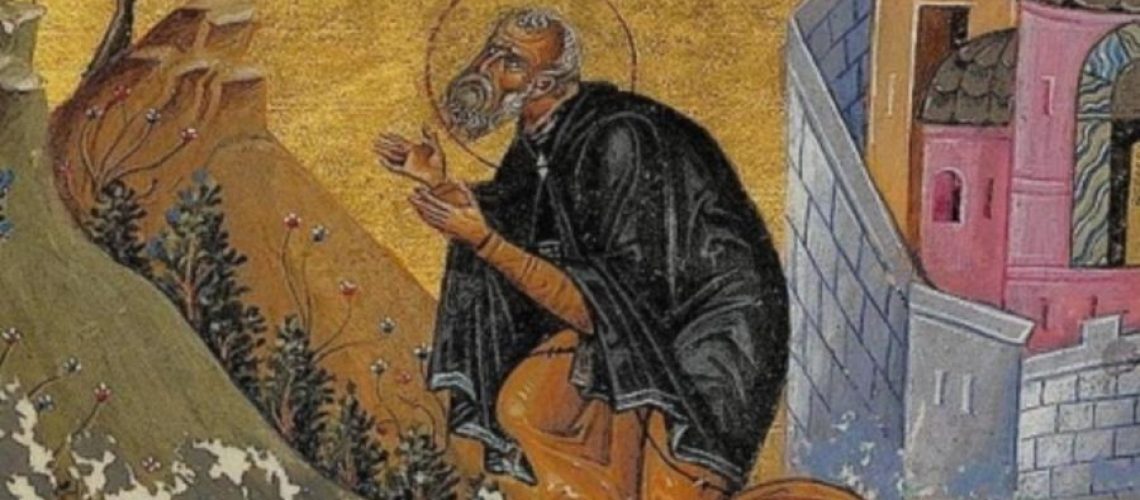
Miracles of St. John the Silent
The miracles recorded in the life of St. John the Silent, as preserved by his disciple and biographer Cyril of Scythopolis in The Lives of the Monks of Palestine, are not presented as exotic marvels designed to dazzle the credulous. Each intervention is a targeted response to genuine human desperation, revealing in its particularity the attentive and personal love of God for those who trust Him. They form a cohesive portrait of divine power operating through a human vessel so emptied of self that nothing remained but transparent charity.
Around the year 490, as a fugitive bishop in the unfamiliar wilderness outside Jerusalem, John fell to his knees and wept, begging heaven to show him a place of perfect seclusion where his soul could rest. His prayer was answered not with a map or a human guide, but with the piercing radiance of a bright, luminous cross suspended in the night sky. A voice, clear and commanding yet unmistakably gentle, spoke: “If you desire to be saved, follow this light.” The cross began to move, gliding over the dark hills, and John, with no luggage but his faith, rose and followed. It stopped precisely at the gates of the monastery governed by the great St. Sabas.
This miracle of divine GPS, the Guiding Cross, is the response to the universal human cry for direction when the future is opaque and every path looks the same. It teaches that God does not merely allow us to wander; He actively guides those who are willing to leave everything and follow His light, even when that light leads into a deeper desert.
Years later, during his isolated hermitage around 494, the violence of the fallen world sought him out. Saracen raiders, hardened men of the desert who lived by the blade, spotted the solitary and vulnerable monk. They advanced to rob and likely kill him. But the God who commands the beasts of the field intervened. A massive lion, its mane a dark halo in the harsh sun, emerged silently from the brush and positioned itself between the saint and his would-be attackers. There was no roar, no lunge. But only the quiet, terrifying authority of a king who needs to prove nothing. The brigands, who feared no unarmed man, fled in terror from this beast that acted as John’s guardian. The same God who shut the mouths of lions for Daniel in the den now weaponized the majesty of a lion to defend His silent servant.
When the doubting disciple Roubâ demanded a festive Easter meal, a tangible proof of the Resurrection’s joy, John’s counsel of trust fell on deaf ears. But after Roubâ stormed away in bitter unbelief, providence arrived on foot: a complete stranger, unknown to both John and any other monk, appeared at the cave entrance bearing steaming bread, dark wine, golden oil, soft cheese, and dripping honeycomb. The man set down these provisions and vanished as mysteriously as he had come, an angelic caterer from a kitchen beyond the world. This was a direct, Eucharistic response to the demand for a sign, proving that God is not offended by our hunger but by our refusal to trust that He can and will feed it.
Perhaps the most intimate miracle was the healing of John’s own biographer. Cyril of Scythopolis, the monk who would later record these events for posterity, fell gravely ill. The sickness was not merely physical but had a moral and spiritual dimension rooted in his disobedience to the elder’s counsel. In a dream-vision, John himself appeared to the feverish Cyril. Not with the gentle demeanor of a passive recluse but with the stern, and corrective love of a spiritual father. He rebuked him for his failure to obey and, in that very rebuke, promised healing. Cyril woke, obeyed the elder’s instruction to go to a specific location, and was instantly and completely healed. This miracle of the Dream-Healing demonstrates that the gift of diakrisis that is, the spiritual discernment of souls, was operative in John with surgical precision. His silence had made him a diagnostician of the human heart; his word, when it came, carried the power to restore both body and soul.
Even after his death on 8 January 558, the miracle-working power that flowed through John did not cease. Numerous pilgrims reported cures of both physical and mental afflictions at his burial site. The number of the faithful seeking his intercession grew so large that a church had to be erected over his tomb to house them. The posthumous healings testify that John’s life was not an escape from the human family but an entry into a deeper, more effective solidarity with it, the communion of saints, wherein death is not a barrier but a bridge.
These miracles are not baroque marvels designed to dazzle; they are, in every case, responses to concrete human need direction for the lost, protection for the vulnerable, provision for the hungry, healing for the sick. John’s silence was never indifference.
Lifestyle: An Application to Leadership and Community Life
John’s decision to conceal his episcopal identity and serve as a menial labourer for four years is arguably the most radical exercise of humility in patristic hagiography. He understood a truth that can revolutionize every sphere of human life, from the Oval Office to the family dinner table: “status is a costume; character is the skin.”
A costume is donned and doffed. It is the external designation, the title, the office, the corner suite, and the Instagram verification badge. It is useful, sometimes necessary, but always temporary. The skin, however, is the living organ of identity. It cannot be removed without death. Character, the settled, habitual disposition to choose the good regardless of cost, is the moral skin of the human person. John, a Successor of the Apostles by sacramental ordination, scrubbed latrines not because he despised his episcopal dignity but because he refused to let the costume of his office become a substitute for the substance of his soul.
For leaders at every level; notably from presidents and governors to pastors, CEOs, and parents, this ethic demands a radical reorientation. A leader who understands that status is a costume will wear authority lightly, with the detachment of one who knows they are dressed for a role that will eventually end. Such leaders will listen to criticism without feeling personally attacked; they will surround themselves with truth-tellers rather than flatterers; they will step down gracefully when their term expires. More importantly, they will invest their primary energy not in protecting their image but in cultivating their integrity.
Applied to family life, the parent who internalizes this truth will understand that their authority over children is a stewardship for formation, not a license for domination. They will not demand respect based on their title of “father” or “mother” but will earn it through the consistent witness of sacrificial love. When a father apologizes to his child for losing his temper, he is taking off the costume of infallibility and revealing the skin of authentic humanity. This act does not diminish his authority; it grounds it in truth, which is the only ground that lasts.
The ultimate fruit of this ethic is the creation of a lovely community. A communio where persons are valued for who they are, not for what they produce or what position they hold. In such a community, the elderly are not discarded as unproductive but revered as repositories of wisdom. The disabled are not marginalized as burdens but celebrated as prophets of a different, deeper way of being human. The poor are not patronized but recognized as the privileged presence of Christ. This is the soil in which saints grow. No saint has ever been mass-produced by a culture of status anxiety. Saints are the harvest of communities that have learned, like John, to treat every human title as a coat to be hung at the door of the banquet hall where all are equally beloved children of the one Father. When status is relativized, holiness flourishes; and when holiness flourishes, souls return to God.

