

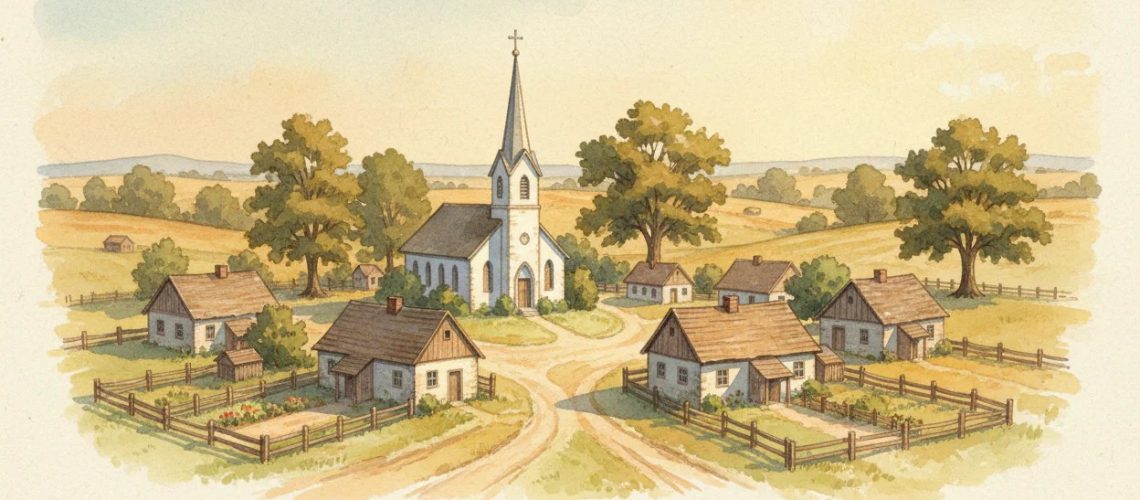
There are places in American history that pulse with the hidden faith of our ancestors—places where the scent of candles, the sound of hymns, and the sacrificial spirit of community can still be felt in the very soil. The Saint Joseph Colony in Arkansas is one such sacred ground, a living testament to the courage and devotion of Catholic immigrants who crossed continents in search of religious freedom and a life rooted in Christ. On May 8, 1892, a devastating tornado destroyed the Saint Joseph Colony. More than a century later, on September 23, 2000, Journeys of Faith moved onto land that had once been part of the Saint Joseph Colony.
For those of us who believe that the stories of the saints, Eucharistic miracles, and Marian apparitions are more than relics of the past—that they are guides for our own journeys of faith—the history of this remarkable colony offers both inspiration and consolation. Drawing upon the legacy of Bob and Penny Lord’s beloved work and the mission of Journeys of Faith, this article invites readers into the story of Saint Joseph Colony: a tale of simple faith, heroic perseverance, and the ever-present hand of Divine Providence. Journeys of Faith and Holy Family Mission now stand upon land that was once part of the Saint Joseph Colony, also known as Marienstadt—German for “Mary’s Place.”
As we open the pages of this community’s past, let us reflect not only on historical dates and immigrant names, but also on the witness of ordinary Catholics who, united in hope and love for Jesus in the Eucharist, shaped a legacy that continues to enrich the Church today. May their sacrifices rekindle within us a deeper desire for holiness and devotion, because their story is not merely history—it is a living call to journey in faith wherever the Lord may lead.
Planting Seeds of Faith
When Father Joseph Strub CSSP first set foot in Arkansas, the landscape before him was both unfamiliar and filled with possibility. The lush hills, open fields, and close-knit towns seemed an unlikely stage for his next mission, yet Father Strub arrived carrying an unshakable conviction that God had a purpose for his journey. He was no stranger to hardship; his life had already been marked by trials that tested hope and perseverance. Arkansas, however, offered a new field in which faith could flourish.
Each day, Father Strub embraced a simple but profound calling: to become the hands and feet of Christ wherever he was needed. He visited isolated families, listened to struggling farmers, and celebrated worship in small makeshift chapels where hymns echoed through rough-hewn timber walls. There was no clear roadmap—only the quiet guidance of the Holy Spirit directing his steps.
The work was not easy. Conversations about faith in a region shaped by different traditions required patience, humility, and compassion. Father Strub learned to plant seeds quietly through acts of kindness and faithful witness, living the Gospel rather than proclaiming it from a distance. Bible studies began humbly, sometimes with only a handful of neighbors gathered by lamplight. Young people were drawn to the missionary priest whose calm spirit and unwavering peace stirred curiosity and trust.
From these modest beginnings, Father Strub’s ministry became a story of slow but steady spiritual growth. Relationships were strengthened over shared meals, and trust deepened through seasons of hardship and harvest alike. Again and again, he discovered that spiritual fruit grows best when watered with grace, service, and genuine love—a truth that shaped every aspect of his ministry in the heart of Arkansas.
Origins of Saint Joseph Colony
In the quiet dawn of the late nineteenth century, amid America’s restless expansion, a small group of devout Catholic immigrants set out on a journey that would test their faith, endurance, and unity. German, French, Italian, Swiss, and Polish Catholics sought not only economic opportunity, but also the freedom to preserve a way of life deeply rooted in the Catholic faith.
The story of Saint Joseph Colony began as an answer to prayer. In post–Civil War America, many Catholic immigrants faced mounting economic hardship and cultural pressures that threatened the traditions and values they had carried from Europe. At the same time, reports of fertile farmland and new opportunities in the untamed regions of Arkansas spread among Catholic communities.
Encouraged by missionary priests and faithful lay leaders, families responded with courage and hope. Alongside their few possessions, they carried rosaries, missals, crucifixes, and cherished statues of Saint Joseph, protector of families. They traveled by river and rugged roads, praying the Rosary at dusk and entrusting their future to the Sacred Heart of Jesus and the care of Saint Joseph.
When they arrived in Conway County, they encountered a land both beautiful and demanding. Forested hills and isolated valleys required exhausting labor before homes, fields, and churches could be built. Yet the settlers understood that the church must stand at the center of community life. Their first humble chapel quickly became the spiritual heart of the colony. German hymns and Latin chants soon rose into the Arkansas air, sanctifying both the land and the labor of the people.
The settlers named their new home “Saint Joseph Colony,” placing it under the protection of the foster father of Jesus. In Saint Joseph they found a model of fidelity, humility, sacrifice, and quiet perseverance. The colony became more than a settlement; it became a living testimony to Catholic faith sustained through hardship, liturgical life, and mutual charity—an echo of the Church’s timeless exhortation: “Go to Joseph.”
Community Rooted in Christ
When Father Joseph Strub arrived in America, he brought more than personal hopes and missionary zeal—he carried a vision. The Saint Joseph Colony was to become more than a settlement; it would be a Catholic community rooted in faith, prayer, and mutual support. With deep trust in God and compassion for immigrants and local residents alike, Father Strub sought to create a haven where believers could grow in holiness and help one another remain faithful to Christ.
The early years were marked by uncertainty. Settlers struggled with language barriers, cultural differences, and the hardships of frontier life. Yet Father Strub believed firmly that the Body of Christ grows strongest through unity. He gathered the people together for prayer, worship, and works of charity. Makeshift chapels and communal kitchens became places not only of nourishment, but also of spiritual renewal.
Stories from those years speak of children learning catechism beneath towering oak trees and families sharing simple meals while listening to Father Strub speak about God’s providence. Hand-carved crosses, treasured prayer books, and handwritten Scripture passages became cherished reminders that God remained present in every trial. Through every hardship, Father Strub reminded his flock that their unity in Christ was their greatest strength.
The Saint Joseph Colony sought not merely to survive, but to fulfill a mission: to radiate the love of Christ through every aspect of daily life. Every home raised, every field planted, and every fence repaired became an act of worship and trust in God’s providence. Father Strub’s vision remains a powerful testimony that when people root themselves deeply in Christ, they build more than communities—they build enduring legacies of faith.
Father Joseph Strub CSSP
When reflecting upon the early history of Saint Joseph Colony, one figure stands out prominently: Father Joseph Strub CSSP. With unwavering devotion and missionary zeal, this German Holy Ghost priest became the providential shepherd of the fledgling Catholic settlement in the rugged hills of Arkansas.
Father Strub’s journey to the American frontier was not born of chance, but of obedience to the Church’s missionary call. Responding to Pope Leo XIII’s appeal for priests willing to minister to struggling immigrants, Father Strub arrived in the United States formed by prayer, sacrifice, and a deep love for the Catholic faith. The Saint Joseph Colony, little more than a dream in the hearts of immigrant families, soon became his sacred charge.
Despite unfamiliar surroundings and harsh conditions, Father Strub labored tirelessly beside the settlers. He worked the land alongside them, celebrated the sacraments under open skies, and forged bonds of unity amid adversity. It was Father Strub who entrusted the colony to Saint Joseph, placing the settlement under the care of the protector of the Holy Family. Under his guidance, cabins gradually dotted the landscape, and the humble chapel became the center of community life.
Yet it was not merely hard work or leadership that distinguished Father Strub. It was his sacrificial love. He comforted the weary, instructed children in the faith, visited the sick, and spent long hours in prayer before the Blessed Sacrament. Early settlers remembered his simple lifestyle, his tireless journeys from homestead to homestead, and his unwavering confidence that Christ would provide for His people.
Father Strub modeled his life after Saint Joseph himself: silent, faithful, hardworking, and protective of those entrusted to his care. Through Eucharistic devotion, Marian piety, and the rhythms of the liturgical year, he gave the colony not only structures and organization, but also a deeply rooted spiritual identity capable of enduring both natural disasters and the hardships of exile.
Through Father Joseph Strub, missionary leadership became not a position of authority, but a daily act of self-giving love—a legacy that continues to inspire all who look to Saint Joseph Colony as a testimony to what faith, hope, and pastoral courage can accomplish.
Life at Catholic Point
Imagine dawn breaking over the fields of Saint Joseph Colony: mist rising from rolling farmland, chapel bells sounding in the distance, and dew glistening upon rows of crops. Catholic Point was not merely a geographic center of the colony; it was its spiritual heart—a place where faith and daily labor existed in harmony.
Families rose before sunrise to gather for morning prayers, entrusting their work to Saint Joseph and the Blessed Virgin Mary. The local church, often among the first permanent structures erected, stood as the soul of the settlement. Within its humble walls, the Holy Sacrifice of the Mass sanctified both the land and the struggles of daily life.
Work itself became an expression of faith. Men tilled the fields and cared for livestock, while women prepared meals, taught catechism, and paused at midday to pray the Angelus. Throughout the day, hymns drifted from open windows, and the Rosary was often prayed aloud in the fields, rising like incense into the Arkansas sky.
On feast days and holy days, ordinary work ceased as families gathered in their finest clothing to attend Mass. Gregorian chant and traditional hymns filled the church, strengthening the settlers’ connection to the universal Church and the communion of saints. Fasting and penance were embraced not reluctantly, but joyfully, offered for loved ones left behind and for the flourishing of the new community.
Evenings brought families together around simple tables where stories of the old homeland mingled with prayers of thanksgiving and hope. The legacy of Catholic Point is the witness of a people formed by sacramental life, sustained by devotion, and convinced that every furrow in the earth and every bead of the Rosary drew them closer to God.
Building Churches, Schools, and Community Life
The Catholic pioneers of Saint Joseph Colony understood that faith flourishes not only within the home, but within a vibrant and united community centered around the altar and the classroom. Even amid the hardships of frontier life, one of their first priorities was the construction of a modest wooden chapel dedicated to Saint Joseph, guardian of the Holy Family.
The settlers knew that their spiritual foundation required more than Sunday worship alone. Inspired by the perseverance of the saints, they quickly organized catechism classes for their children. Under the guidance of devoted religious sisters and dedicated lay catechists, the colony’s first school emerged as a beacon of hope in the wilderness. There, children learned reading, writing, prayers, and the virtues necessary to become faithful Catholic adults.
These achievements were accomplished not through wealth, but through sacrifice and trust in God. Families shared what little they possessed and worked side by side to raise churches, furnish altars, and establish Catholic life in the Arkansas frontier. Feast days, processions, and communal devotions soon became the heartbeat of social life. As Angelus bells echoed across the countryside, they reminded the settlers that God remained present in both labor and prayer.
With the guidance of dedicated priests and the tireless labor of laypeople, parish communities multiplied throughout the region. Churches such as St. Boniface in New Dixie, St. Joseph in Conway, Sacred Heart in Morrilton, Assumption in Atkins, St. Mary’s in Saint Vincent, and St. Joseph at Catholic Point became centers not only of worship, but also of education, charity, and fellowship. Schools rose beside the churches, ensuring that catechesis remained woven into daily life. Harvests, whether abundant or meager, were always first offered to God. Corpus Christi processions wound down country roads, rosaries glimmered at dusk, and the sound of litanies drifted gently upon the Arkansas breeze.
Surviving Treasures of the Saint Joseph Colony
Several sacred reminders of the Saint Joseph Colony still survive today:
- The church bell at Journeys of Faith
- The original sacristy
- The tabernacle, now housed in the Holy House Replica
- The marker stone from Immaculate Heart of Mary Church, now located at Sacred Heart Church in Morrilton
- The stained-glass window on the right side of Saint Andrew’s Cathedral in Little Rock, gifted by the Saint Joseph Colony
These surviving treasures stand as silent witnesses to the faith, sacrifice, and perseverance of the Catholic settlers who built Saint Joseph Colony. Though many buildings and homes have disappeared with time, their spiritual legacy continues to endure—calling future generations to remember, to believe, and to journey forward in faith.


[…] XVI’s Way to Liturgical Peace is It! Must Work to Make It Happen – Fr. Allan J. McDonaldHistory of Saint Joseph Colony in Arkansas – Brother R. Joseph Freyaldenhoven, O.S.A.(T.), at CSMThe Feminising Synod of the Pachamama […]
Wonderful ‘Blue Print” on how to start a “Holy Community” in today’s secular world. Don’t need to “reinvent the wheel.” Where in Arkansas was St. Joseph Colony?