

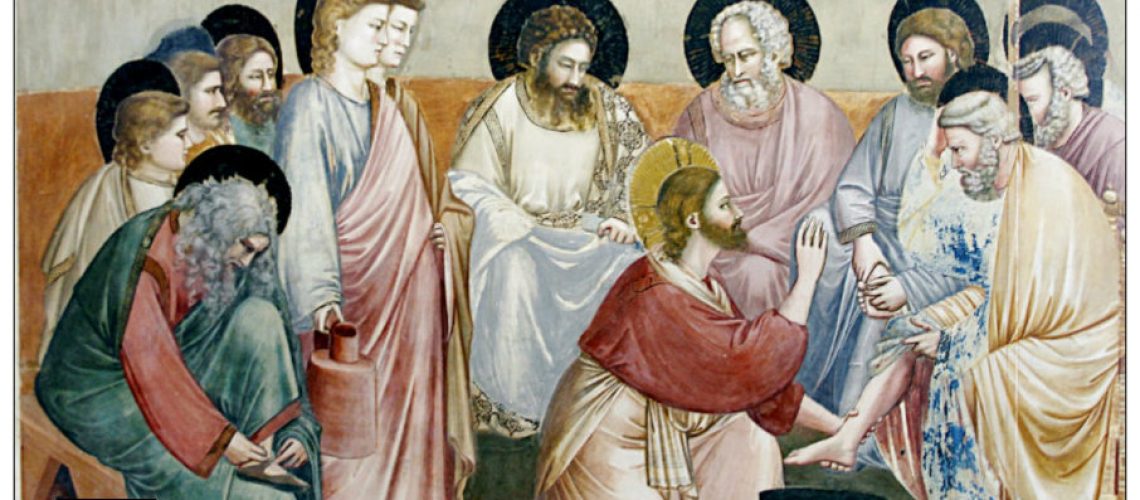
Our culture’s panic over judgment—its trigger warnings and therapeutic euphemisms—reveals a terrifying truth: we have mistaken amnesia for enlightenment. We have forgotten the posture of Our Lord. Modern man imagines God as a cosmic authoritarian whose laws threaten his freedom, yet Holy Thursday confronts us with something far more disarming: the Creator kneeling before His creatures, washing the dirt from their feet.
Peter recoils, and so do we. Christ’s journey—from the poverty of the manger to the posture of a slave and ultimately to the Cross—is the revelation of divine glory in its purest form. The scandal of kenosis lies in this: a love so absolute that it descends to the floor to serve, overturning every human notion of power in the process. To be in union with Him is to share His posture. Until we recover this image of the kneeling God, we will continue to mistake truth for violence and the Church’s moral clarity for oppression.
If this is the God we worship—the King of the Universe on His knees before the image whose face He wears—then what, exactly, is there to be afraid of? The world trembles at shadows while Christ waits with a basin, ready to wash away the grime we pretend not to have. Our anxieties dissolve in the presence of a Lord whose authority is service, not threat.
The Hallucination of the Tyrant
The flight from objective truth is no sophisticated philosophical choice, but a desperate defensive maneuver against a perceived tyrant. The falsely emancipated see in every moral absolute nothing but an unforgiving gavel—the tool of a distant, capricious Overlord who demands a joyless conformity. Conditioned to view freedom as the absence of a Master, we treat the Church’s dogmas as the barbed wire of a spiritual prison. Yet the tyrannical god we are fleeing is a hallucination that vanishes in the shadow of the Upper Room.
If the Lawgiver tied a towel around His waist to scrub the travel-dust from His followers’ heels, then the Eternal Law cannot be a tool of subjugation. Rather, it is the ultimate act of rescue. We do not fear the instructions of a doctor who has entered the contagion of our misery to bring a cure, nor should we fear the boundaries set by the King who kneels to serve us. Divine Authority does not look like a boot on a neck; it looks like God on His knees.
The world flees the caricature of an Authoritarian deity, only to find itself terrified of the real Creator—the one who knows every grain of our lives and has the meekness to kneel within the story.
The Unvarnished Life
This leads us to the heart of our resistance. The retreat into “Toxic Tolerance” is a refusal to take off our shoes. We prefer a distant, affirming deity because such a god does not require us to reveal our wounds. Peter’s protest in the Upper Room—“You shall never wash my feet”—sprang from a profound sense of inadequacy. It is piercing to have the Light of the World touch the unvarnished reality of our lives, the parts we try hide under the armor of our pride.
It is easier to keep our boots on and our hearts hidden, maintaining a polite, sterile distance from the Divine. In our restless age, we call this “autonomy.” It is, in fact, spiritual malnutrition. We fear the judgment of the Church because we mistake the diagnosis for the sentence, forgetting that Christ kneels precisely because He knows how deep our malady runs—and He has brought the water to wash it away.
The Water That Walks
The Gospel of John diagnoses this spiritual paralysis at the Pool of Bethesda. Jesus enters the Temple courtyard—a place charged with the perceived presence of God—to find five porticos filled with the sick, withered, and crippled. As St. Augustine observed, these five porticos represent the five books of the Torah. It is a striking image: a crowd of physically broken humanity huddled under the shadow of the Law.
It was accepted belief that the Law saves, but St. Paul offers the incendiary counter-claim that the “Law was powerless” to do so (cf. Romans 8:3). To the devout, this sounded like divine cruelty. If the Mosaic Law cannot save, why give it? Paul understands the Law is not the cure; it is the finger pointing at the wound, yet incapable of closing it. It is necessary, because without it, we would never know how desperate our condition is. The people in the porticos were not there because they were healthy, rather, the Law had successfully diagnosed their inability to heal themselves.
The water promises grace and life, but it presents an eternal problem: the sick must get to the water. The Covenant of the Law implies a bargain—God will keep His end, but we must keep ours. The tragedy of the human condition is that we simply cannot do it. We are too battered and bruised to reach the pool on our own. Whether by the lust of the eye or the coldness of the heart, we cannot go a single day without failing the Law’s standard of perfection. Like the man crippled for thirty-eight years, we know we are sick, wish to be well, but have “no one to put us into the pool.”
Jesus did not stir the water for the man, nor did He call for someone to carry him. Instead, He bypassed the mechanism of the Law entirely. He did not negate the promise of the Old Covenant; He fulfilled it by becoming the Water that walks. At Bethesda, Jesus reveals that the Father’s will is no longer that the cripple must struggle toward the water, but that the Water has come to the cripple.
At the heart of the Gospel, Jesus stands as the embodiment of a Law called Mercy.
We often hear that “mercy triumphs over judgment,” but the truth cuts deeper: in Christ, mercy becomes judgment—a decree to heal, not to condemn. Unlike a cortisone shot that merely masks pain, Divine Mercy is the cure that obliterates sin. If the Law was the finger pointing to our need, Mercy is the hand that lifts us from the pallet.
The Asymmetry of Grace
The world’s version of mercy is a fragile, symmetrical contract: I will tolerate your sins if you tolerate mine. This toxic tolerance is a peace treaty between self-interested parties that demand nothing because it offers nothing; it preserves a counterfeit tranquility by avoiding the truth.
But Holy Thursday shatters our notions of merit; Christ disregards the worthy and lowers Himself before each Apostle without distinction.
Then He comes to Judas. Without hesitation.
The Lord who knows the silver’s weight clinking in Judas’s purse, who sees the kiss already forming in the darkness of Gethsemane, kneels before him just the same. This is neither tolerance nor indifference. He did not affirm the betrayal. He loves and serves the man pushing Him toward the Cross, fully aware there is no turning back.
Grace operates with staggering asymmetry: we demand a mercy that waits for our repentance; God offers it unnegotiated. He takes the initiative not because we are ready, but because we are not. While we build facades of virtue to make ourselves “safe” enough to approach Him, Christ does not wait at a distance for us to become clean. He approaches us; He kneels and reaches for the very places we hide. This mercy is difficult to receive, not because it asks too much, but because it gives too much, stripping away the illusion that we have earned anything at all. It leaves us, like Peter, caught between love and resistance—wanting Him and yet recoiling from what His closeness reveals.
The God who kneels does not ask permission to love us. He simply begins.
The Weaponization of Niceness
This divine lowliness is not weakness—it is the essential precursor to salvation. The feet washed in the Upper Room were the same feet that walked out of the tomb on Sunday, and the towel around His waist was the necessary overture to the Resurrection. Our society desperately needs this truth: a civilization that rejects a God who lowers Himself eventually ends up with a man contemptuously standing over his neighbor.
When we remove the humility of Christ from our cultural foundation, our vaunted compassion inevitably curdles into tyranny. We see this in weaponized niceness—a pseudo-mercy that demands ideological conformity and punishes the dissenter. Without the Basin and the Towel, we are left only with the Gavel. We become a society of judges who have forgotten how to be servants; in our attempt to create a heaven on earth through policy, we create a hell of mutual suspicion.
The Courage to be Lifted
Our anxiety finds no remedy in “Safe Spaces.” It requires the courage to stop hiding in the fog and approach the Basin of Truth. We must stop viewing the Church’s moral clarity as an assault and see it as the Water that heals the soul’s paralysis. If the sinless God is on His knees before us only to raise us up, what is left to fear in this world or the next? The real danger is the calcified pride that keeps us standing while Love kneels.
This commitment to clarity is a profound act of imitation rather than hostility. The Upper Room offers something far more radical than condemnation: mercy that actually saves. To let Christ wash us is not a metaphor; it is a decision. It means allowing the truth to name our sins without flinching, trusting that the hands which expose the wound are the same hands that heal it.
A culture cannot kneel until its people do. True renewal bypasses legislatures and universities to begin in the quiet, devastating grace of letting God do for us what we cannot do for ourselves. The post-Christian world is collapsing under the weight of its own self‑invention; only those who have been lifted by the One who kneels will have the strength to stand. The basin is full. The Water has come to us. All that remains is for us to sit down, take off our shoes, and let Him lift us up.


[…] is There So Much Fear of the T.L.M. by Progressives? – Fr. Allan J. McDonald at Southern. . .The God Who Kneels – M.L. Kramer at Catholic Stand MagazineWhy Are Babies Most Often Cradled on the Left Side? […]