
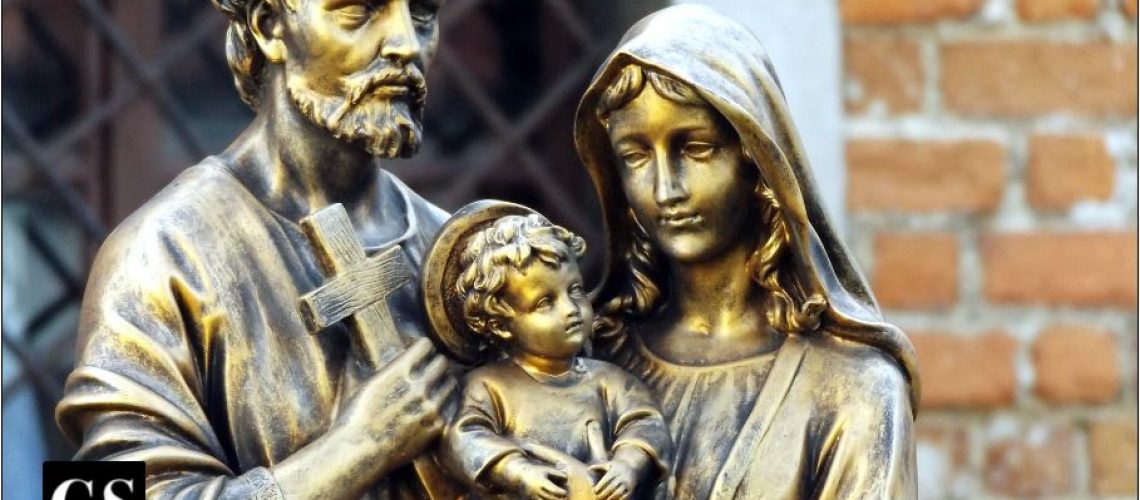
In Italy, May 1 is a national holiday. Established in 1889, the holiday is known as the Festa dei Lavoratori or Festa del Lavoro (literally, the feast of workers or of work).
Some 66 years later, in 1955, the Church, through Pope Pius XII, picked May 1 as the feast of Saint Joseph the Worker. I tend to think it was not coincidental!
Even before the establishment of the feast, however, popes wrote a great deal about the foster father of Jesus. We have Pius IX’s Quemadmodum Deus, in 1870, Pope Leo XIII’s Quamquam Pluries, in 1889, and, and Benedict XV’s Bonum Sane, in 1920. Since then we also have John XXIII’s Le voci che da tutti, John Paul II’s Redemptoris Custos, Pope Francis’ Patris Corde, and more.
It might be wise, then, to consider a few passages that will help us, in the words of the Pharaoh, to “go to Joseph” (Genesis 41:55) with our needs and to imitate this great saint. (I realize the Pharaoh was not talking about Jesus’ father, but he may well have been because Pharaoh’s Joseph also found great favor with the Lord, too!)
Redemptoris Custos
In n. 22, John Paul II writes: “Work was the daily expression of love in the life of the Family of Nazareth. The Gospel specifies the kind of work Joseph did in order to support his family: he was a carpenter. This simple word sums up Joseph’s entire life.”
The phrase, “Work was the daily expression of love in the life of the Family of Nazareth,” is at once very simple and amazingly profound. Joseph’s life was a constant expression of love for Jesus and Mary. His labors were the rough manual work of a carpenter. Yet the reason for that work was anything but rough. He labored to feed, clothe and care for his family. His work was an expression of his overwhelming love for his wife and foster son.
It is often common to think of work as a punishment or a necessary evil. But do we ever consider it as an expression of love for our families, and especially of love for Jesus and Mary?
Quamquam pluries
In n. 3, after reminding us that Mary is far holier than any other creature, Pope Leo XIII makes a convincing argument regarding Joseph’s holiness.
“But as Joseph has been united to the Blessed Virgin by the ties of marriage, it may not be doubted that he approached nearer than any to the eminent dignity by which the Mother of God surpasses so nobly all created natures. For marriage is the most intimate of all unions which from its essence imparts a community of gifts between those that by it are joined together. Thus in giving Joseph the Blessed Virgin as spouse, God appointed him to be not only her life’s companion, the witness of her maidenhood, the protector of her honour, but also, by virtue of the conjugal tie, a participator in her sublime dignity. And Joseph shines among all mankind by the most august dignity, since by divine will, he was the guardian of the Son of God and reputed as His father among men. “
Leo XIII bases Joseph’s holiness on his participation in Mary’s holiness precisely because he was married to the Blessed Virgin. Married couples share their gifts, time, talents, but also, in a sense, in the holiness of the other. How many conversions have taken place because one spouse prayed and sacrificed for the other? Do we look at marriage as a sharing in holiness, just as Joseph shared in Mary’s?
Bonum sane
Writing in 1920 after the sufferings of World War One, Pope Benedict XV commented on “the school of Joseph.” He said it teaches all to imitate Jospeh’s virtues, and that devotion to Joseph is the key to devotion to Mary and Jesus.
“Therefore, at the school of Joseph, all will learn to consider passing current events in the light of their futures that last eternally, and consoling the inevitable hardships of the human condition with the hope of the good things of heaven, they should aspire to the latter through obeying the divine will, living soberly, according to the dictates of justice and piety. . . . With the flourishing of the faithful’s devotion to St. Joseph, there will simultaneously increase as a consequence their devotion to the Holy Family of Nazareth, of which he was the august Head, the two devotions spontaneously welling up one from the other. In fact, through Joseph we go directly to Mary, and through Mary, to Jesus, the origin of all holiness, who consecrated the domestic virtues with His obedience to Joseph and Mary.”
We see that Joseph faced sufferings and trials throughout his life. Immediately after Jesus’ birth, Joseph took the child and his mother and fled to Egypt (Matthew 2:13). Once there, he had to struggle in a foreign land, only returning when the threat had passed.
Yet, Joseph did not complain. Rather, he lived a holy life obeying God at every turn. His prompt response to the angel’s message, without hesitation, questioning, or negotiating, indicates that Joseph’s entire life was one of submission to the divine will.
Once we begin to study at the school of Joseph, we come into contact with Mary, for love of whom he did everything, and to Jesus, who is Love Incarnate. Do we take the time to study at this school and learn the lessons Joseph can teach us?
Patris corde
In his 2020 apostolic letter Patris corde, that is, “With a Father’s heart,” Pope Francis commemorated the 150th anniversary of the proclamation of Saint Joseph as patron of the universal church. The letter speaks of Joseph as a father, but also notes that God works through everything in our lives.
“All too often, we think that God works only through our better parts, yet most of his plans are realized in and despite our frailty . . . Since this is part of the entire economy of salvation, we must learn to look upon our weaknesses with tender mercy. . . . Even through Joseph’s fears, God’s will, his history and his plan were at work. Joseph, then, teaches us that faith in God includes believing that he can work even through our fears, our frailties and our weaknesses. He also teaches us that amid the tempests of life, we must never be afraid to let the Lord steer our course. At times, we want to be in complete control, yet God always sees the bigger picture.”
God always sees the bigger picture. He works through everything so that we might become saints and advance His plans for the salvation of sinners.
Fr. Jacques Philippe expressed this same idea in his book “Interior Freedom.”
Fr. Phillippe writes, “God is ‘realistic.’ His grace does not operate on our imaginings, ideals, or dreams. It works on reality, the specific, concrete elements of our lives. Even if the fabric of our everyday lives doesn’t look very glorious to us, only there can we be touched by God’s grace. The person God loves with the tenderness of a Father . . . is not the person we’d have liked to be or ought to be. It’s the person we are. God doesn’t love ‘ideal persons’ or ‘virtual beings.’ He loves actual, real people.“
Conclusion
If we look to Saint Joseph, we will find a model of holiness for all states of life. Is it any wonder that so many saints have recommended going to Joseph? March is the month of Joseph, but one month out of twelve is not enough to devote to this saint. We need to consider him every day, so as to be able to imitate his example.

