
Stations One Through Three
The Church is closed, and I understand that. But still I come here often just to pray. Praying at home is good and necessary, but praying in or near the church, and Jesus in the Blessed Tabernacle, has always brought me more peace and meaning. Fortunately my Parish makes it easy to visit and pray outside of the Church. There is the Shrine of the Blessed Virgin and the fourteen Stations of the Cross on the perimeter. I frequently use the Stations as an aid in my prayer and meditation, and this is what I would like to share with you at this time.
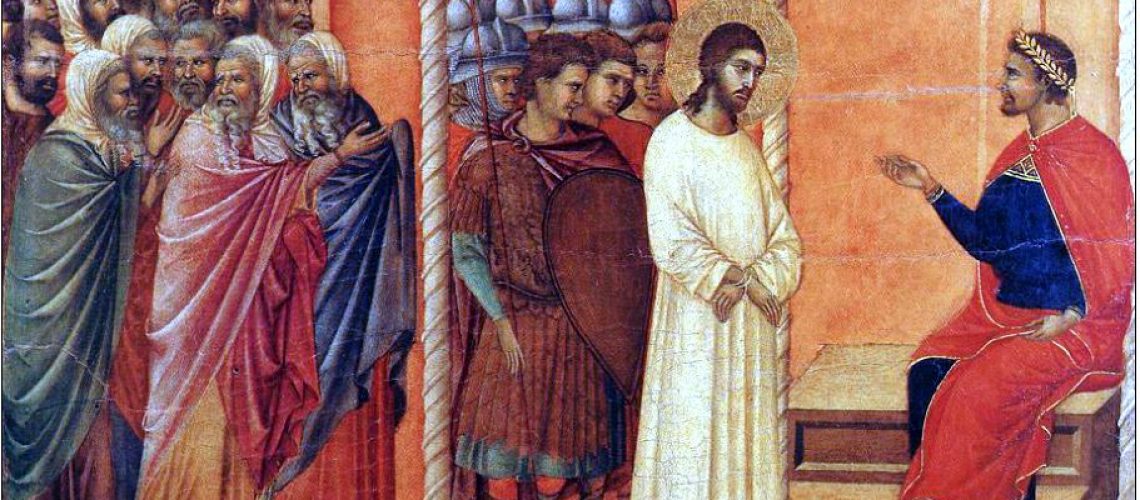
Station #1: Jesus is condemned to death
In the first Station Jesus is staring at heaven, looking past Pontius Pilate as he speaks to the chief priests saying, “Shall I crucify your king ?’ The chief priests answered, ‘We have no king but Ceasar.’ Then he handed Him over to them to be crucified.” (John 19: 15-16, NAB). In that moment Jesus saw not only His death, but also His resurrection. Surely He will die, and surely He shall live.
Death and resurrection go together, hand in hand. Suffering is penetrated by hope, hope stained in blood. In seeing death, we must also see life, and allow hope to ease that pain. St. Paul tells us that, “Death is swallowed up in victory. Where, O death is your victory? Where, O death is your sting?” (1Corinthians 15:55, NAB).
Station #2 Jesus Accepts His Cross
In the second Station Jesus stands tall with a look of determination on His bruised and bloody face. He reaches for His cross not only with confidence but also with conviction and purpose. The purpose which is His mission and His will aligned with the Father’s will. As He reaches out to embrace the cross, He is also reaching out to us, all of us, past, present and future. According to Divine Justice, His death, His sacrifice, will pay the debt for our sins. His outstretched arms beckon us to His kingdom. His reach is an invitation, an invitation for eternal life in the kingdom of Heaven, to enjoy peace and happiness for all eternity-if we believe in Him, if we obey Him, if we love Him. Accepting His invitation mandates repentance and baptism, and living according to the Gospel values.
As I look closer and continue with my meditation I notice a look of sadness upon His countenance. It is not sadness for Himself. It is not self-pity for the hardship and cruelty He will soon suffer. No, it is a sadness for us. Some of us surely will refuse His invitation; many have already done so. In response to His invitation some of us will declare “non serviam” by the way we live.
For those who refuse His invitation the gates of Heaven will be closed for all eternity, and Hell with all its torments shall be their home. This is what saddens our Lord and weighs heavy on His heart. The sacrifice He is willing to make, the sacrifice of His life is not sufficient to move the hearts and the will of those who choose to not serve and worship our Lord and our God. They unwittingly follow Lucifer the same choice resulting in the same fate.
Station #3 Jesus Falls the First Time
In the third station we see Jesus falling to one knee. He has two guards and neither offers any assistance. One is just standing and waiting, waiting for Jesus to get up on His own. The other, less patient, is whipping Him with a cord, hastening Him to get up and continue His death walk. We all have a cross to bear and sooner or later the weight of that cross may cause us to stumble or fall. The unexpected vicissitudes of life can make that cross a little heavier. And who will be there to help you up, to lighten your burden, to give you hope and strength?
In the Book of Job Satan tells our Lord that Job’s faith is based on God’s blessings, take away the blessings and Job will forsake his God. Satan speaking to our Lord: “You have blessed the work of his hands, and his livestock are spread over the land. But now put forth your hand and touch anything that he has, and surely he will blaspheme you to your face.” And the Lord said to Satan, “Behold, all that he has is in your power; only do not lay a hand upon his person.” (The Book of Job1:10-12 NAB)
Job suffered immensely, losing his wealth, most of his family, his good health, and even his friends. The latter, instead of helping him increased his burden by saying that his punishments were the result of his sins. Eliphaz his neighbor and alleged friend came to visit and during his conversation with Job said, “Reflect now, what innocent person perishes ? Since when are the upright destroyed ?” Meaning that the innocent don’t suffer, you are suffering, therefore you are not innocent. (The Book of Job 4:, NAB). On another day Zophar, another alleged friend, in a conversation that should have centered on bringing comfort and understanding resulted in insult and false accusations: Zophar ended his visit with these words: “Know then that God exacts of you less than your guilt deserves.” Meaning you deserve worse. (Job 11:6). A third visitor, Bildad, thought of as a friend tells Job that his children died because of their sins: “If your children sinned against Him, He delivered them into the hand of their transgression.” (Job 8:4). Even Job’s wife believing that his situation is hopeless said to her husband: “Curse God and die.” (Job 2:9).
Pain, suffering, extreme hardship is it enough to forsake God, to stop believing that God is all Good, and always there for us ? Job’s answer is that we should trust in God during good and bad times ( Job 2:10). Hardship and suffering should bring us closer to the Cross, and closer to God, not further away. God is there and He will not give us a cross heavier than we can bear. “The Lord is close to the broken hearted.” (Psalms 34:19, NAB.


nice
Very well written article. I think many people will find it informative.
[…] Jesuit Stood Up to Nazi’s & Survived WWII – Sister M.J. Calore, S.S.C.J., on XStations of the Cross: Personal Prayer & Meditation – Richard Auciello at Catholic Stand MagazineQuestions about liturgy: Wrapped Low-Gluten […]