
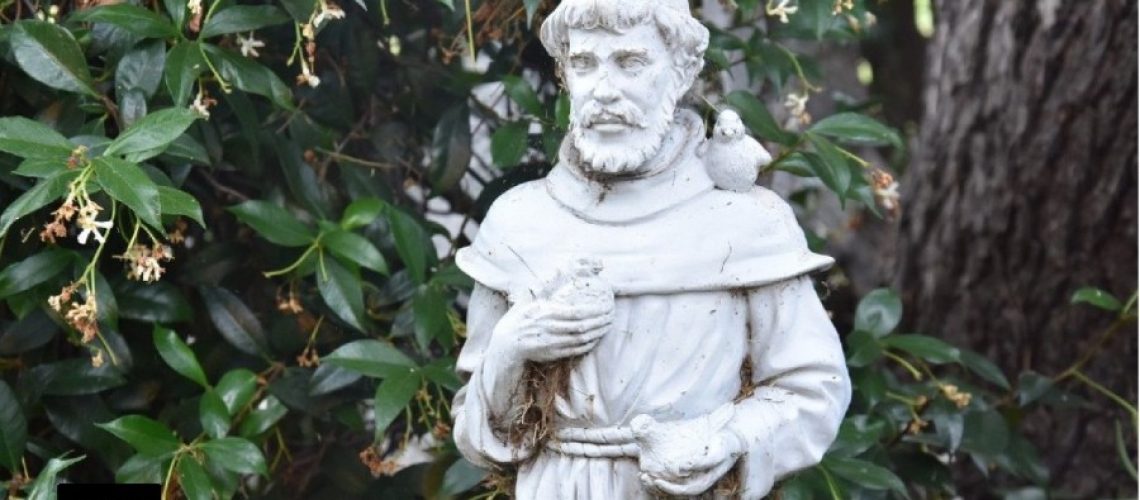
Just before Holy Week I was able to go on pilgrimage with some of the American students I teach in Rome. It was a very rewarding experience.
The theme of the pilgrimage was “Visiting the patron saints of Italy,” namely, Saint Catherine of Siena, Saint Francis of Assisi, and Saint Carlo Acutis.
The college students were eager to leave Rome and get out into the country, but I reminded them that a pilgrimage isn’t simply a vacation or a break from the routine. As Pope Benedict XVI said during his visit to Santiago de Compostela:
“To go on pilgrimage is not simply to visit a place to admire its treasures of nature, art or history. To go on pilgrimage really means to step out of ourselves in order to encounter God where he has revealed himself, where his grace has shone with particular splendour and produced rich fruits of conversion and holiness among those who believe.”
“Above all,” he continued, “Christians go on pilgrimage to the Holy Land, to the places associated with the Lord’s passion, death and resurrection. They go to Rome, the city of the martyrdom of Peter and Paul, and also to Compostela, which, associated with the memory of Saint James, has welcomed pilgrims from throughout the world who desire to strengthen their spirit with the Apostle’s witness of faith and love.”
The Meaning of Pilgrimage
While our pilgrimage did include museums and examinations of art, the purpose of a pilgrimage is never just these things. As Pope Benedict explained, a pilgrimage means to “step out of ourselves.” A pilgrimage helps us encounter God in the places where He has revealed Himself in the past with particular strength.
On the one hand, we step out of ourselves with the instruments of prayer and the sacraments, especially confession and the Eucharist. However, it also means encountering Christ in our neighbor. And being away from home and its comforts means there are innumerable encounter opportunities. There are also many opportunities to practice patience and charity.
The Pope notes that pilgrimages often go to places where the saints can strengthen our spirit. In our case, it was to see the patron saints of Italy and consider their examples. I would also add that going on pilgrimage reminds us that our lives are pilgrimages to heaven. We are all wayfarers or pilgrims on a journey, with a shared goal of heaven.
The Value of our Pilgrimage
Since a part of pilgrimage is to be inspired by the saints, we should ask: what can Saint Catherine of Siena and Saint Francis of Assisi (and Saints Clare and Carlo Acutis) teach the college students of today? Can they teach anything at all? After all, the ages in which these saints lived were, with the exception of Carlo Acutis, were completely different from today. There were no iPhones, no Instagram, no instant communication.
However, as the students learned, these saints speak to the yearnings of the human heart. They remind us of what it means to be human. They show us how to seek holiness in all circumstances and in every moment.
During the pilgrimage we were fortunate to hear particularly excellent talks on Saint Francis of Assisi and Saint Carlo Acutis.
Saint Francis of Assisi
The Franciscans run the entirety of the religious aspect of Assisi. In their various congregations and divisions, they run the churches that mark the major milestones in the lives of Francis and Claire. There is the church where Francis stripped his clothes to return them to his father and the church that houses his earthly remains. There is also the Church where he died, and my personal favorite, San Damiano.
The church of San Damiano is small, but its importance in the history of the church is outsized. It was here that the crucifix spoke to Francis, and it was here that Francis, having failed as a solider, found his true calling.
Several Franciscans contended (and, since he is their saint, I accept their interpretation) that Francis ended up at San Damiano because he felt like a failure. He desired to be a knight but failed, instead ending up captured and imprisoned. He also wanted people to consider him good-looking, funny, and sociable, but these all rang hollow.
It was in the isolation of San Damiano, away from everything that the world calls important, powerful, and significant, that Francis found God and finally found Himself. He would rebuild the chapel and take care of the lepers and other sick there. Eventually it would become the first monastery of the Poor Clares.
Saint Carlo Acutis
Saint Carlo Acutis is another saint in Assisi (although he is not from Assisi). Here Monsignor Anthony Figueiredo, who literally wrote the book on Saint Carlo, privileged us with a talk on the teenaged saint. Msgr. Figueiredo’s book ”Blessed Carlo Acutis: 5 Steps to Being a Saint” was originally published January 29, 2021 by Catholic Truth Society. It was re-released February 28, 2026 by Ignatius Press as “Carlo Acutis Saint of the Young.”
Although Carlo died very young, Monsignor summarized his spirituality in five points: frequent Communion, Eucharistic Adoration, daily Rosary, confession, and acts of charity. While these truths that Carlo loved were simple, he penetrated them deeply and resolved to become a saint.
Carlo shows us that holiness is not a matter of having lived many years, or of having advanced degrees in philosophy, theology, and canon law. Rather, it is a matter of giving God the priority that He deserves in life, and making the decision to become a saint in spite of the obstacles.
The Lessons to be Learned
So, can the saints teach college students today about holiness? Do they continue to speak to us today, even centuries after their deaths? Yes, because they speak to us. They answer the questions that humanity has asked for centuries.
Saint Francis sought out God when he had hit rock bottom. However, what seemed to be a terrible humiliation, and a great suffering became the cause of his joy. God can use anything to make us saints; we just need to cooperate with Him. Failure, for example, can be particularly difficult to accept. However, for Saint Francis the series of failures in his life led to a deeper relationship with God and to holiness.
Saint Carlo reminds us that it is not our bank accounts, our intellects, or our talents that matter.
We can only achieve sainthood by giving everything we have to God. Growing the Kingdom of God takes everything we have, whether it’s ten talents, or five, or one. We must grasp the simple truths of the Gospel, and let them truly sink in. God is love, He wants our love, and, at the end of our lives, He will judge us on how we have loved.
The most important day of any pilgrimage is the day when we get home. It is then that we must decide how to live what we have learned. Indeed, although we come back to the same place, to the same lodgings, with the same people, the journey that we have taken in our souls means that a true pilgrimage marks us forever.


[…] CæliCardinal Burke to Headline St. Louis de Montfort Academy Ribbon-Cutting Ceremony – TFPA Pre-Holy Week Pilgrimage – Fr. Nathaniel Dreyer at Catholic Stand MagazineAre Groypers Heirs To MAGA? – Rod […]