
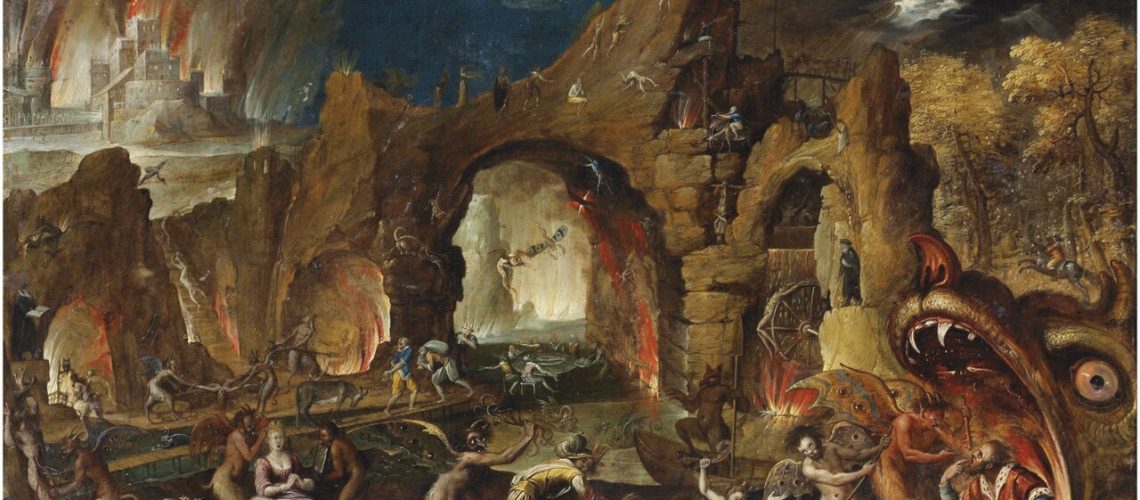
In place of the visio Dei, Christ has a visio mortis as he contemplates the repulsive horror and self-isolation of sin’s selfishness (Alyssa Pitstick, summary, Balthasar’s Mysterium Paschale, First Things).
At 95.94 (at the time of writing) I look back on more than 80 years of addiction and wonder if it is really true that “Your love goes deeper than my sins and failings and transforms me, Jesus, I trust in You.”(Litany of Trust) However, I was reassured when I came across a blog post I’d written eight years ago about Hans Urs von Balthasar’s Holy Saturday theology. Balthasar proposed in Mysterium Paschale that Christ’s entry into Hell was not triumphant; rather “Christ’s suffering was like that of the damned…his suffering went to the length of infernal punishment.”
In this article I’ll not argue for or against Balthasar’s vision. (A thorough discussion on both sides is available in First Things [December 2006, January 2007] for the interested reader. And, I should add, the Magisterium has neither accepted nor rejected Balthasar’s proposal.) Rather, I want to present a theology for addicts that takes Christ’s suffering in Hell as a guide for recovery, a call “to embrace the darkness.” This is the call that Fr. Anthony Ciorra gives in his book, 12 Step Spirituality: A Guide for Everyone:
Now what I want to suggest is on this whole topic of the human addiction, the addiction to control and our addiction to want to play God, that when the darkness comes into our lives, when things are not going well, then in fact we want to flee. Instead of staying there, instead of staying with the darkness and staying with the questions, we flee. And as I mentioned in a previous presentation, we then become attached to other things. And that the whole point is that in the darkness, if we stay with the darkness, if we stay with the pain, if we stay with the questions, that’s really where God lives [emphasis added] and ultimately that’s where our ultimate desires are fulfilled.
Christ’s cry on the cross “Eli, Eli, lama sabachthani?” (My God, my God, why have you forsaken me?) foreshadows the darkness in Sheol—no light of God, only the dead. It is this darkness the addict lives in before recovery.
At the 12 Step meetings I’ve attended these last 42 years, my heart breaks when I hear addicts tell their stories: husbands and wives rejected by their spouses, barred from seeing children; fired from jobs, shunned by friends; arrested, jailed; infected, broken physically. And they were, as Step 1 of the 12 Steps says, “powerless” in these situations, just as Jesus was, according to Balthasar, powerless in His human nature when He arrived in Hell.
Fr. Ciorra acknowledges this powerlessness and points out that the addict’s escape route—alcohol, drugs, codependency, sex—does not work. We have to face the pain, embrace the darkness. “If we stay with the darkness…that’s really where God lives.” As Jesus was resurrected and taken from Hell, so shall we be, if we turn to God, the Higher Power of the 12 Steps.
There is an important difference (among many) between His resurrection and our recovery from addiction. The Resurrection was essentially a binary event; our recovery is continuous, bit by bit. The darkness in recovery becomes light, not all at once, but as in the Easter Vigil service when the first candle is lit and then one by one each person in the congregation lights his candle from another so that the church gradually brightens. I am one of those candles; the darkness is not gone, but it will be if I put my trust in Jesus: “Your love goes deeper than my sins and failings and transforms me.’’ Let me, by the grace of Holy Saturday, believe it.

