
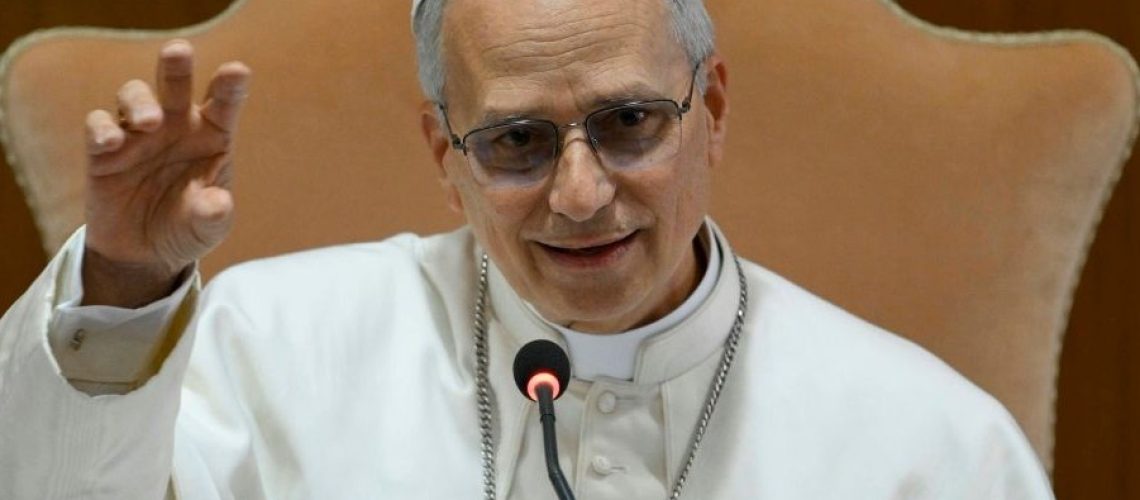
An Analysis in Light of the Spiral of Silence
In the grand Hall of Benedictions, before an assembly of diplomats representing the Vatican, Pope Leo XIV delivered an address that transcended traditional papal discourse on peace and poverty. With a pointed urgency, the pontiff turned his focus to the very architecture of modern conversation, issuing a stark warning about the state of public discourse. His words, a blend of theological concern and sociological observation, have ignited a compelling debate: Was Pope Leo XIV offering a divine diagnosis of a digital ailment, or has he misinterpreted the symptoms of a changing public square?
The Pope’s central critique was unambiguous: “It is painful to see how the space for genuine freedom of expression is rapidly shrinking. At the same time, a new Orwellian-style language is developing which, in an attempt to be increasingly inclusive, ends up excluding those who do not conform to the ideologies that are fuelling it.”
This dual concern, a shrinking public forum coupled with a coercive, redefined lexicon, resonates powerfully with the foundational communication theory of the Spiral of Silence, as pioneered by Elisabeth Noelle-Neumann [1]. Analysing his speech through this lens reveals a pontiff who, perhaps intuitively, has identified a core mechanism of a fractured discourse, though his analysis invites a nuanced examination of how fear and conformity operate in the networked age.
The Spiral of Silence: The Pontiff and the Perceived Majority
Developed by German political scientist Elisabeth Noelle-Neumann in the 1970s, the Spiral of Silence theory posits a deeply human, social mechanism [1] [2]. Individuals, fearing isolation or reprisal, constantly scan their environment, using a “quasi-statistical organ” to gauge the climate of opinion. If they perceive their own views to be in the minority, they are more likely to remain silent on controversial issues. Conversely, those who believe they hold the majority view express themselves more confidently. This creates a self-reinforcing cycle: the perceived majority grows louder, the minority shrinks further into silence, and the public perception of what opinions are acceptable becomes dangerously skewed.
Pope Leo XIV’s lament over shrinking spaces for “genuine freedom of expression” appears to be a direct observation of this spiral in action. He speaks for those who “do not conform,” suggesting they are being pressured into silence not by legal fiat, but by a social and linguistic climate. His reference to an “Orwellian-style language” points to the weaponization of vocabulary, where terms like “inclusion,” “tolerance,” or “progress” are rigidly defined by specific ideological frameworks. To dissent from the framework is to risk being labelled as hateful, backward, or “excluded” from the moral community. This fear of social and reputational sanction is the very engine of Noelle-Neumann’s spiral.
In the digital public square, this dynamic is amplified. A user considering posting a dissenting view on a platform like X (formerly Twitter) or in a Facebook group must perform a rapid, often anxious, calculation: How will my followers react? Will I be “ratioed,” reported, or publicly shamed? The visibility of aggressive counter-responses and the permanence of digital records heighten the perceived cost of speaking out. The pontiff’s analysis correctly identifies the outcome: a public sphere that appears monolithically dominated by one set of opinions, not because dissent has vanished, but because it has been strategically withheld.
Echo Chambers: The Amplifier of the Spiral
The Pope’s warning about an exclusive, ideological language also implicates the parallel phenomenon of the Echo Chamber, which acts as a powerful accelerant for the Spiral of Silence. Through algorithmic curation and personal choice, individuals increasingly encounter only information and opinions that reinforce their pre-existing beliefs [3]. This environment, driven by “homophily” or love of the same [4], doesn’t merely shelter people from disagreement; it actively constructs alternative realities where a specific ideological lexicon becomes the only valid one.
Within these chambers, the perceived majority opinion of the spiral is not just heard, it is constantly echoed, amplified, and purified. This creates a closed loop of reinforcement where dissent seems not just minority but alien, unreasonable, or morally corrupt [5]. The pontiff’s critique that inclusivity ends up “excluding those who do not conform” precisely describes the boundary-policing function of the echo chamber. It hardens the illusory consensus created by the spiral into a dogma, making those inside the chamber less capable of hearing alternative perspectives and those outside it more fearful of speaking.
A Correct Diagnosis, But an Incomplete Prescription?
The Spiral of Silence theory provides a potent framework for validating Pope Leo XIV’s core anxiety. It explains the illusion of consensus and the chilling effect on dissent he describes. However, a critical analysis must ask whether his framing captures the full picture.
First, the theory of the Spiral of Silence has faced critiques for potentially overstating conformity and underestimating the role of vocal minorities and “hard-core” non-conformists who are immune to isolation fears. In the digital age, these hard-core groups often form powerful counter-publics, their own insular echo chambers, that can defy the mainstream spiral. The pontiff’s speech, while defending a silent minority, may itself be emanating from a powerful, institutionally backed counter-public: the Catholic Church. His analysis risks presenting the Church solely as a victim of the spiral, without acknowledging its own historical and social capacity to shape insular informational environments for its adherents.
Second, the concern about “Orwellian language” is itself a contested narrative. From another perspective, evolving language around identity, gender, and equity is seen as a necessary correction to historical exclusions, an expansion, not a contraction, of empathy. Critics of the Pope’s view might argue that what he perceives as coercive political correctness is, for marginalized groups, a long-overdue demand for dignity and recognition. The battle over language is a struggle over whose experiences are validated in the public sphere, and the spiral of silence can operate to suppress marginalized voices just as it can suppress conservative ones.
Ultimately, Pope Leo XIV’s speech is less a precise sociological treatise and more a profound moral intervention. By invoking the dynamics of the Spiral of Silence [1][2] and its amplification through digital Echo Chambers [3], he has translated a complex communication theory into a universal human concern: the danger of a world where belonging is purchased at the price of truth, and where fear governs expression.
His analysis is correct in its identification of the core mechanism stifling discourse: the social fear described by Noelle-Neumann. Where it becomes debatable is in its implicit framing of who the silenced are. The spiral is an agnostic tool; it can silence progressive voices in traditional communities as effectively as it can silence conservative ones in liberal digital spaces.
The pontiff’s greatest contribution may be in framing this not as a political problem alone, but as a spiritual and human one. In calling out the dynamic, he issues a challenge: to cultivate the courage to break the spiral, to deliberately seek out the echo from outside our chamber, and to defend a concept of free speech that is not merely the liberty to shout, but the responsibility to listen and the grace to speak with both conviction and charity. In an age of algorithms and anxiety, that remains a revolutionary, and perhaps sacred, proposition.
References
[1] Noelle-Neumann, E. (1974). The spiral of silence: A theory of public opinion. Journal of Communication, 24(2), 43–51. https://doi.org/10.1111/j.1460-2466.1974.tb00367.x
[2] Noelle-Neumann, E. (1977). Turbulences in the climate of opinion: Methodological applications of the spiral of silence theory. Public Opinion Quarterly, 41(2), 143–158. https://doi.org/10.1086/268371
[3] Garimella, K., Morales, G. D. F., Gionis, A., & Mathioudakis, M. (2018). Political discourse on social media: Echo chambers, gatekeepers, and the price of bipartisanship. Proceedings of the 2018 World Wide Web Conference, 913–922. https://doi.org/10.1145/3178876.3186139
[4] Colleoni, E., Rozza, A., & Arvidsson, A. (2014). Echo chamber or public sphere? Predicting political orientation and measuring political homophily in Twitter using big data. Journal of Communication, 64(2), 317–332. https://doi.org/10.1111/jcom.12084
[5] Ho, S. S., & McLeod, D. M. (2008). Social-psychological influences on opinion expression in face-to-face and computer-mediated communication. Communication Research, 35(2), 190–207. https://doi.org/10.1177/0093650207313159


[…] ReportThe End of Hollywood is an Opportunity for Catholics – Mike Parrot at Crisis MagazineA Pontiff’s Warning in the Age of Digital Conformity – Haile Haile at Catholic Stand MagazineWhy Do People Homeschool? – Dixie Dillon Lane […]
Voodoo is still around, as well as curses and hexes. Then there’s the great, silent, collective unconscious. You can’t silence the will, the mind, the power of say 10 million people’s simultaneous, laser like thoughts, aimed and concentrated; a wave of hate at injustice, wish and vehemence projected at a person, institution, group or political party. All this is going on at once over someone’s, rant, speech or rhetoric. These human discordant airwaves that exist at the present time in our world that offer both hope and danger. As the Buddha said,
“All that we are, is the result of what we have thought”.