
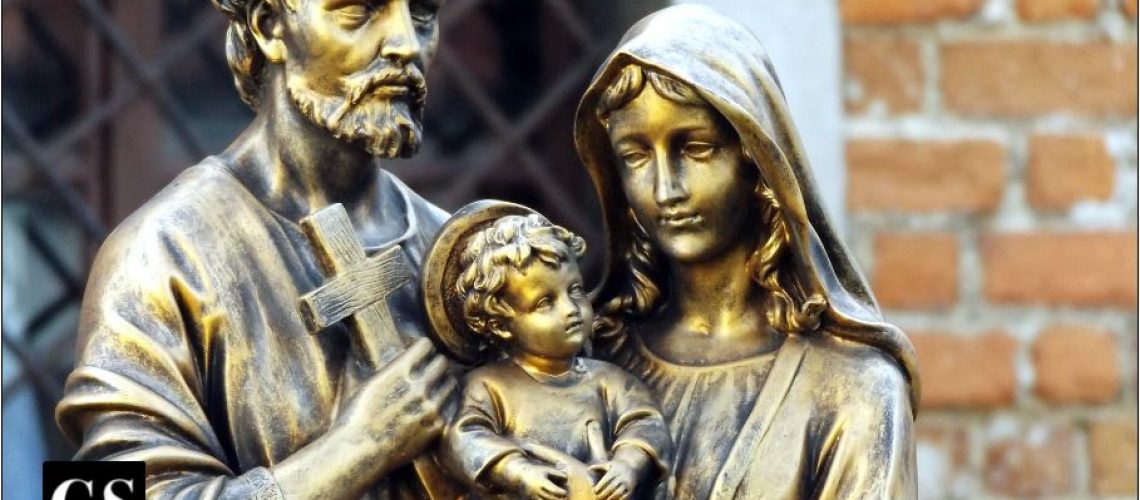
During Advent and Christmas seasons, Catholics’ attention focus mainly on “baby” Jesus. So, too, we celebrate the Feast of the Immaculate Conception and contemplate Jesus’ Mother, the Blessed Virgin Mary. But what about the third member of the Holy Family?
St. Joseph should garner some attention from all in December as well. And later in the liturgical calendar we will celebrate his two designated feast days in March and May. However, Catholic dads and husbands should give more attention to this man all year long as a wonderful example to emulate.
No man was closer to both Jesus and Mary than Joseph. Someone so important in their lives deserves our honor and praise. Catholics have always said that the better we know Mary, the better we know her Son. Similarly, when we intensely consider the part Joseph played, we more deeply understand the greatness of Mary.
There is no more intimate union than that of being married, which is why Pope Leo XIII said about Joseph, “There can be no doubt that, more than any other person, he approached that supereminent dignity by which the Mother of God was raised far above all created natures.”
Then over 100 years later, Pope Benedict XV wrote, “Through Joseph we go directly to Mary, and through Mary to the origin of all holiness, who is Jesus.”
Joseph is the “head” of the Holy Family by way of being the husband and foster-father. Yet, his story has always been overshadowed by Our Lady and Our Lord. And he is one of the only major holy people in the Bible who has no spoken words attributed to him.
The early Church rarely gave Saint Joseph much attention. He was figuratively and literally seen as that masculine figure standing dimly in the background. Only recently did this change.
The Church Gradually Increased Attention to Joseph
It was less than a century ago that the Church finally started giving Joseph his due. Pope Pius IX declared the Feast of St. Joseph in 1847. Then on December, 8, 1870 he named St. Joseph the Patron Saint of the Universal Church.
Later in 1889, Pope Leo XIII wrote in one of his encyclicals, “In those lands where the 19th of March – the Feast of St. Joseph – is not a Festival of Obligation, we exhort the faithful to sanctify it as far as possible by private pious practices, in honor of their heavenly patron, as though it were a day of Obligation.”
In 1955, Pope Pius XII added a second feast day to honor Saint Joseph. He declared May 1 as the feast of St. Joseph the Worker. The Pope purposely chose this date as it coincided with International Workers Day (aka May Day), which began as a secular celebration of workers’ rights, especially in the communist Soviet Union. Pope Pius XII wanted to ensure that workers retained the Christian understanding of work. No saint could help exemplify this more than Jesus’s foster-father who was known for his industriousness and hard work as a carpenter and the many qualities he most likely passed on to his young son.
About 10 years later, Pope John XXIII added Joseph’s name to the Canon of the Mass (Eucharistic Prayer 1). Finally, in more recent years, the Church made sure all four main Eucharistic Prayers now include naming Joseph. By doing so, the entire Holy Family is now recalled at every liturgy of the Mass.
Pray the Litany of Saint Joseph
The Litany of Saint Joseph is a prayer which appeals to the intercession of Joseph to pray for us, while emphasizing his virtues and various roles as a member of the Holy Family. Officially recognized by the Church in 1909, the litany is composed of twenty-one invocations expressing the merits and dignity of Joseph.
Obviously, the litany is both a way to pray and to recall the history and perfection of the Holy Family. But it also provides a unique inspiration especially to husbands and fathers. In this prayer they see Joseph as a model for the heads of families fulfilling their duties.
Some of the virtues and roles of Saint Joseph stated in the prayer translate in the following ways to what a 21st century Catholic male should emulate.
“Joseph, Most Chaste”
Chastity is often confused with how we tell our unmarried teenagers to refrain from sexual activity. The Catechism actually describes a chaste man as one who “governs his passions and finds peace, or he lets himself be dominated by them and becomes unhappy.”
Chastity and the virtue of self-control are fundamentally linked. But to be chaste is not meant solely to be in self-control of sexual urges. A chaste man loves properly and orients his desires appropriately. In so doing, the sexual union of man and wife actually brings about communion rather than destroying it.
A chaste husband then, develops the moral habit that allows him to see and treat his spouse as a sacred subject instead of a sexual object.
“Joseph, Lover of Poverty”
Joseph had to abandon his livelihood and home on his family’s pilgrimages to Bethlehem, Egypt, and Nazareth. Today’s husband/dad would do well to understand that God will provide and “No one can serve two masters…You cannot serve God and mammon” (Matthew 6:24). The term “mammon” was a reference to wealth and material possessions. If we prioritize these above God and focus too heavily on materialism and worldly matters, we will strain our relationship with our Lord.
“Joseph, Most Faithful”
Faithfulness connotes making a commitment. In the busyness of modern life, it is often easy for husbands/dads to push aside belief in and worship of God for belief in and worship of less important things, such as a career, sports, recreation, or leisure. Getting oneself and one’s family to Mass every weekend needs to be a commitment that every Catholic husband/dad keeps.
“Joseph, Pillar of Families”
Joseph’s vocation was to guard the baby Jesus and the Mother of God. Husbands/dads today should see this holy Saint as not just the head of the Holy Family 2,000 years ago. He is the model today and always for showing the importance of becoming the strong foundation of one’s family, providing unconditional love, humble reliability, and charitable loyalty.
Joseph Deserves Our Tribute
As the Church demonstrates, all Catholics should honor Saint Joseph for all that he did and does. He was the most chaste spouse and protector of the Blessed Virgin Mary, and the foster-father and guardian of Jesus. Now he is also the patron saint of the Universal Church.
While we do not worship Joseph, we should pray for his heavenly intercession before God. Moreover, husbands and fathers should consistently strive to imitate him and honor him as the “just and righteous man” he was (Matthew 1:19).


[…] Innocents – Childermas: “They were the Church’s First Blossoms” – Fr. Z’s BlogDads & Husbands Should Emulate St. Joseph – Dan Fitzpatrick at Catholic Exchange MagazineGiotto as a Guide to Christmas Light & […]