
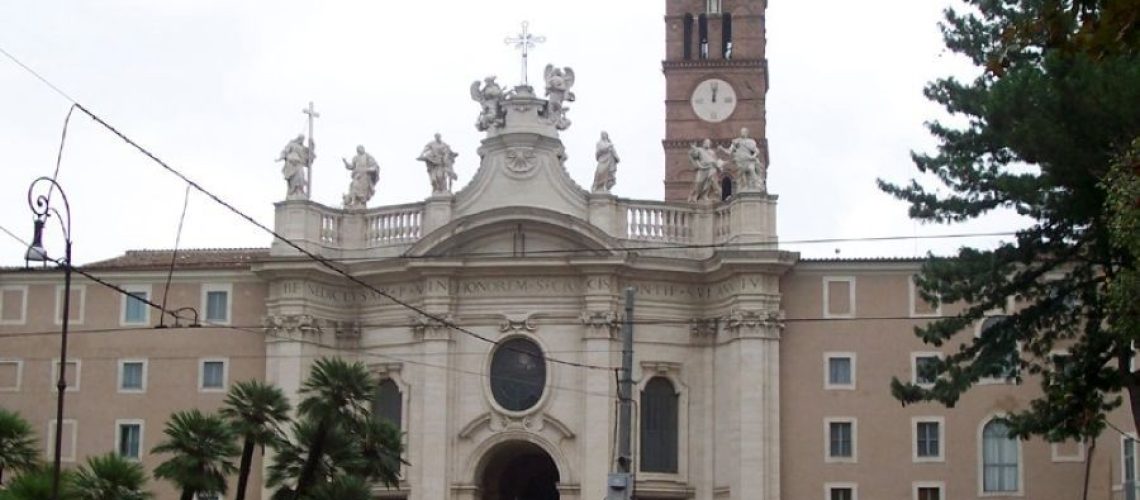
As the Jubilee Year wound down, I was able to make a pilgrimage to Rome with several families from my parish. This is very late in the Jubilee Year to make a pilgrimage, but it is still a pilgrimage, nonetheless.
Oddly enough, I work in Rome and throughout this year our parish church was also a Jubilee church. And as if that isn’t enough, the Abbey where I live was also honored for the past three years. The Holy See granted a plenary indulgence for all visitors for three years because of the Thomistic Triennium: 800 years since Aquinas’ birth, 750 since his death, and 700 since his canonization.
Saint Mary Major
Our pilgrimage began early in the morning with a train ride. We went first to Saint Mary Major Basilica. According to tradition the site plan of the church was miraculously laid out in snow – in the full heat of Rome in August no less! As such, “Saint Mary of the Snows” was the name originally given to the church.
The church is both the oldest and largest basilica dedicated to our Lady. The famous icon of Salus Populi Romani is in this church, as are relics of the manager. (According to tradition St. Luke painted the Salus Populi Romani.) Likewise, there are also the mortal remains of many popes, most recently Pope Francis, and other prominent figures, such as the great architect Bernini.
Saint John Lateran
Our pilgrimage also went to another papal basilica: Saint John Lateran. Now, there is no “Saint John Lateran,” meaning, there is no saint whose name is “John Lateran.” But the Laternani family once owned the property, hence the name Saint John Lateran. And the church is actually dedicated to not just one, but two saint Johns: John the Baptist and John the Evangelist.
Founded in 324, Saint John Lateran is the pope’s cathedral. It is the first public church in Rome and the oldest basilica in the West. Outside, there is the inscription that bears witness that this church is the “mother and head of all the churches in the city and the world.” As the head of all churches, it also contains, quite literally, heads: those of Saint Peter and Saint Paul. Likewise, there is a panel of wood said to be part of the table where Christ celebrated the Last Supper.
What is perhaps most visually impressive, though, are the large statues of the apostles that line the central nave. Each statute stands at 14 to 15 feet tall! They remind us that these saints were not just real people, but also giants in the faith that we must look up to, both literally and figuratively.
Santa Croce in Gerusalemme
After Mass and lunch, we headed to yet another basilica: Santa Croce in Gerusalemme. For some reason, it’s hardly ever referred to with an English title, which would be “Holy Cross in Jerusalem.” As the name implies, the Church is known for its relics of the Passion: the finger of Saint Thomas the Doubting Apostles, the title from the Cross, wood from the Cross itself, as well as nails and pieces of the Crown of Thorns.
This church is also known for those who are buried in it. Surprisingly, the interred include a young girl who died at the age of six-and-a-half.
Antonietta Meo
A side hallway in the church leads to where the relics of the Passion are located. Venerable Antonietta Meo’s remains are located in a small room located just off this hallway. There are also display cases with some of her clothes, toys, her letters, and her cane.
Antonietta died at such a young age from bone cancer, and the church of Santa Croce was her parish. If canonized, she would become the youngest non-martyr in the Church (Saints Francisco and Jacinta Marto, the Fatima visionaries, died at the ages of 10 and 9, respectively).
A special presentation
I was familiar with the young venerable and was glad that the children on the pilgrimage with us could learn about her and see her tomb. However, what made this visit special was the talk given to us by one of the postulators of Antonietta’s cause.
The postulator was a good friend of some of the parishioners, who had arranged the presentation in the main church. In particular, her presentation mentioned three points that I had not heard before. The three points give great insights into the person of Antonietta.
Her cane
The postulator commented on Antonietta’s cane which is on display in the cases by her tomb. When Antonietta lost her leg on account of her cancer, she would use her cane to walk to church. Once inside, she would go directly to the tabernacle and tap her cane on the tabernacle door before beginning her prayer. She insisted that this was to “wake Jesus up” so He could then hear her prayers. Such was her childlike simplicity and faith in Christ’s presence in the Eucharist.
Her statue of Christ
The postulator also made mention of a small statue of the Child Jesus sleeping. Antonietta would put the letters she wrote to Jesus underneath this statue. Through several providential occurrences, the postulator was able to retrieve the actual statue when it was thought to have been lost. She and not only showed it to us, but also let the children hold it.
The image was certainly mass produced in plaster over the years, but it was very special to Antonietta. Upon closer examination, the statue revealed something curious. The image is certainly of the Child Jesus, asleep. But the wood on which he lays makes the form of the cross. In other words, the cross was Jesus’ constant companion, and it was under the cross of the Child Jesus that Antonietta left the letters she wrote for Him.
Her letters
Antonietta is perhaps best known for these letters. She had just learned to write, and there are 105 letters that she wrote to Jesus, God the Father, and Mary. The postulator noted that sometimes the letters contain grammatical mistakes or spelling errors, but this simply testifies to their genuineness. However, she pointed out one letter in particular, letter #9, in which Antonietta has a very profound insight and desire for holiness. This letter was written after she lost her leg to her cancer, and reads, in its entirety:
“Dear child Jesus You are Holy. You are good help me do me this favor give me back my leg give me souls loving Jesus don’t leave again from my heart be always with me Dear child Jesus You are holy!…You are good!…Help me do me this favor give me back my leg if you want. If you don’t want, Fiat voluntas tua. Jesus give me souls…loving Jesus…don’t leave again from my heart stay always with me.”
Our guide pointed out two things for us. The first is Antonietta’s complete trust in God. She asks Jesus to “give her back her leg”! This request embodies a sense of faith and trust that few of us would have, a request few of us would dare to make. Secondly, this petition is beautifully conditioned: “If you want.” God is not only all-powerful and all-knowing, He is also all loving and knows what is best for us.
Conclusion
As we headed back to the parish, I couldn’t help but think of Antonietta’s example. The pilgrimage was great, but perhaps what was most important was that encounter with a young venerable. At only six-and-a-half she embodied what Christ asks of us: “Amen, I say to you, unless you turn and become like children, you will not enter the kingdom of heaven” (Mathew 18:3).
Picasso famously said, “It took me four years to paint like Raphael, but a lifetime to paint like a child.” Something similar can likely be said of us: we can reach independence in our finances, in our work, and in our education, but to learn to trust like a child is the work of a lifetime.
Editor’s Note: The church pictured above this article is Santa Croce in Gerusalemme.


[…] Mass Project Seeks to Expand Knowledge of Beauty of Tradition – P.A. Kwasniewski, Ph.D.A Jubilee Pilgrimage & Venerable Antonietta Meo – Fr. Nathaniel Dreyer at Catholic StandCardinal Dolan Calls on Parents to Name Babies After […]
I remember another venerated Saint, Lucia, whose tomb is in Venice and is the patron saint for those seeking cures for sight afflictions. It tells a sad story of sacrifice and redemption. Italy is a sacred nation, beautiful and alive with color and mystical history. Too many tourists seem to dilute the reverence it deserves.
Hi Ordinary Papist, and Merry Christmas!
Yes, there is a real wealth of sacred treasures in Italy. It’s true that many tourists seem to pass over the great religious heritage, although, in my experience, many Italians do the same. Perhaps for them it’s a case of “familiarity breeds contempt.”
God bless!
Fr. Nate