
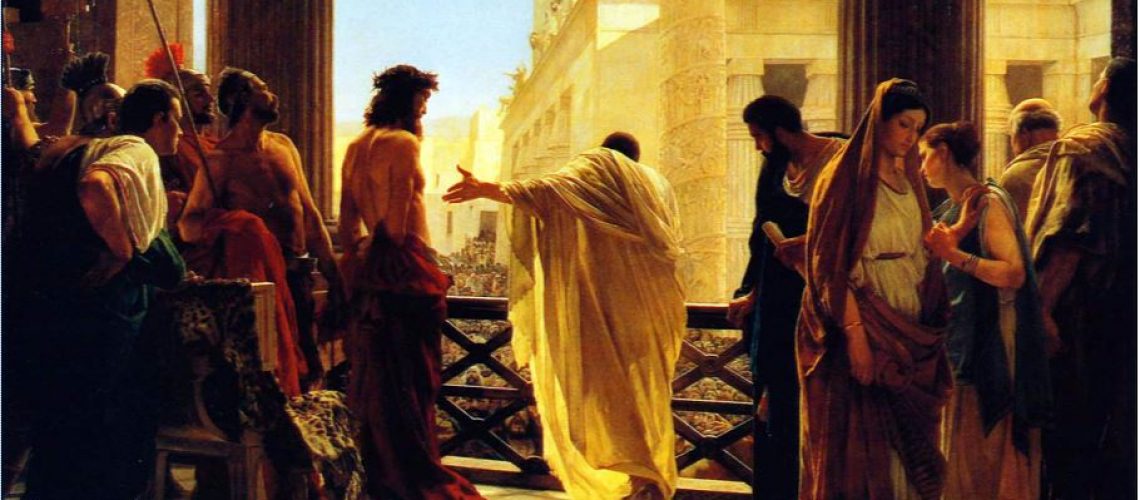
Jesus is sentenced to death. Sentenced to end living in this life, the life that we are born into, and that we know and experience through the physical body and five senses. But it is not the only life that exists. Some, or perhaps even many, in our culture believe that death is final and complete, but those of us who live by the light of Christ know that there is more to come; namely, the four last things: death, judgment, heaven or hell.
Perhaps it is appropriate to say that death is a beginning; the beginning of eternity. When Jesus is sentenced to death, He stands straight and tall with a fearless expression in his demeanor, and of course in his soul. His life is always an example for us . Is He not asking us to face death in the same way?
Jesus suffered terribly before His death. Every drop of His blood from the Agony in the Garden to the Crucifixion has redemptive value—offering salvation to thousands of souls. And He is teaching us to do the same; that is, to join our suffering to His as part of the sacrifice offered to God the Father in the Holy Mass. When we join our sufferings to the sufferings of Jesus, He takes those sufferings to Calvary and they become part of the sacrifice offered to God the Father for the expiation of sins, past, present and future.
St. Paul explains the value our pain and suffering can have when offered to God as follows:
Now I rejoice in my sufferings for your sake, and in my flesh I am filling up what is lacking in the afflictions of Christ on behalf of his body, which is the church (Colossians 1:24, NAB).
Jesus wants us to join our suffering to His, not so that we can suffer less, or He can suffer more, but in order to use that suffering as reparation, as payment for sin, thus giving merit to our suffering when it is used in this way. We don’t (and cannot) add to Jesus ‘redemptive sacrifice. His sacrifice is perfect and eternal. But we are invited to participate in the economy of salvation; surely, this is a great honor and privilege.
Through prayer we can join our pain and suffering to Jesus’ pain and suffering, and that works, but the high point, the most efficacious way to participate in the economy of redemption is through the Holy Sacrifice of the Mass. We, Catholics, understand that even though Jesus is truly present during the Mass in the Eucharist (the consecrated Host), and through the person of the priest (in Persona Christi), He does not suffer again. His suffering is not reproduced; however, it is present during the Mass.
The suffering of Christ on the cross does “show up.” It is not “new suffering;” it is the same suffering that occurred once on calvary. The question is: since the extreme, terrible, yet perfect act of redemption occurred over two thousand years ago, how can it “show up” again during the Holy Sacrifice of the Mass, every Mass, every day, throughout the world? The answer is found in the mystery of the Mass where eternity and the present walk hand in hand, embrace, and become momentarily united in the “here and now” every time the consecration of the bread and wine takes place. It is the miracle of the Mass.
This same mystery is expressed by Fr. Thomas Merton as follows:
life in Christ is life in the mystery of the Cross. It is not only a hidden supernatural participation in the divine life in eternity, but a participation in a divine mystery, a sacred action in which God Himself enters into time and, with the cooperation of men who have answered His call and have been united in a holy assembly, the Church, carries out the work of man’s redemption (New Seeds of Contemplation, Fr. Thomas Merton, p.16.
End Note:
This essay is the result of praying and mediating on the stations of the cross conveniently placed in a half-circle just outside of my parish church.

