
Atheists, neo-pagans, and other non-Christians are always trying to say certain Catholic Holy Days have their origins in pagan celebrations. Halloween and All Saints Day are a perfect example of this silliness.
Jon Sorenson calls out this nonsense in an article entitled “The (Fake) Pagan History of Halloween.” Sorenson says, “Neo-pagan websites claim that Halloween was an attempt by early Christians to “baptize” the Gaelic harvest festival of Samhain.”
Sorenson goes on to say, “this myth is also based on bad research and propaganda that developed after the Protestant Reformation. Given the contempt of the reformers for the Catholic doctrine of Purgatory and prayers for the dead, this development is not surprising.”
So just what is the connection between Halloween and All Saints Day? Actually, there is no connection. Halloween is a secular holiday, and All Saints Day is a Catholic Holy Day of Obligation.
Halloween
Almost no one denies that Halloween originated as a Celtic religious festival called Samhain. History.com states, “Halloween has its roots in the ancient, pre-Christian Celtic festival of Samhain, which was celebrated on the night of October 31.”
As History.com also explains, Samhain was “usually celebrated from October 31 to November 1 to welcome in the harvest and usher in “the dark half of the year.” Celebrants believe that the barriers between the physical world and the spirit world break down during Samhain, allowing more interaction between humans and denizens of the Otherworld.”
And this is where the Halloween – All Saints Day connection begins and ends. But since All Saints Day is a Catholic Holy Day celebrated on November 1 (followed by All Souls Day on November 2), the atheists and neo-pagans are not about to let such a tantalizing connection go to waste.
History.com bolsters the myth. It says “As Christianity gained a foothold in pagan communities, church leaders attempted to reframe Samhain as a Christian celebration.”
But Halloween is not and never has been a “Christian celebration.” Halloween is purely a secular holiday that comes before All Saints Day and All Souls Day. The false connection revolves around the word Halloween.
The phrase “All Hallows’ E’en” came into use in the Middle Ages. E’en is an old-fashioned contraction of the word evening. And evening vigils the day before holy days or feast days have been a long-standing tradition in the Church. All Hallows E’en was one such vigil.
All Hallows E’en simply means the evening before All Saints Day. But eventually Halloween replaced All Hallows E’en – and the neo-pagans pounced.
All Saints Day
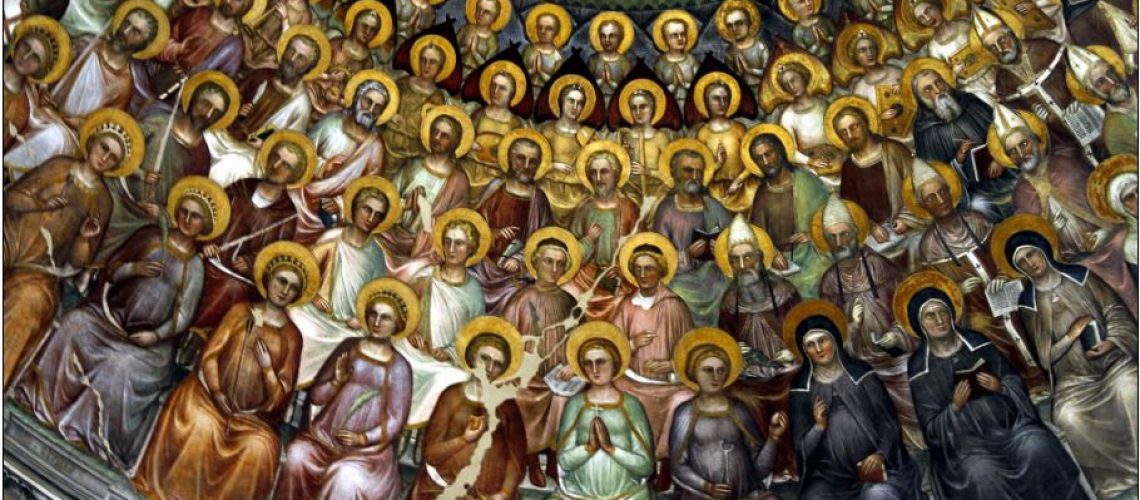
The Church has been celebrating All Saints Day for close to 1,200 years. (A number of past CS articles have noted this, Here for instance.)
As the “Catholic Encyclopedia” says:
“[Pope] Gregory III (731-741) consecrated a chapel in the Basilica of St. Peter to all the saints and fixed the anniversary for 1 November. . . . [Pope] Gregory IV (827-844) extended the celebration on 1 November to the entire Church. The [evening] vigil seems to have been held as early as the feast itself.”
It’s highly doubtful that either of the Popes Gregory were thinking about co-opting a Celtic festival for the Church. They were simply setting aside a day honoring the Church Triumphant – the saints in heaven.
Trick or Treat
History.com says, “Although it is unknown precisely where and when the phrase “trick or treat” was coined, the custom had been firmly established in American popular culture by 1951”.
And this “custom” goes only back hundreds of years. So it also has nothing to do with All Saints Day. But Trick or Treating does have its roots in Samhain, as History.com again notes.
“During some Celtic celebrations of Samhain, villagers disguised themselves in costumes made of animal skins to drive away phantom visitors; banquet tables were prepared and food was left out to placate unwelcome spirits.
“In later centuries, people began dressing as ghosts, demons and other malevolent creatures, performing antics in exchange for food and drink. This custom, known as mumming, dates back to the Middle Ages and is thought to be an antecedent of trick-or-treating.”
But once again, trick or treating has nothing whatsoever to do with All Saints Day.
All Souls Day
All Souls Day, of course, is celebrated on November 2. This is because it’s only fitting that the Church commemorates and prays for all the faithful departed.
The Catholic Encyclopedia explains:
“The theological basis for the feast is the doctrine that the souls which, on departing from the body, are not perfectly cleansed from venial sins, or have not fully atoned for past transgressions, are debarred from the Beatific Vision, and that the faithful on earth can help them by prayers, alms, deeds and especially by the sacrifice of the Mass.”
So with All Saints Day and All Souls Day on November 1-2, November became a perfect month for remembering and praying for the dead. But none of this has anything to do with Trick or Treating or Halloween.
What About Day of The Dead?
Further complicating the Halloween – All Saints Day (and All Souls Day) connection, however, is El Día de los Muertos. This is more commonly known as the Day of the Dead.
History.com says, “The Day of the Dead (el Día de los Muertos), is a Mexican holiday where families welcome back the souls of their deceased relatives for a brief reunion that includes food, drink and celebration.”
But as History.com also notes, “El Día de los Muertos is not, as is commonly thought, a Mexican version of Halloween, though the two holidays do share some traditions, including costumes and parades.
“The roots of the Day of the Dead, celebrated in contemporary Mexico and among those of Mexican heritage in the United States and around the world, go back some 3,000 years, to the rituals honoring the dead in pre-Columbian Mesoamerica. The Aztecs and other Nahua people living in what is now central Mexico held a cyclical view of the universe, and saw death as an integral, ever-present part of life.”
So, the Day of the Dead is not a Catholic holy day. Even so, many Catholics do celebrate it on November 1-2.
As Fr. Charles Grondin explains at Catholic.com:
“. . . Día de los Muertos is meant to embrace death as part of the cycle of life and as something that need not be feared. Death is embraced almost like any other milestone in life. The skull face painting is seen as normalizing death and stands in complete opposition to the themes of Halloween.
“So long as the elements of celebrating Día de los Muertos do not contradict our faith or blur the essentials of our faith, there is nothing wrong with Catholics celebrating it.”
Summing Up
So just to summarize:
- Samhain is an ancient Celtic festival. Samhain festivals took place around October 31 / November 1. Some aspects of current secular Halloween festivities have their roots in Samhain.
- All Saints Day is a Holy Day the Catholic Church has been celebrating on November 1 for about 1,200 years. There is no connection between Samhain and All Saints Day.
- All Hallows’ E’en was the evening before All Saints Day.
- All Hallows E’en eventually became Halloween. Halloween eventually became a secular holiday that took on some of the aspects of Samhain and mumming.
- Atheists and Neo-pagans now try to say “Christianity tried to reframe Samhain as a Christian celebration.”
- But Halloween is not and never has been a Catholic or Christian celebration.
- Day of the Dead is not a Mexican version of Halloween, and it too is not a Catholic celebration.
The Bottom Line
So enjoy Halloween, trick or treating, Halloween parties, or Day of the Dead celebrations. Just don’t let some of the more modern, neo-pagan aspects of the holidays take over. Stay away from devil and witches costumes, or anything associated with the occult.
And since today is All Saints Day, a Holy Day of Obligation, be sure to go to Mass. While you are there, start the month of right. Say a prayer for all the deceased who are in Purgatory. And pray for all the souls in purgatory throughout the month of November.


Odd that Christmas is celebrated very near the pagan Feast of Darkness, the Winter Solstice, when in fact Jesus was probably born in the Spring (when shepherds would be watching their flocks)? Luke 2:8-14
This article is about All Saints Day and Halloween, but since I did open it referencing the mistaken beliefs that “certain Catholic Holy Days have their origins in pagan celebrations” I’ll give you some leeway. Jimmy Akin (and a number of others others) have already addressed the Winter Solstice nonsense. You can read one of Akin’s articles on the subject here: https://www.catholic.com/magazine/print-edition/was-jesus-born-december-25th
The article you link to says it doesn’t matter. “So what if Christians subverted a pagan holiday?” It freely admits what I’m saying. And it really is not important. So what? — if the Church appropriated pagan holidays (and pagan symbols, such as the Christmas tree)? It only shows that they were smart about taking over a pagan culture. None of this has to do with the truth of the Christian message.
We used to have arguments over whether one should serve ham on Easter!
The question “So what if Christians subverted a pagan holiday?” is hyperbolic sarcasm. Akin also says, “Ultimately, though, the evidence doesn’t support the claim.” And, as I said, Akin’s article is one of many.
If you want to accept the claim that “the Church appropriated pagan holidays” go right ahead and do so. At least I can agree with you that “None of this has to do with the truth of the Christian message.” And none of this has anything to do with my article either so this discussion is concluded.