
At first, I was angry; the Church doors were closed with a notice that read: “CLOSED UNTIL FURTHER NOTICE.” This was hard for me to accept. I understood that Masses were suspended, for health reasons–until further notice. But why close the Church?
Before the pandemic, my church, like most Catholic Churches, was open every day. Except for Mass, the Church was never crowded and the current pandemic stipulations restricting gatherings to ten or fewer people were easily met. So why close the Church? I missed my “as needed” holy hour the opportunity to pray, meditate, and just stay in the presence of our Lord, in the tabernacle. Ever since my conversion to Catholicism, I have been spiritually dependent on prayer inside the Church; it has always worked for me. The benefits were meaningful, real, and necessary. I have always needed my holy hour and now the Church was closed.
Anger
Anger and disappointment only added more clutter to my mind. I surmised that the Church was closed because the priest was not here on a daily basis. I made up a number of excuses and it helped a little. But most importantly I realized that I must trust in the Lord all the time and in every circumstance. I prayed to overcome my anger and disappointment. It worked; and what came next surprised me and taught me to be patient and to trust in God sooner rather than later.
The Stations of the Cross
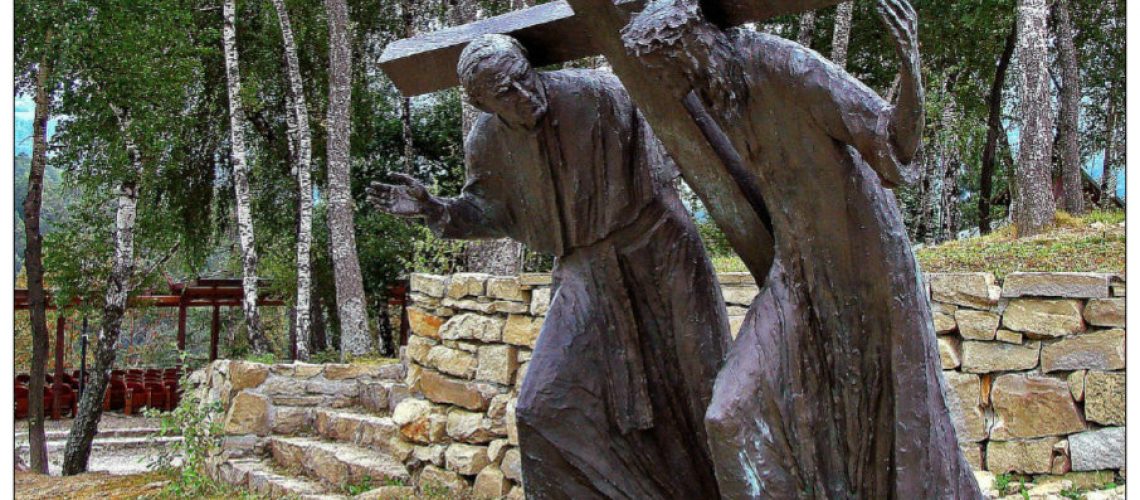
I suddenly took serious notice of the Stations of the Cross constructed outside of the Church. Previously I had observed these stations previously, but never paid attention since the Stations of the Cross was not a devotion I practiced. Now, this devotion became extremely important to me, I felt that the Lord was moving me towards this sacramental and that His Blessings were available through this devotion. Thus the beginning of my substitute Holy Hour. I usually prayed the Rosary during my tabernacle Holy Hour; so now I would pray the Rosary while meditating on the Stations of the Cross.
Station #1
We see Jesus in the praetorium standing tall, facing Pontius Pilate aware of His impending death sentence. A sentence was given to us all, sooner or later. Pilate lets Jesus know that he has the power to execute life or death. Jesus’ demeanor shows no fear or anxiety as He answers: ” You would have no power over me if it had not been given to you from above….” (John 19:11).
Jesus was prepared for this day. Will I be prepared for my day of death? Will I face it with confidence and courage believing that the City of God awaits me? Will I have time to make “last minute” changes; for example, the opportunity to confess my sins? Or will death reach out and grasp me unexpectedly, not affording me the opportunity to reconcile with God,or make amends? Just as Jesus was prepared for His day of death, I need to prepare for mine, not the day of, but during every day of my life.
As I pray the Rosary my meditation continues; I wonder did Jesus think of His Glorious Resurrection when he was condemned to die? Could he see himself in his Glory, with mission accomplished and the gates of Heaven opened, granting the opportunity for salvation for everyone who would take advantage of it? As I continue my prayers I find that I need to pray for myself, my loved ones and even those I don’t know by reciting, at the end of the first mystery, the prayer given to us by Our Lady of the Rosary at Fatima: ” O my Jesus, forgive us our sins, save us from the fires of hell, and lead all souls to Heaven, especially those in most need of your mercy.” (Our Lady of Fatima, July 13th, 1917).
Station #2
In the second station, we see Jesus accepting His cross with open arms: Jesus embraced that cross, not as an instrument of death, but as an instrument of salvation and eternal life. On my deathbed will I embrace or resent the instrument of my death, whether it is heart failure, cancer, or one thousand other causes? Will I be courageous enough to embrace my cross as the doorway to heaven?
As I continue praying the Rosary and thinking about Christ’s Ascension, I am aware that He knew His final destination when He reached for that cross. And I ask myself when it is my time to face eternity, will I be certain of my final destination? Jesus of course will ascend to the Father with one hundred percent certainty. How much certainty will I have on my judgment day? I need to realize now that the final destination will be determined by how I live my life each day here and now. The thief on the cross to the right of Jesus was able to achieve his salvation at the last minute, but he had time to do this and he had Jesus at his side to help him. He heard Jesus say: …”Amen, I say to you, today you will be with me in Paradise” (Luke 23:43). Will I hear these or similar words in my hour of death?
Station #3
Jesus falls for the first time; we can see the Roman guard striking him with a stick or whip. When we fall, when the burdens of life overwhelm us, when we are at our weakest, do others hit us with a figurative stick or a whip? We see the fallen Jesus without family or friends. When we fall, do some of our “friends” turn from us, ignore us, or even add insult to injury? Do we experience to any degree what Job experienced in his contest against Satan when his best friends became his closest tormentors? (cf. Job 16-19).
As I continue with my meditations on the Rosary I think about the descent of the Holy Spirit on the Apostles. When I’m at my lowest ebb, overwhelmed and distraught will I despair and give up, or will I turn to God seeking the power of the Holy Spirit and pick up my cross rising to overcome adversity?
Conclusion
For now, my meditations are brought to a close. I came here angry and empty; I walk away with peace of mind and gratitude because the Lord has granted me His consul, though I am not worthy to ask, reminding me of Jesus’ words: “Come to me, all you who labor and are overburdened, and I will give you rest. Shoulder my yoke and learn from me, for I am gentle and humble in heart, and you will find rest for your souls. Yes, my yoke is easy and my burden light.” (Matthew 11:28-30).
Post Script
The major premise of this essay is that the Church itself, that is the building per se, is a holy place because Jesus is there in the tabernacle; where ever the tabernacle is, there is Jesus. This does not mean that He is not in other places as well, of course, he is; God is omnipresent. But it is also true that Christ is completely and always in the consecrated Hosts which are kept in the tabernacle; thus not only making the tabernacle itself holy but also the church. Just as the Holy Eucharist resides in the tabernacle, the tabernacle resides in the Church (building). In a manner of speaking, granted the aforementioned conditions, the Church itself becomes a tabernacle; thus, just being near the Church places us near to God.(but this is not the only way to be near to God).


Beautifully written and so meaningful right now!
Sorry for the late response; thank you for your comment.