

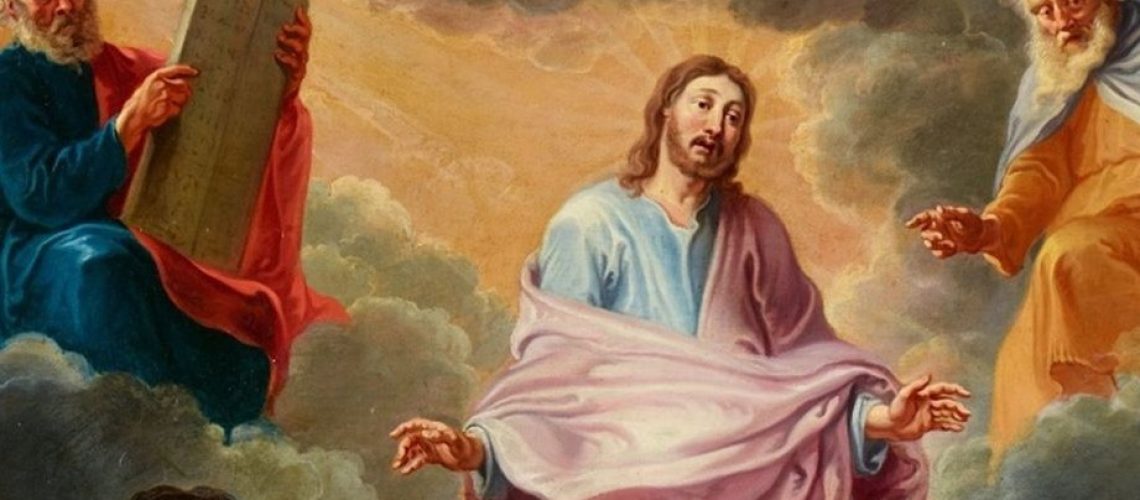
As I write this, the previous week’s Sunday Gospel was Luke 9:28-36. To refresh your memory, it is the story of the transfiguration.
Peter, John, and James go up a mountain with Jesus to pray. Suddenly they see Jesus talking to Moses and Elijah.
It is not the first time I’ve heard this passage read in church, nor the first time I have read it on my own. The presence of Moses seems obvious – his central place in the history of the Jewish people is uncontestable. This time, though, curiosity got me – why Elijah?
Isaiah, for instance, seemed to have had the most definitive understanding of how the messiah would bring redemption to the world. His portrait of the suffering servant is incredibly prescient.
The standard answer to the question of why Moses and Elijah during the transfiguration is that Moses represents the Law and Elijah the Prophets. This event validates Jesus fulfillment of both law and prophecy.
So Why Elijah?
The answer to “why Elijah” emerges when we look at the prophet’s life. Elijah’s story begins in 1 Kings:17.
In verse 14 Elijah tells a woman that a miracle will occur. (The miracle parallels the feeding of the 5,000 by Jesus.)
Elijah tells the woman that she will not suffer from feeding him, but that “the LORD, the God of Israel, says: The jar of flour shall not go empty, nor the jug of oil run dry, until the day when the LORD sends rain upon the earth.” Later in the chapter Elijah resurrects the woman’s dead child through prayer – a clear parallel to the both the Lazarus miracle and the resurrection of Jesus.
Some Context
The context for these events is that Israel has been in the clutches of a severe drought. The woman decided that she and her son would eat a cake made from the last of their flour and oil and then prepare themselves for death.
Later in his story Elijah flees from the king of Israel, Ahab. He ends up walking forty days to Mount Horeb, the mountain of God where Moses received the law. On his final journey with his successor, Elisha, Elijah divides the water of the Jordan so that he and Elisha can pass through on dry ground.
Elijah also anointed Jehu as King of Israel, and calls evil down on king Ahab (until he repents, after which God delays the punishment He had decreed). He had a role in blessing and removing kings of Israel.
The cup of wine Jesus blessed and gave to the apostles was probably not “the cup of Elijah.” It may have been the third cup of the Seder (the Passover meal), or perhaps the fourth; online references are not unanimous.
But there is a fifth cup of the Seder. This cup is the cup of Elijah.
Other manifestations of divine intervention take place throughout 1 and 2 Kings prior to Elijah’s death. But Elijah did not just simply die. In 2 Kings 2:11 we learn Elijah was taken up to heaven on a fiery chariot in a whirlwind.
There is more to the story of Elijah, but these highlights give us a strong basis on which to proceed.
Elijah And The End Times
The final chapter of Malachi contains apocalyptic language including the following:
“Now I am sending to you Elijah the prophet, Before the day of the LORD comes, the great and terrible day” (Malachi 3:23).
In Jewish tradition, one of the things Elijah will do upon his return is to resolve unanswered questions, which includes, according to Chabad.org, the question of whether there should be four or five cups of wine at the Seder table. (This is why the fifth cup at a Seder is poured but left undrunk.)
The questions asked of John the Baptist by the priests and Levites in John 1:21 illustrate the importance of Elijah and the familiarity of the people with his story. The questions are meant to find out if he was claiming to be the Messiah, Elijah, or the Prophet (another way of referring to the Messiah).
There is no scripture to quote directly to demonstrate that Elijah will return to herald the Messiah. But his return is a sign of the end times in some Christian and Jewish traditions.
Adding It Up
When we look at the position Elijah holds among the prophets and in Jewish tradition, it is no wonder he was present with Moses during the Transfiguration. It could be that his assumption into Heaven on a whirlwind gives him something special to share with Jesus before his Passion.
It is sure that his parallel miracles and his moments of suffering gave him some commonality with Jesus that could have made their conversation fruitful. Finally, his presence with Moses may have been a validation for Peter, James, and John that Jesus was in fact the Son of God, who said:
”Do not think that I have come to abolish the Law or the Prophets; I have not come to abolish them but to fulfill them” (Matthew 5:17).
Finally, Elijah’s role in selecting and confirming a king over Israel – and prophesying the destruction of a failed king – gives him a special authority to confirm the Heavenly Kingship of Jesus.
So, as often happens, when I find myself challenged by some scripture, a little study and thought will usually see me through to a better understanding. Moses and Elijah. Now it makes sense!





2 thoughts on “Why Elijah and Not Isaiah?”
It sounds like a1000 piece puzzle.
I just take one piece at a time….