

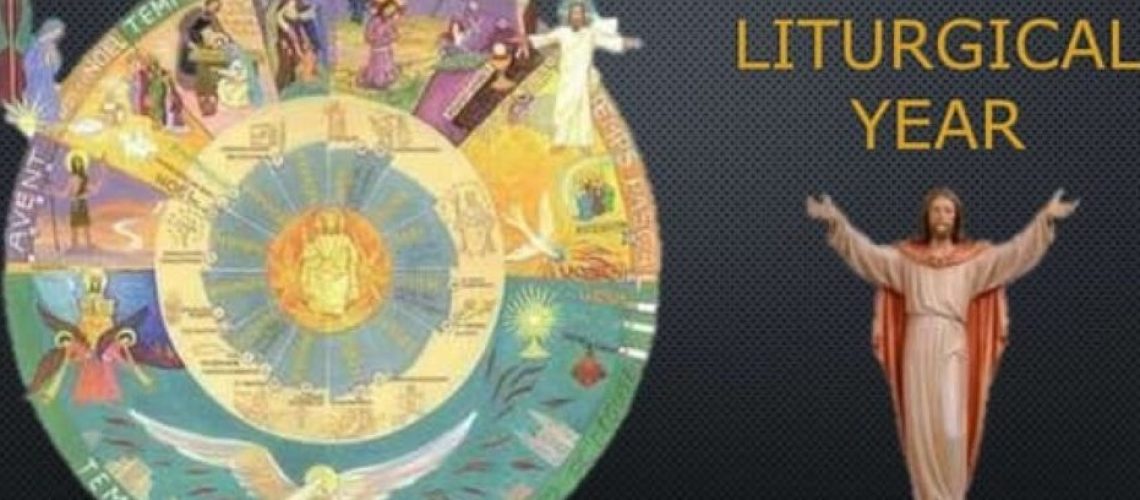
Many of us know someone who has just completed a “dry January.” While there can certainly be benefits to abstaining from alcohol or other pleasures, doing so outside of a relationship with God and His Church severely limits those benefits. Additionally, nearly half of the month of January is a Liturgical Season of feast, not fast. Dig deeper and one finds that the idea of “Dry January” is neither Holy, nor well timed.
One unique element of the Catholic Faith compared to protestants that receives little attention is the richness of our six Liturgical Seasons. The hot-button issues of Sacred Tradition, Intercession of the Saints, and the concept of Purgatory drive the fierce debates and conflict. While if asked, there is no doubt some protestants would say that the Liturgical seasons are manmade traditions; it is not an idea that raises the hackles of the anti-Catholic brigade. Many protestants observe Advent. They celebrate Christmas and Easter, but simply do not recognize them as seasons.
It is a good thing that our fellow Christians are not attacking our Liturgical seasons, because then it would be a two-front war. As it stands; the Liturgical Seasons are under a fierce attack from the modern Western society and popular culture.
Christmas sales and decorations start before Advent, as well as Thanksgiving. It should be no surprise that those who follow the cultural calendar and decorate for Christmas before Advent and Thanksgiving are the same ones throwing out their trees and taking down the decorations immediately after Christmas Day. They coopt Advent into Christmas, start it early, and then end Christmas after one or two days.
What a rich and beautiful blessing it is to celebrate Christmas for 19 days this year from Christmas day until the Baptism of the Lord on January 12. Fittingly, Easter lasts 50 days and overlaps the Triduum on Easter Sunday. But so many Catholics, Orthodox and devout Christians are no longer enjoying the fullness of theses joyous seasons. Additionally, the preparatory and penitential seasons of Advent and Lent have been forgotten or trivialized. Advent has been reduced to Christmas countdown calendar that dispenses candy or toys and too often an advent wreath becomes simply a decoration. This becomes obvious when you see candles that have never been lit or are all the same height. Lent has no real secular version, but even among practicing Christians can be reduced to giving-up candy and possibly a good fish fry if you are lucky.
Similarly, the secular society has tried to introduce Meatless Mondays for health and environmental reasons. While its more likely the alliteration that resonates, like Taco Tuesdays, rather than an outright assault on our Catholic tradition; Catholics should resist replacing Friday with Monday. Adding Monday or any other day is fine, but Fridays are for fasting and Sundays are feasting. Many American Catholics are unaware that even though we are no longer required to abstain from meat on Fridays outside of lent, we are still called to observe Fridays as “a special day of penitential observance throughout the year,” according to the USCCB Pastoral Statement on Penance and Abstinence issued in 1966 and still in effect.
The statement goes on to say “we urge all to prepare for that weekly Easter that comes with each Sunday by freely making of every Friday a day of self-denial and mortification in prayerful remembrance of the passion of Jesus Christ.” It further states, “even though we hereby terminate the traditional law of abstinence binding under pain of sin… we do so in the hope that the Catholic community will ordinarily continue to abstain from meat by free choice.” While in many other countries abstaining from meat is still prescribed, the United States is seeing a resurgence of Catholics choosing to abstain from meet every Friday. Regardless of how, all Catholics are called to do penance in some way each and every Friday. We are called to be separate from the world in this way, but together as one Church in these practices.
Many people seem to feel supported and encouraged in their dry January and meatless Monday by their social networks and groups they join. However, much more support and encouragement, as well as unity in prayer, is available through Catholic Social Networks, the Parish, the family, and the Universal Church. Often, the world adopts healthy practices such as meditation, sacrifice, and fasting because they recognize the positive fruits from these practices. Yet, separating the practice from the spiritual (Prayer) and liturgical (The Church), separates the practice from God and diminishes the possible benefits to us and others.
Dry January only helps the individual. But, abstaining from, or reducing alcohol, or other pleasures during Lent provides the same health benefits, while uniting your sacrifice in payer for the benefit of others. Jesus describes the power of fasting in Mathew 17:21 and Mark 9:29. We are called to dedicate our sacrifice in Lent for more than just losing weight. Why simply improve your physical health, when you can also atone for your sin, and dedicate the sacrifice as prayer for something greater than yourself?
From a practical standpoint, Lent is longer than the 31 days of January. Therefore, abstaining from something for Lent is healthier than just abstaining for January. And if all of Lent is too great a sacrifice for you to bear, many Catholics simply choose to reduce their chosen pleasure during Lent. They allow themselves to Feast on Sundays or only give up alcohol on Weekdays or some other variation of milder sacrifice. Any of these partial abstinences still unite the believer with the Church, its sacrifice, and the Liturgical Season of Lent. The preparatory seasons of Advent and Lent are intended to make us ready in mind, body, and soul for the feast we anticipate. The sacrifices of fasting and abstinence aid in our spiritual journey.
Of the six Liturgical Seasons, all Catholics should be familiar with Advent, Christmas, Lent, and Easter. Sacred Paschal Triduum, the holiest “Three Days” of the Church’s year should resonate even if the name is not familiar. The sixth Liturgical Season is “Ordinary Time,” which is divided into two sections after Christmas Time and another after Easter Time. “Ordinary” does not mean plain, but rather according to Ascension Press comes from “the Latin word ordinalis, which refers to numbers in a series… Thus, the numbered weeks of Ordinary Time represent the ordered life of the Church—the period in which we live our lives neither in feasting or in more severe penance.” Here we count the weeks as we journey through the life of Christ. “The goal, toward which all of history is directed, is represented by the final Sunday in Ordinary Time, the Solemnity of Our Lord Jesus Christ, King of the Universe,” per the USCCB.
These Liturgical Seasons give our trip around the sun deeper meaning than the changing colors of the trees, while challenging us along the way to strengthen our relationship with God. Then, like ornaments on a tree, the feast days of Saints add further beauty and inspiration to our year. Saints’ Feast days are so frequent they are like mile markers throughout the year. Many regions and cultures throughout the world elaborately celebrate significant feast days and Holy days with festivals, parades, and celebrations.
The Liturgical Calendar year begins on the First Sunday of advent each year. That is essentially New Year’s Day for the Church. The Liturgical Seasons dictate how the Church prays the Liturgy of The Hours.
All Priests and many lay faithful pray this daily prayer of the Church, marking the hours of each day and sanctifying the day with prayer. In chapter 5 of Sacrosanctum Concilium, the Church beautifully states, “Holy Mother Church is conscious that she must celebrate the saving work of her divine Spouse by devoutly recalling it on certain days throughout the course of the year. Every week, on the day which she has called the Lord’s Day, she keeps the memory of the Lord’s resurrection, which she also celebrates once in the year, together with His blessed passion, in the most solemn festival of Easter. Within the cycle of a year, moreover, she unfolds the whole mystery of Christ, from the incarnation and birth until the ascension, the day of Pentecost, and the expectation of blessed hope and of the coming of the Lord.
The Church has also included in the annual cycle days devoted to the memory of the martyrs and the other saints. Raised up to perfection by the manifold grace of God, and already in possession of eternal salvation, they sing God’s perfect praise in heaven and offer prayers for us.”
Someone who says that the Mass is boring, does not truly understand or appreciate what is happening at Mass. Similarly, there is no boring time of the year if you embrace the Liturgical Seasons, Holy days, and Feast Days. Our Catholic culture is under assault, and it takes concerted effort to push back. Families, singles, and seniors all have good reason to hold fast to these traditions. Not only does embracing the Liturgical Calendar make life more interesting, but it also strengthens our relationship with God and others. You can think of these special days and seasons as energizing power boosts for your walk with God.
Yes, our Catholic culture is struggling to survive against the world, but it is not all bad news. The relationship between the faithful and the culture is not solely one-way. In some ways we have seen the Liturgical Seasons, Holy Days, and feast days influence our culture. Fat Tuesday, McDonald’s Filet-o-Fish, Halloween, and Valentine’s Day are some examples. Some very popular businesses close on Sundays. And at least for now, the stock market still closes on Good Friday.
Take heart, have courage, and participate in the Liturgical Seasons. Teach them to you children and enjoy their beauty. Do not let society stop you from celebrating Christmas with an occasional drink all the way through the Baptism of The Lord in mid-January. Join your fellow Christians to fast together and to feast together growing closer to the Lord.





3 thoughts on “Why Catholics Might Think Twice About Dry January”
Catholics can and should make sacrifices in every season. Abstaining from drink or meat is no less a penance in January or on Monday than in Lent or on Friday. Sharing the fast of a Muslim, a Buddhist or an Atheist or just a poor sinner is our Christian duty.
As I wrote, there is much more to Lenten Fasting and abstaining than simply personal penance. In Lent, a Christian unites their fasting and abstaining in prayer with the entire Body of Christ. The third element is preparing ourselves for Good Friday and Easter. As I wrote, it’s fine to add January, Mondays, and any other time of year; but a Christian should not substitute January for Lent or Monday for Friday. Unfortunately, that’s exactly what many are doing.
Thank you, Mr. McHugh. “To everything there is a season…”