

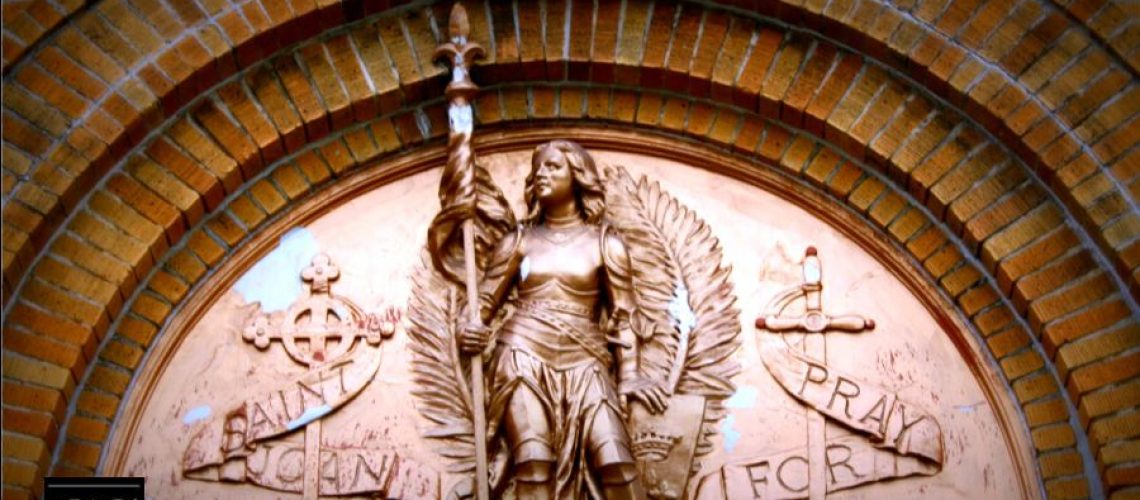
Years ago, during a cold Michigan November, as a freshman in college, I was surprised by call from my mom. She wanted me to know that the principal of my high school, a very dear friend of the family and my former middle school gym teacher, coach, and assistant principal, had been killed in a car accident. It was unexpected, to say the least, and it hit the small Catholic community of the school very hard; there were only 56 of us in my graduating class, and many of us returned to the school that very night for a prayer vigil and for the funeral in the week that followed.
Those days were and remain mostly a blur, though one memory stands out quite clearly: at the prayer vigil, after the priest chaplain had said some words, he invited one of the sisters on staff to say a few words. She was (and is) a sort of minor celebrity in the area, who is well-known for hosting a radio show, giving talks and retreats, and, of course, teaching theology at the high school. I didn’t quite know what to expect from her, and to be entirely honest, the only words I remember from her little meditation were the first ones: “Well, I’ve been asking myself: what can you say at a time like this? . . . And the answer is, well, not very much.” I think she summarized the situation perfectly: there’s just not much that can be said. It’s hard, it hurts, and that’s that.
The Current Crisis
I was reminded of this on February 24th, when, at the early hour of 6 am, one of the parochial vicars at the parish I work at (I live at one parish, but work at another) texted me: “The war has begun; Russia has invaded Ukraine.” It might seem odd for a priest to be so in the know about the happenings in Ukraine and to care so much, but this priest has a vested interest in the situation: he’s Ukrainian, and his widowed mother, single-mother sister, and niece all still reside there.
What can you say at a time like this? Not very much. I promised prayers, and that was that.
This was not, however, my last encounter of the day with Ukraine: in the abbey, working with me in the library, is a Ukrainian sister. When the morning Mass finished, I had about thirty minutes on my hands to figure out how to deal with a person whose country has just descended into war, whose family all resides in what has overnight become the most dangerous and unstable region in the Europe, if not in the world. Mind you, I have no blood sisters, so I did the best I could: I gathered a choice collection of teas (carefully avoiding the likes of “Russian black tea”) and some random American chocolates that my mom had mailed to me not long ago, and headed over to the library, hoping against hope that tea and chocolate might somehow ameliorate the destruction of national sovereignty, the danger of death for close family members, and general violence taking place 1,500 miles from Italy: the middle of nowhere for me, but in her backyard.
A Real-Life Situation for Some
The first sister to greet me in the library was the secretary, although perhaps greet, or even see, are not the best words. Having taken her glasses off, she didn’t even notice the blur (which I am) passing by, and simply continued crying until I made some awkward noise. “I’m so sorry!” she replied, “It’s just that I received an audio message from the sisters in Ukraine.” Through the wonders of WhatsApp and Telegram, our priests and our sisters throughout the world manage to keep in touch, and, even in the midst of the chaos, we will receive the occasional message that makes its way through the morass of cyberspace.
The sisters, along with the elderly and abandoned children in their care, had fled west on train, away from the violence engulfing the eastern side of the country. Everyone was still alive and in one piece, but asking for prayers. Later the next day, our priests would send a message: they were okay but had stayed behind at the parishes and also requested prayers.
The sobbing sister added: “They say there have been attacks right where Sister is from!” Armed with this information, yet feeling rather disarmed and unprepared, I made my way into the library to find the Ukrainian population of one that happened to work in my Italian library. She was in good spirits, and graciously received my tea and chocolates, perhaps more out of sympathy for my pathetic gesture than genuine gratitude, but she received graciously them nonetheless.
We had the usual small talk about work in the library. It’s always the same routine: I give the work to be done, she agrees to do it, and then I return a few hours later to find she has done whatever she thought was best or simply wanted to do, and I say it’s ok and probably better that way anyways. Our library is a mess for that reason, but at least everyone is happy.
Once I had established the work to be done, and having ascertained with my usual certainty that it would never be accomplished, she added, “Father, please pray for my country. I don’t know if you know, but we’re at war now.” I asked how her family was: “I talked to my mom yesterday; she’s fine, but my brother is away cleaning out bunkers near our city so they can use them if . . . .” letting me complete the sentence for myself. A few days before the violence began, she had mentioned that her region is very patriotic: she assured me they would fight to the death if anything were to happen, that they wouldn’t be taken over easily. She added, “My mom said that the people in the town are filled with hatred right now. They are so angry. . . . Please pray.”
A Loss for Words
What can you say at a time like this? What do you say when someone’s world is falling apart? Not very much. I promised I’d pray, and then went about my daily work.
Most of us usually respond, with the best of intentions, “Oh, I’ll pray for you.” When faced with a major disaster, the outbreak of war, the death of a loved one, the words seem hollow, at best. Often times, we throw out that phrase as if there were nothing left to do, as if to say, “Well, I can’t do anything really useful, or really effective, but, as a last resort, I have this prayer thing I can send your way.”
Yet, to think that way is really to misunderstand the power of prayer. We feel useless in such situations because, in a sense, we are: “Without Me,” says Jesus, “you can do nothing” (John 15:5). Nothing, says Jesus – not, “You can do some things poorly,” not, “You can sort of fake things” – nothing. Rather than be the last resort, prayer should be our first solution.
This isn’t to say that God instantly heals all problems; God is not some sort of divine aspirin or Band-Aid, who instantly cures our headaches and patches up our wounds. Rather, He is the one who gives light in the darkness, who gives hope to the hopeless, and who is the only one who can change hearts with His grace. That is the real solution to the world’s problems, and while, with grace, we might be able to do our little bit here and there, the radical solutions that are needed need God’s grace and intervention.
At the end of the day, we were told that two sisters in the community had decided to start a novena praying for peace. One of the sisters, of course, was the Ukrainian; the other, her sister in religion, is, perhaps surprisingly, Russian. Jesus Christ is the source of peace and of unity. During the Last Supper, when He, with His perfect knowledge, could see the struggles His apostles and His church would face, Saint John tells us what His solution was: “I pray not only for them, but also for those who will believe in me through their word, so that they may all be one, as you, Father, are in me and I in you, that they also may be in us, that the world may believe that you sent me” (John 17:20-21). Jesus Himself prayed.
What can you say at a time like this? Maybe to others, not very much, but to God, we can say a flood of prayers.





5 thoughts on “What to Do When the World Falls Apart”
Thank you for this glimpse of your world and for your insights. Your piece is balanced and true and finds us right where we are.
Thanks for your comment! God bless, and let’s keeping praying!
Pingback: TVESDAY EDITION – Big Pulpit
When the world is falling apart, what I should be doing is exactly what I should have been doing all along when I thought things were fine: work all the time to love God with my whole heart, mind, soul, and strength, and my neighbor as myself. This is the way of the saints. I don’t often think much about doing this when things are going smoothly, but these rough patches have a way of bringing priorities back into focus.
Hi Brian,
Thanks for your comment. It’s true: we should always be living a life of prayer, and should always be thinking of God. Yet, as you say, it’s so easy to lose sight of Him when things are going well, but God can use those difficult moments to call us back. I think what C. S. Lewis writes in The Problem of Pain applies well to any pain or difficulty: “Pain insists upon being attended to. God whispers to us in our pleasures, speaks in our conscience, but shouts in our pain: it is His megaphone to rouse a deaf world.”
God bless, and let’s keep praying!
Fr. Nate