

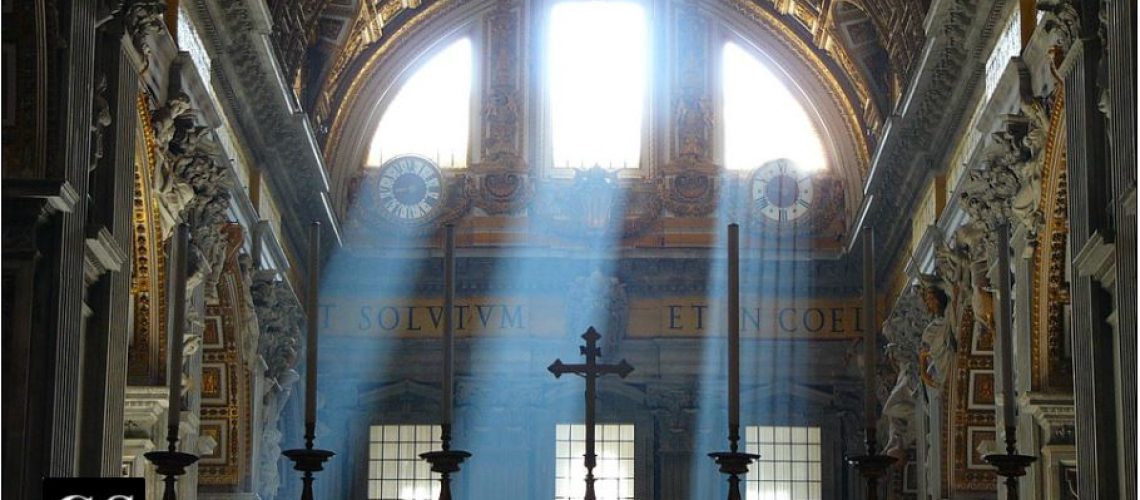
Are members of the Catholic Church different in terms of belonging, than members of a secular group or organization? And, is the doctrine and Tradition of the Catholic Church essential, or peripheral, in answering this question? Can one be a true member of the Catholic Church, assenting only to particular doctrines or dogmas of the Faith?
The Catechism of the Catholic Church defines the word “Catholic” in paragraphs 830-831:
The word “catholic” means “universal,” in the sense of “according to the totality” or “in keeping with the whole.” The Church is catholic in a double sense: First, the Church is catholic because Christ is present in her. ‘Where there is Christ Jesus, there is the Catholic Church’ (cf. St. Ignatius of Antioch, Ad Smyrn. 8, 2: Apostolic Fathers, II/2, 311). In her subsists the fullness of Christ’s body united with its head; this implies that she receives from him ‘the fullness of the means of salvation’ (cf. UR 3; AG 6; Eph 1:22-23) which he has willed: correct and complete confession of faith, full sacramental life, and ordained ministry in apostolic succession. The Church was, in this fundamental sense, catholic on the day of Pentecost (cf. AG 4) and will always be so until the day of the Parousia. Secondly, the Church is catholic because she has been sent out by Christ on a mission to the whole of the human race (cf. Mt 28:19): All men are called to belong to the new People of God. This People, therefore, while remaining one and only one, is to be spread throughout the whole world and to all ages in order that the design of God’s will may be fulfilled: he made human nature one in the beginning and has decreed that all his children who were scattered should be finally gathered together as one…. The character of universality which adorns the People of God is a gift from the Lord himself whereby the Catholic Church ceaselessly and efficaciously seeks for the return of all humanity and all its goods, under Christ the Head in the unity of his Spirit” (cf. LG 13 §§ 1-2; cf. Jn 11:52).[1]
The primary point here is that being Catholic necessarily entails that one accepts through the gift of Faith, that Christ Himself is living and present in the Catholic Church, not merely in sign and symbol, but in fact and Truth – for all Eternity. Christ is the Head, and members of His Church are members of the One Body of Christ: [i]n her subsists the fullness of Christ’s body united with its head; this implies that she receives from him the fullness of the means of salvation.
And, this belief, this dogma, is the central event of Salvation history: “The mystery of Christ’s resurrection is a real event, with manifestations that were historically verified, as the New Testament bears witness. In about A.D. 56, St. Paul could already write to the Corinthians:
I delivered to you as of first importance what I also received, that Christ died for our sins in accordance with the scriptures, and that he was buried, that he was raised on the third day in accordance with the scriptures, and that he appeared to Cephas, then to the Twelve’” (cf. 1 Cor 15:3-4) …[2]
If Christ offered His life in sacrifice on the Cross for our sins and was raised from the dead by His Father in Heaven, this must-have import in the lives of all Christians. But, how specifically: through the fullness of the means of salvation, correct and complete confession of faith, the full sacramental life, and an ordained ministry which possesses apostolic succession:
Justification has been merited for us by the Passion of Christ who offered himself on the cross as a living victim, holy and pleasing to God, and whose blood has become the instrument of atonement for the sins of all men. Justification is conferred in Baptism, the sacrament of faith. It conforms us to the righteousness of God, who makes us inwardly just by the power of his mercy. Its purpose is the glory of God and of Christ, and the gift of eternal life (cf. Council of Trent (1547): DS 1529): ‘But now the righteousness of God has been manifested apart from law, although the law and the prophets bear witness to it, the righteousness of God through faith in Jesus Christ for all who believe. For there is no distinction: since all have sinned and fall short of the glory of God, they are justified by his grace as a gift, through the redemption which is in Christ Jesus, whom God put forward as an expiation by his blood, to be received by faith. This was to show God’s righteousness, because in his divine forbearance he had passed over former sins; it was to prove at the present time that he himself is righteous and that he justifies him who has faith in Jesus’(cf. Rom 3:21-26).[3]
Thus, the Catholic Church differs from all secular organizations, in that, it is a living and breathing entity – Christ is present in her. And, its members are separate, because they receive God’s grace through the full sacramental life of the Church: all that is firmly rooted in the Revealed Word of God, Sacred Tradition, and the doctrine and dogmas taught and upheld by the teaching authority of the Church (the Magisterium).
This living transmission, accomplished in the Holy Spirit, is called Tradition, since it is distinct from Sacred Scripture, though closely connected to it. Through Tradition, ‘the Church, in her doctrine, life, and worship perpetuates and transmits to every generation all that she herself is, all that she believes’ (cf. DV 8 § 1).
‘The sayings of the holy Fathers are a witness to the life-giving presence of this Tradition, showing how its riches are poured out in the practice and life of the Church, in her belief and her prayer’” (cf. DV 8 § 3).[4]
‘Sacred Tradition and Sacred Scripture, then, are bound closely together and communicate one with the other. For both of them, flowing out from the same divine well-spring, come together in some fashion to form one thing and move towards the same goal’ (cf. DV 9).
Each of them makes present and fruitful in the Church the mystery of Christ, who promised to remain with his own ‘always, to the close of the age’” (cf. Mt 28:20).[5]
Through Tradition, the Church, in her doctrine, life, and worship perpetuates and transmits to every generation all that she is, all that she believes. And, this belief, is expressed most fully in the Profession of Faith (Nicene Creed):
I believe in one God, the Father almighty, maker of heaven and earth, of all things visible and invisible. I believe in one Lord Jesus Christ, the Only Begotten Son of God, born of the Father before all ages. God from God, Light from Light, true God from true God, begotten, not made, consubstantial with the Father; through him all things were made. For us men and for our salvation he came down from heaven, and by the Holy Spirit was incarnate of the Virgin Mary, and became man. For our sake he was crucified under Pontius Pilate, he suffered death and was buried, and rose again on the third day in accordance with the Scriptures. He ascended into heaven and is seated at the right hand of the Father. He will come again in glory to judge the living and the dead and his kingdom will have no end. I believe in the Holy Spirit, the Lord, the giver of life, who proceeds from the Father and the Son, who with the Father and the Son is adored and glorified, who has spoken through the prophets. I believe in one, holy, catholic and apostolic Church. I confess one Baptism for the forgiveness of sins and I look forward to the resurrection of the dead and the life of the world to come. Amen.”[6]
Thus, the Nicene Creed is not only a Confession of Faith professed by all Catholics (at least during every Sunday Mass and Holy Days of Obligation), it is also professed by members of the Eastern Orthodox Church, as well as by members of the Anglican and Lutheran denominations. This should beg the question, is the Creed intended to be spoken at Mass with no personal integrity – or prayed in Faith – believed with every fiber of one’s being? The Catholic Church answers this question, in that, the Nicene Creed itself, has been defined a dogma of the Church. The word dogma is defined in the Modern Catholic Dictionary as such:
Doctrine taught by the Church to be believed by all the faithful as part of divine revelation. All dogmas, therefore, are formally revealed truths and promulgated as such by the Church. They are revealed either in Scripture or tradition, either explicitly (as the Incarnation) or implicitly (as the Assumption). Moreover, their acceptance by the faithful must be proposed as necessary for salvation.”[7] “a.
The Nicene Faith possesses a unique status in the hierarchy of dogmas by reason of its testimony to and celebration of the mystery of the Trinity as revealed in Christ Our Savior and by reason of its definitive reply to an ever-recurring question. This does not imply that the Nicene Faith exhausted the richness of Scripture regarding the person of Christ. For example, the Council of Chalcedon in 451 confessed that He was ‘in every respect like us, except without sin.’ b. We agree that authoritative teaching in the Church serves the people of God by protecting and nurturing the Faith. Dogma has a positive and a negative function. It authoritatively repudiates erroneous teaching, and asserts the truth as revealed in the saving deeds of God and in His gifts to His Church and to His world.”[8]
Here one should see – dogmas are formally revealed truths, promulgated as such by the Church, they are doctrine – taught by the Church to be believed by all the faithful as part of divine revelation. They are rooted in the Revealed Word of God (Scripture) and Tradition.
Therefore, the Magisterium, or Teaching Authority of the Church, is necessarily bound to protect, defend, and teach all members of the Church that which is essential: the Deposit of Faith (Divinely Revealed Truth), and the Living Church established by Christ, the “fullness of the Faith,” lived out in the Sacramental Life of the Church, and accepted and assented to by all the faithful as necessary for Salvation.
Basing itself on Scripture and Tradition, the Council teaches that the Church, a pilgrim now on earth, is necessary for salvation: the one Christ is the mediator and the way of salvation; he is present to us in his body which is the Church. He himself explicitly asserted the necessity of faith and Baptism, and thereby affirmed at the same time the necessity of the Church which men enter through Baptism as through a door. Hence they could not be saved who, knowing that the Catholic Church was founded as necessary by God through Christ, would refuse either to enter it or to remain in it” (cf. LG 14; cf. Mk 16:16; Jn 3:5).[9]
[1] Catholic Church. Catechism of the Catholic Church: Revised in Accordance with the Official Latin Text Promulgated by Pope John Paul II, 2nd ed. (Vatican City; Washington, DC: Libreria Editrice Vaticana; United States Catholic Conference, 1997), 830-831. (Hereafter cited as CCC.)
[2] Ibid., 639.
[3] Ibid., 1992.
[4] Ibid., 78.
[5] Ibid., 80.
[6] United States Catholic Conference of Bishops, “Nicene Creed,” accessed August 5, 2024, https://www.usccb.org/prayers/nicene-creed
[7] Hardon, John A. 1980. Modern Catholic Dictionary. 1st ed. Garden City, N.Y.: Doubleday., pg. 168-169.
[8] United States Catholic Conference of Bishops, “The Status of the Nicene Creed as Dogma of the Church,” accessed August 5, 2024, https://www.usccb.org/committees/ecumenical-interreligious-affairs/status-nicene-creed-dogma-church#:~:text=We%20confess%20in%20common%20the,and%20that%20the%20Holy%20Spirit%2C
[9] CCC., 846.


5 thoughts on “What Does It Mean to Be Catholic?”
Pingback: Odrubljivanje glave sv. Ivana Krstitelja, Može li egzorcist postavljati pitanja demonima i više sjajnih poveznica! - Katoličke vijesti
Pingback: SATVRDAY MID-DAY EDITION | BIG PULPIT
This topic delves into the essence of Catholic identity, exploring the beliefs, practices, and values that define what it means to be Catholic. It’s an invitation to reflect on faith, tradition, and community, offering a deeper understanding of the spiritual and cultural dimensions of Catholicism.
Confusion in the Church today. Not of God. He will sort it out. Jesus, I trust in You.
This is all very nice, but the question is : “What happens when the magisterial authority refuses to pass on and uphold the traditional teaching? What then?” I run into so many Catholics who don’t even want to admit the possibility. “Oh no, that could never happen, because yada yada blah blah blah.” Well, it’s happening now. Deal with it.