
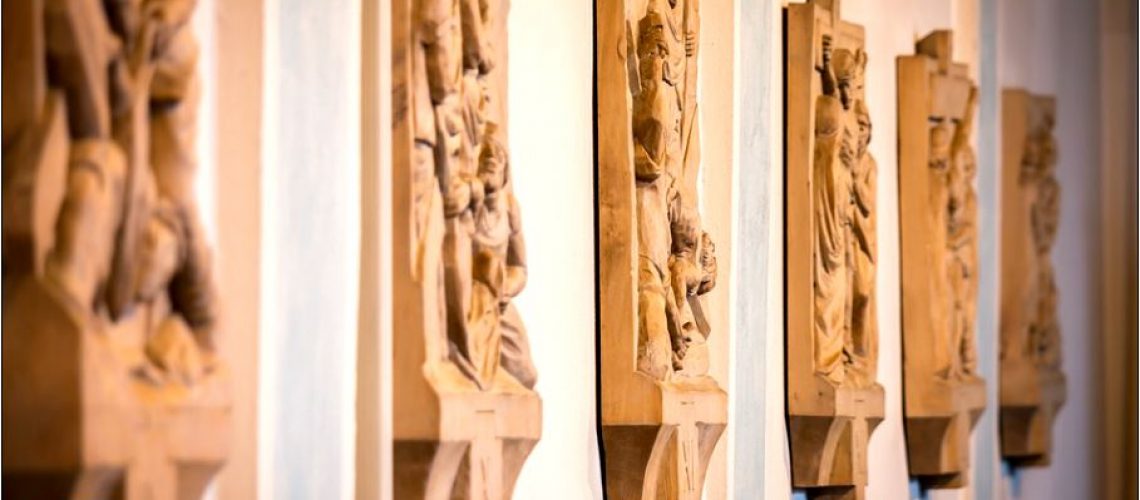
As the season of Lent nears its end, I look back to evaluate my Lenten journey. Did I make real sacrifices? Did my prayer life increase appreciably? In short, did I do enough to count this Lent as a season of penance and spiritual growth? Some years, I must acknowledge a gnawing awareness that my self-denial was not as great as it could have been. It is a comfort then, that in addition to whatever meager sacrifices and prayers I offered, I can still say, “Well, I attended Stations of the Cross.”
Stations of the Cross and School Children
This devotion began for me in the fifth grade. As a new student at St. Mary’s School in Alpha, New Jersey, I attended Stations of the Cross with my classmates every Friday afternoon in Lent. It was not a pious decision we all made; the sisters who taught us required us to go. Still, at my first experience at Stations, I was amazed that every child in the school followed the prayers in the little booklet, and knew when to stand or kneel or genuflect. The priest leading a couple of altar servers to the fourteen pictures along the walls of the church intrigued me. The sound of the priest’s reading, our childish voices responding in prayer, and the repeated melody of the Stabat Mater verse at each station created a mood that I can barely describe. It was a mixture of reverence, contrition, and sorrow, but also wonder at the love which drove Christ to make each step along the road to Calvary.
More than a generation has passed since my ten-year-old self was impressed and inspired by the simple ceremony in which we participated on every Lenten Friday. My own children are grown, and yes, I did bring them with me to Stations sometimes during their childhood. As an adult, I find the Stations just as reverent and even more inspiring than I did as a child.
Details on the Road to Calvary
The Stations of the Cross, sometimes called the Way of the Cross, follow fourteen incidents that are part of Jesus’ ordeal along the road to Calvary. Details such as Jesus’ sentencing at Pilate’s praetorium, the crucifixion, his death and being removed from the cross and placed in his mother’s arms and finally in the tomb, all are noted and meditated upon. With sorrow, the Stations report three times when Jesus fell, and the Stabat Mater comments, “Jesus fell again in weakness, stumbling, as we do, to lead us.”
The Stations mention people who met Jesus along the way to Calvary. First, he met his grieving mother. Veronica wiped his anguished face, and Simon helped to carry the cross. The women of Jerusalem wept and lamented Jesus’ cruel fate as he passed by them. In every instance, Jesus’ response is love. Remembering his mother’s sorrow hours later, Jesus assigns the beloved disciple, John, to care for her (John 19:25-27). Jesus accepts the help of Simon and Veronica. He stops to speak with the women of Jerusalem, thinking of them and their children, rather than of himself (Luke 23:27-28). To the cruel ones who force him up when he falls and nail his hands and feet, Jesus makes no protest, no condemnation.
The accounts of Jesus’ interactions with loved ones and strangers along the way and the three times when he fell under the weight of the cross bring Jesus’ passion to life. The dusty road, the brutal executioners, and the garments being stripped from his tortured body bring the reality of Jesus’ suffering into the minds and hearts of those praying the Stations of the Cross.
Scriptures in the Stations
The format of the Stations of the Cross varies, depending on which version of the devotion is used. Several different sets of prayers and meditations on the fourteen stations have been published. The format usually includes, at each station, a reading or prayer by a leader, some common prayers for participants, and a verse of the Stabat Mater. At each Station, the celebrant declares, “We adore you, O Christ, and we praise You.” The participants respond, “Because by your holy cross You have redeemed the world” (Stations).
One popular publication, The Stations of the Cross, A Scriptural Version, includes Biblical readings as well as prayers composed specifically for each station. Gospel narratives tell the historical events such as Pilate condemning Jesus to death and Jesus telling the women of Jerusalem, “Weep not for me, but weep for yourselves and for your children” (Mark 14:61-64; Luke 23:27-28). Old Testament readings provide a suitable commentary or show how the event was prophesied. At the seventh station, for example, Jesus falling for the second time is accompanied by verses from Isaiah which speak eloquently and prophetically about Jesus, “Though he was harshly treated, he submitted and opened not his mouth. … A grave was assigned him among the wicked and a burial place with evildoers, though he had done no wrong nor spoken any falsehood” (Isaiah 53:7, 9).
A highlight for me in the Scriptural Version of the Stations is at the sixth station, Veronica Wipes the Face of Jesus. The celebrant reads the Gospel account of the sheep and the goats. When the redeemed, entering Paradise, ask, “Lord, when did we see you hungry, and feed you; or thirsty, and give you drink?” Jesus answers, “As long as you did it for one of these, the least of my brethren, you did it for me” (Mt. 25:37-40). This parable is an interesting connection to make with the account of Veronica on the hill of Calvary. Always the Teacher, even in his passion, Jesus allowed one of his followers to express her devotion to him in a simple act of mercy, wiping his face. Veronica’s devotion illustrates the lesson that every kindness which we bestow others, we are also bestowing on Jesus.
Another interesting connection of Scripture to the sixth station is in the participants’ response, a meditation from the Old Testament. The response reflects a heart-warming description of true friendship. A faithful friend is described as “a treasure,” “a sturdy shelter,” and “a life-saving remedy” (Sirach 6:14-17). The account of Jesus’ passion provides an example of true friendship for future millennia to recognize and emulate.
The Moving Origin of Stations of the Cross
The images that the celebrant follows in the Stations of the Cross ceremony are often pictures that adorn church walls, or in some places statues or images in outdoor displays or gardens. In the sixteenth century, the actual places in the holy land which are depicted in the images were officially named “Via Dolorosa,” which means “Way of Sorrow” (Saunders). By this time, following the stations had already become a popular devotion.
The devotion originated from the tradition that the Mother of Jesus had visited the places of his passion, from the praetorium to the tomb, every day after his death (Saunders). This makes the practice ever more meaningful. One can easily imagine Mary walking along the way, recalling the events of his passion, and longing for her son’s presence. By three days after the crucifixion, she knew that he had risen from the dead. Her grief would have been relieved. However, after his ascension, she may likely have longed for her son. To walk the way along which he walked, to pray and meditate on her beloved Son would be natural. Contemplating Mary, in her great yet tender maternal love, revisiting the places of her Son’s suffering adds a new dimension to the practice of the Stations of the Cross.
Good Friday Stations
Holy Week provides many opportunities to worship, to pray, to fast, and to meditate on Christ’s passion. Parishes around the world hold Masses and special events such as the Seven Last Words and the Stations of the Cross, to assist Catholics to live a genuinely spiritual Holy Week. Interestingly, the only required liturgies this week are Palm Sunday and Easter Sunday Mass. Holy Thursday and Good Friday are not holy days of obligation; their services are optional. The healthy attendance that we see at these services always gives me hope for our Church’s future. People attend them because they want to.
It is the same with Stations of the Cross. The devotion has little formality, no pomp or circumstance, and is not obligatory for the faithful. It witnesses to the simplicity of hearts gathered only because they wish to remember, as Holy Mary did, the sorrowful steps of Jesus’ love on the hill of Calvary.
If Lent has not seemed spiritual enough this year, a Catholic can take advantage of Stations of the Cross on Good Friday. Attending this simple service will not disappoint. The Way of the Cross, a rich compilation of prayers and meditations less than an hour-long, will provide an opportunity to walk with Jesus in spirit, to contemplate his love, and consider how one might offer a worthy response of love in return.
Works Cited
Saunders, William. “How Did the Stations of the Cross Begin?” www.ewtn.com/catholicism/library/how-did-the-stations-of-the-cross-begin-1155. From Arlington Catholic Herald, March 10, 1994. Accessed 10 April 2022.
The Stations of the Cross, A Scriptural Version. Baltimore: Barton-Cotton, Inc., 1965. Print.

